
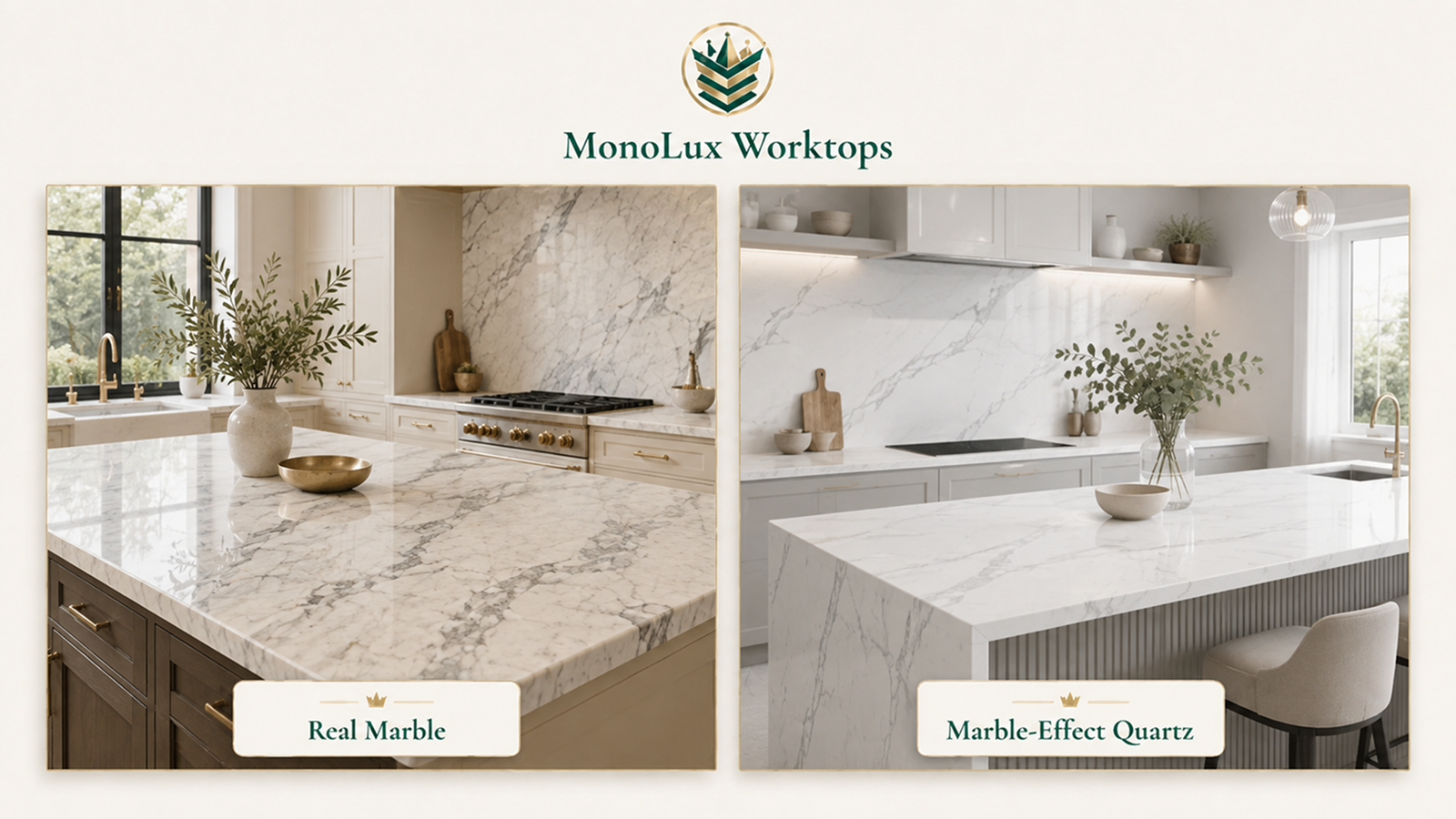
Real marble and marble-effect quartz can create a similar first impression, but they behave quite differently after installation. Marble gives you a natural slab with individual veining and an appearance that changes with use. Marble-effect quartz gives you a designed stone pattern with more control over colour and movement, plus a simpler care routine for many products.
The choice boils down to what you want from the surface. Marble makes sense if natural variation, patina and the character of the actual slab matter to you. Marble-effect quartz worktops suit buyers who prefer a more predictable marble look and would rather avoid some of marble’s day-to-day care requirements.
You can browse our current quartz worktops to see how Calacatta, Carrara and other marble-style designs compare before ordering samples.
Quick Answer: Marble-Effect Quartz vs Real Marble
Marble and marble-effect quartz can look similar, but they differ in care, durability and how they age. The table below gives a quick side-by-side comparison.
| Factor | Real marble | Marble-effect quartz |
| Pattern | Unique natural veining | Designed pattern with more predictable movement |
| Slab variation | Every slab is individual | Slabs can still vary slightly |
| Sealing | Depends on the stone, finish and treatment | Some major manufacturers state no sealing is needed |
| Staining | Can absorb liquids and discolour | Many products are designed to resist staining |
| Acid etching | Acid can dull the finish | Care guidance depends on the quartz manufacturer |
| Heat | Use a trivet | Use a trivet |
| Ageing | Can develop patina, etches and fine scratches | Usually chosen for a more controlled appearance |
| Repairs | Honing and repolishing may restore some damage | Some chips can be repaired, while cracks are harder |
| Pattern planning | Actual slab selection matters | Vein direction and joins still need planning |
| Price | Around £400–£900/m² supplied and fitted | Around £300–£600/m² supplied and fitted |
Which Gives You the Marble Look You Want?
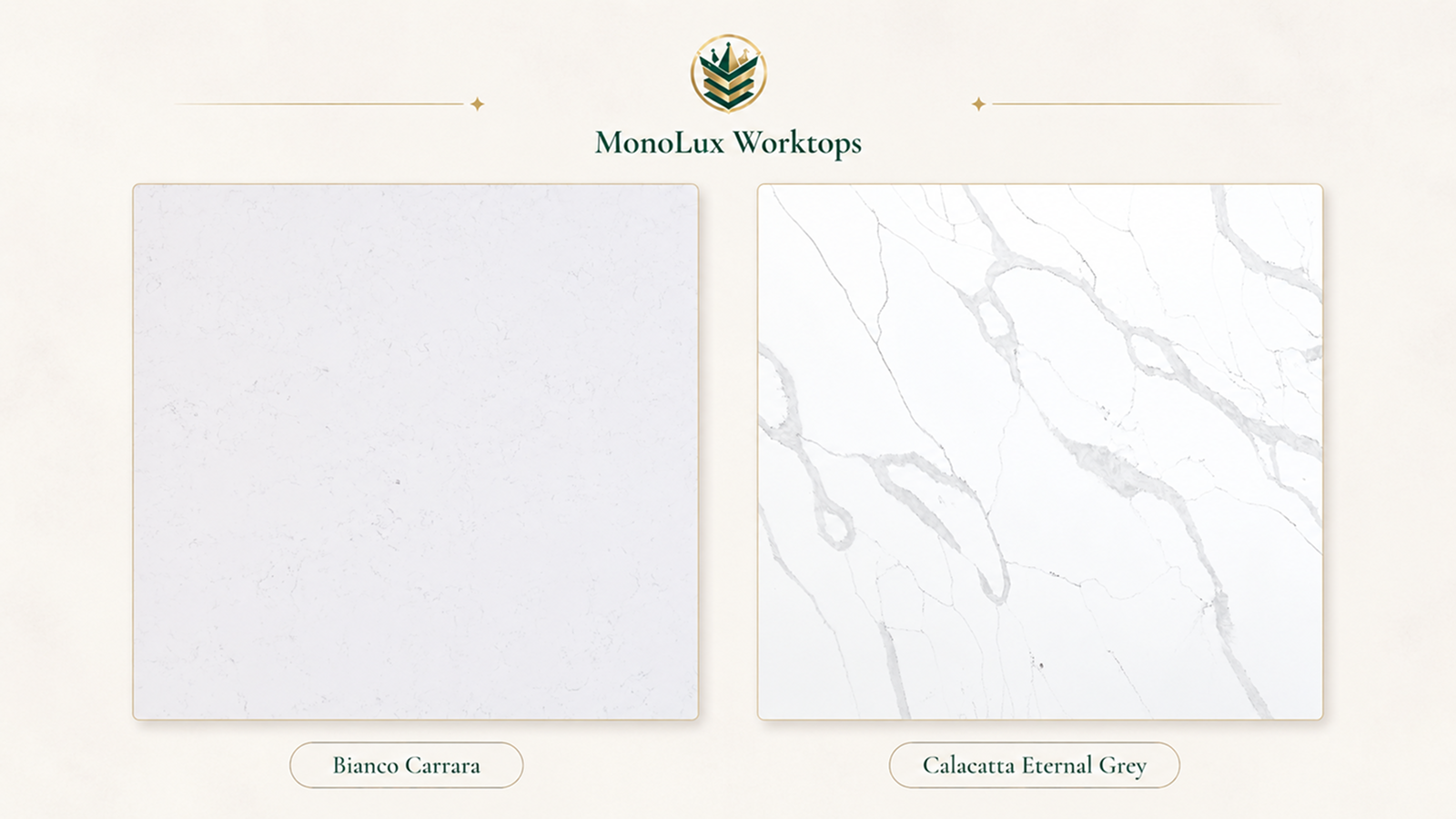
Natural marble gets its pattern from the stone itself. Veins can change direction, widen, fade or disappear across one slab, and the next slab may look noticeably different. That irregularity is part of the attraction for buyers who want a surface that cannot be repeated exactly.
Marble-effect quartz uses a designed pattern, so colour and vein style are usually easier to compare before fabrication. However, that does not mean every slab is identical. Small samples are useful for checking the background and vein colour, but our guide to comparing quartz worktop samples at home explains what else to check before choosing.
In our range, Calacatta Eternal Grey Quartz shows broad grey movement over a bright white base, while Bianco Carrara Quartz uses finer, softer grey detail.
For a deeper comparison between those two styles, see our Calacatta vs Carrara quartz guide.
Staining and Etching Are Not the Same Problem
This is one of the biggest differences between real marble and engineered quartz.
A stain is discolouration caused by something entering the surface. Oil, coffee, tea and wine are common examples on absorbent stone.
An etch is damage to the finish itself. Marble contains calcite, which reacts with acids such as lemon juice, vinegar, tomatoes and wine. The result may be a dull patch even if no colour has soaked into the stone. The Natural Stone Institute notes that one spill can both stain and etch.
Quartz removes that marble-specific acid-etching issue, but that does not make every cleaner safe. Manufacturer guidance differs.
For deeper quartz stains and chip and crack behaviour, our quartz durability guide covers those problems separately.
Does Real Marble Always Need Regular Sealing?
Not on a fixed calendar.
Marble varies by type, finish and absorption rate. The sealer used and the amount of exposure also matter. The Natural Stone Institute explains that impregnating sealers can improve stain resistance without making stone stainproof, and some natural stones may not need sealing at all.
Engineered quartz worktops are different, but the claim still needs to stay product-specific. Caesarstone and Cambria both state that their own surfaces do not need sealants. For any quartz product, the care sheet supplied with that surface should take priority over generic advice.
Heat, Scratches and Repairs
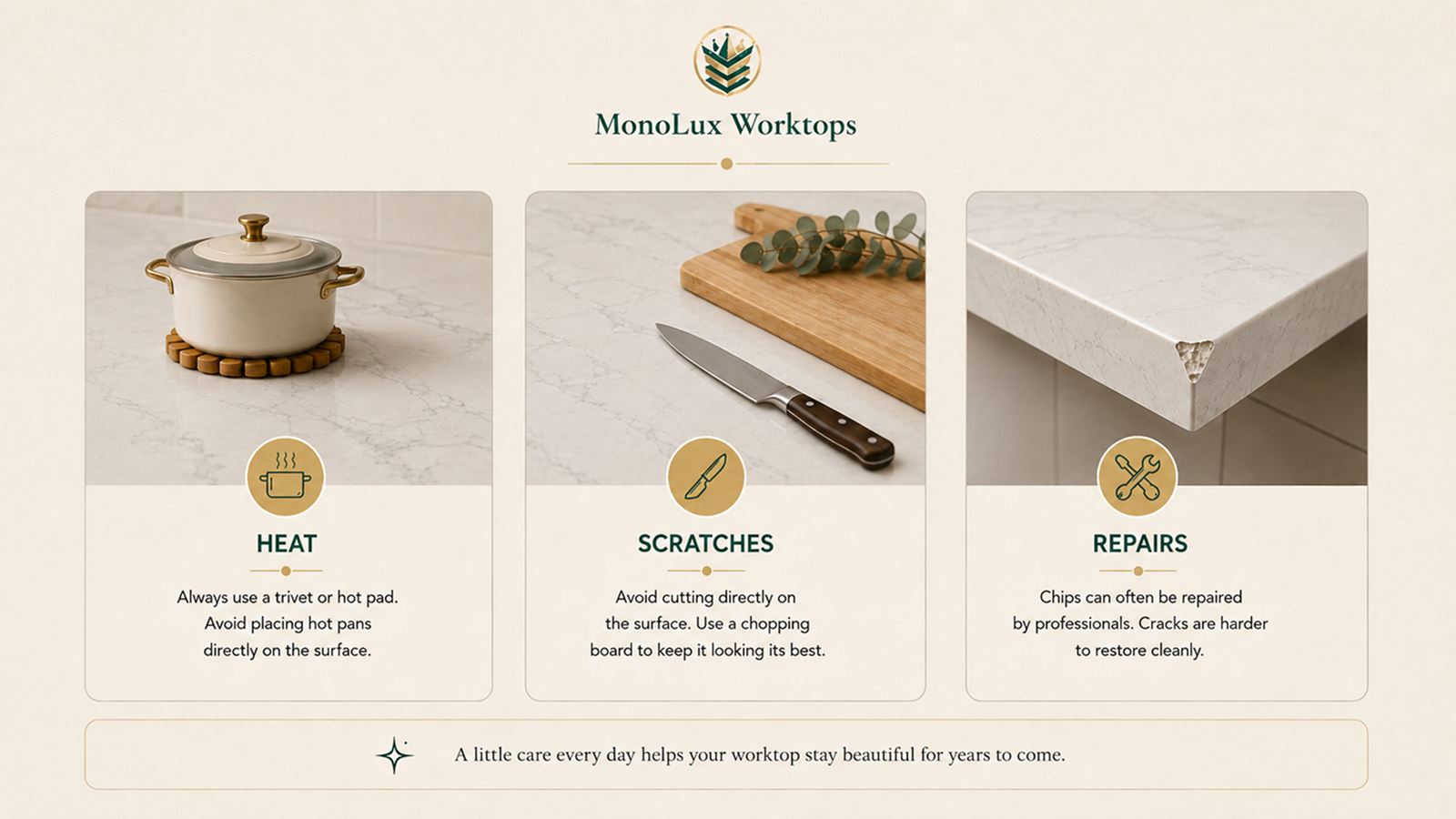
Neither material should be treated as indestructible.
- Heat: Natural-stone guidance and major quartz manufacturers both recommend trivets or hot pads. Our guide to hot pans on quartz covers appliance and cookware heat in more detail.
- Scratches and chips: Marble can scratch and nick. Quartz can also chip at edges and is not scratchproof.
- Repair: Marble can sometimes be rehoned or repolished after etching, scratches or surface wear. Some quartz edge chips may also be repairable, but cracks can be more difficult to restore cleanly.
Marble, therefore, has one ownership trait that is often missed in simple comparisons: some visible wear can be professionally refinished rather than treated as permanent damage.
How Do Marble and Marble-Effect Quartz Age?
Marble changes as it is used. Fine scratches, dull etch marks, and tonal changes can gradually become part of the surface. Some owners dislike that and prefer to restore the finish. Others accept the marks as patina and like the fact that the stone looks lived-in rather than unchanged.
Marble-effect quartz is usually chosen by buyers who want a more controlled, designed appearance. It still needs sensible care. Edges can chip, heat can damage some products, and strong chemicals may leave marks.
Where the Difference Shows Up During Templating and Fitting
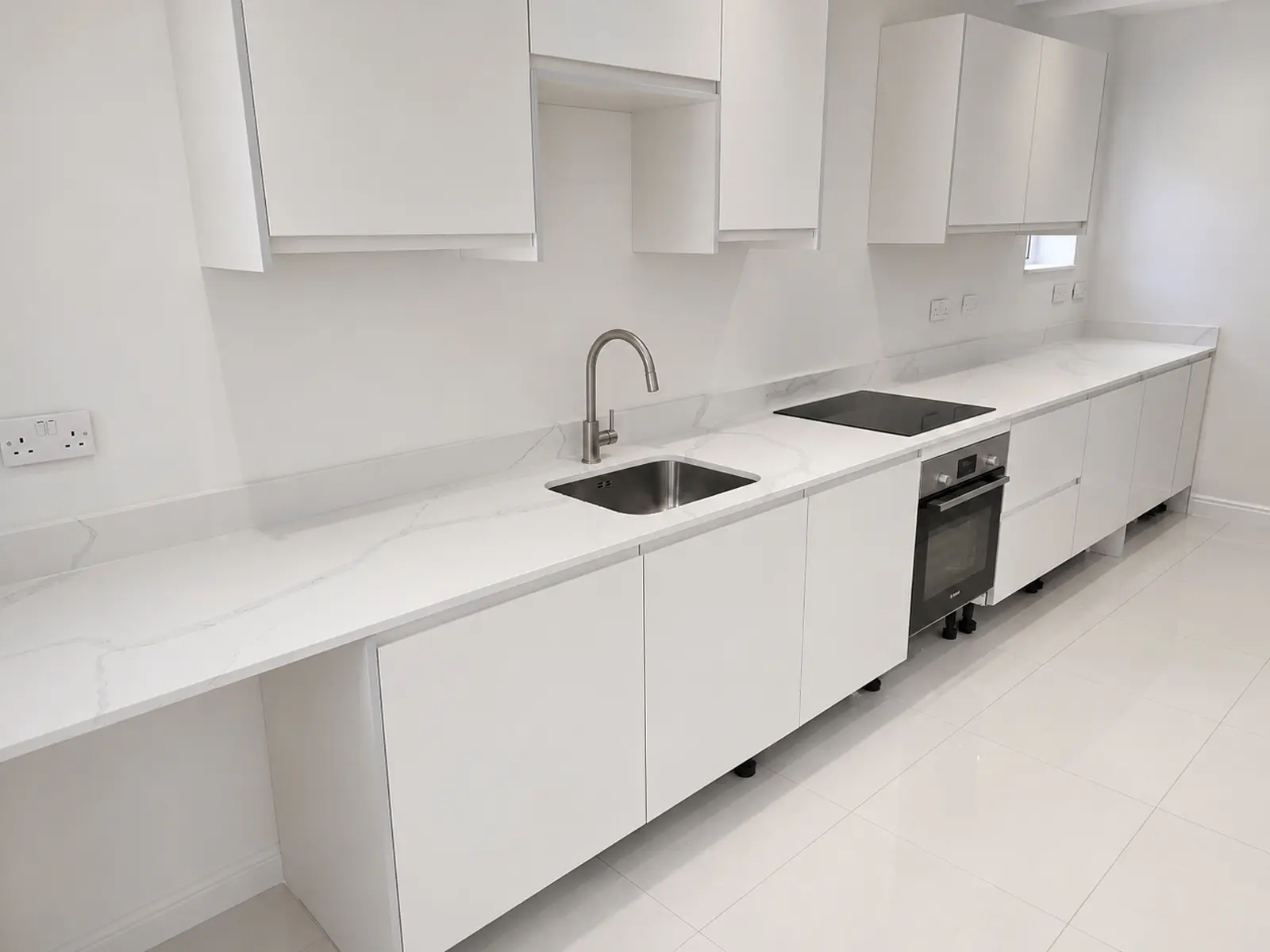
The choice also affects how the worktop is planned before cutting. For a strongly veined surface, decisions may include:
- where joins sit
- which way the veins run
- how the island is orientated
- how splashbacks continue the pattern
- how the waterfall ends the horizontal worktop
- where sink and hob cut-outs interrupt the design
Natural marble gives the fabricator a unique slab to work around. True bookmatching also needs suitable neighbouring slabs processed as matching pairs.
Quartz gives more control over the chosen design, but joins and vein transitions still need attention. Our Calacatta Eternal Grey project in Slough is a useful example. The large island uses waterfall ends on both sides, so the vein layout had to work across horizontal and vertical pieces rather than on one flat worktop alone.
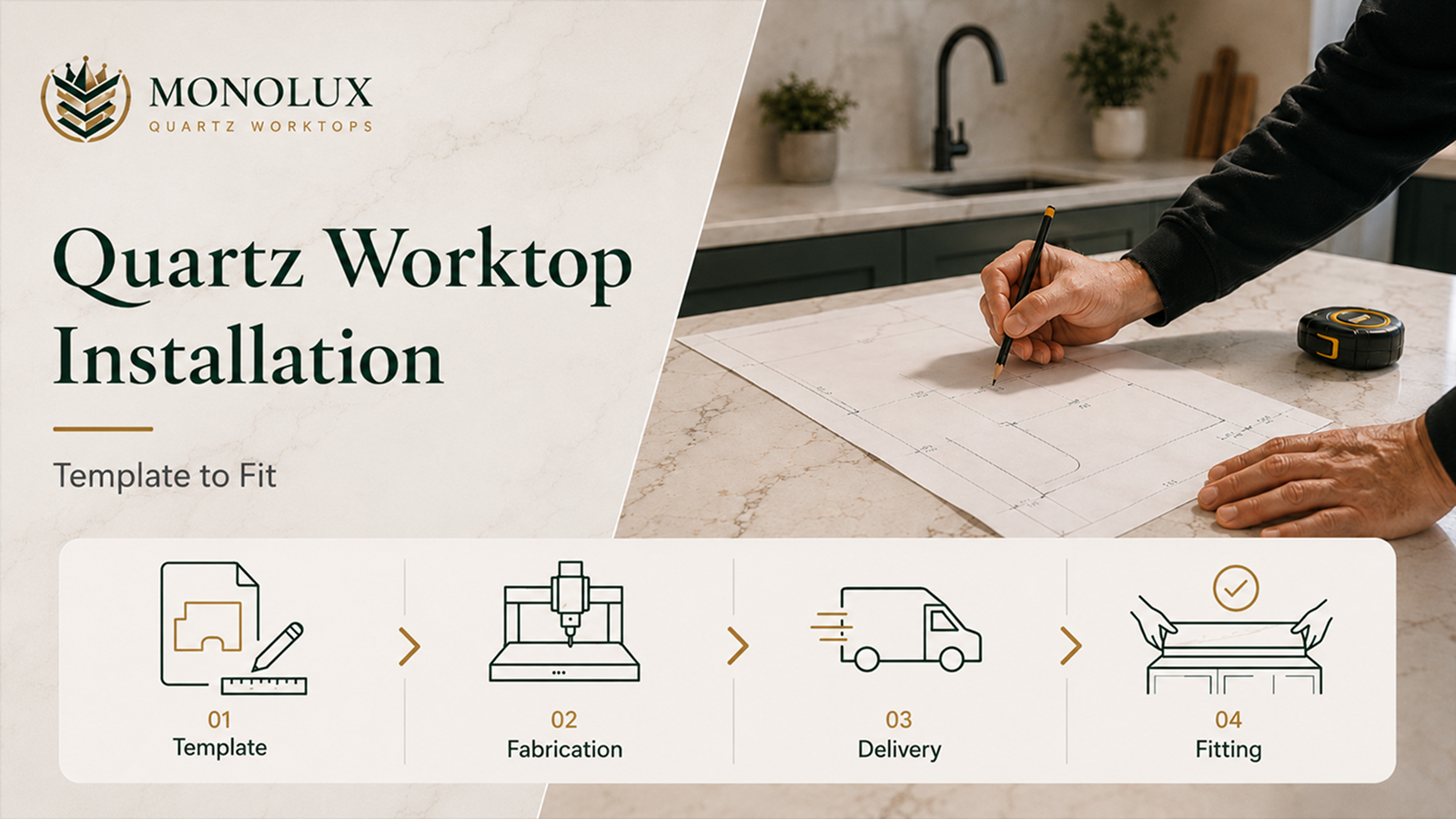
The full process from measurements to fitting is covered in our quartz worktop installation guide.
Is Real Marble More Expensive Than Marble-Effect Quartz?
Real marble is often more expensive, but the ranges overlap. As a rough 2026 UK guide, marble-effect quartz usually costs around £300–£600 per m² supplied and fitted, while real marble commonly falls around £400–£900 per m². Rare marble, premium quartz and complex fabrication can push either material above those ranges.
The layout can matter almost as much as the stone. A large island, extra slab waste, shaped edges, sink and hob cut-outs, full-height splashbacks, waterfall ends and detailed vein matching can all increase the fitted price.
Material thickness can also affect the appearance and final quote. Our 20mm vs 30mm quartz worktop guide explains the practical and visual differences.
For a useful comparison, ask for the same scope on both quotes, including material, fabrication, templating, delivery, fitting and VAT. Our quartz worktop budget guide breaks down the main factors that change a fitted quartz quote.
Ready to Plan Your Marble-Look Quartz Worktop?
If marble-effect quartz fits the way you want your kitchen to look and work, we can help you take it from a shortlist to a fitted surface. You can order free samples on selected designs, view full slabs at our showroom and warehouse, and send us your layout for an expert quote review in under two hours.
We handle templating, in-house CNC fabrication, delivery and fitting, including sink and hob cut-outs, edge profiles, joins, upstands and splashbacks. Five-day installation after templating is available on suitable projects, and our fitted worktops are backed by our 25-year quality guarantee and one-week rapid-fix pledge.
You can also spread the fitted cost across three instalments with Klarna or Clearpay. Use our quartz worktop price calculator to build a layout-based estimate and compare the marble-effect quartz options that suit your kitchen.
FAQs
- Which is better for kitchen worktops, quartz or marble?
Quartz suits buyers who want simpler routine care and more predictable patterns. Marble suits buyers who value a unique natural slab and are comfortable with etching, sealing considerations and gradual patina. - Do marble-effect quartz worktops look realistic?
Many modern quartz designs reproduce Calacatta and Carrara-style veining closely, but the pattern is designed rather than naturally formed. Full-slab viewing gives a better impression than a small sample. - Which quartz looks most like real marble?
Calacatta quartz usually has broader, more dramatic veining, while Carrara quartz tends to use finer grey movement. The better match depends on the type of natural marble you are trying to reproduce. - Does real marble stain or etch?
It can do both. A stain is absorbed discolouration. An etch is acid damage to the finish, often leaving a dull patch. The same spill can cause both effects. - Does marble need sealing every year?
Not necessarily. Sealing needs vary with the marble, finish, sealer and level of use. Some natural stone may not need sealing, so follow guidance for the exact slab installed. - Are marble worktops more expensive than quartz?
As a rough UK guide, marble-effect quartz costs around £300–£600/m² supplied and fitted, while real marble is often around £400–£900/m². Premium quartz, rare marble and complex fabrication can push either figure higher.