
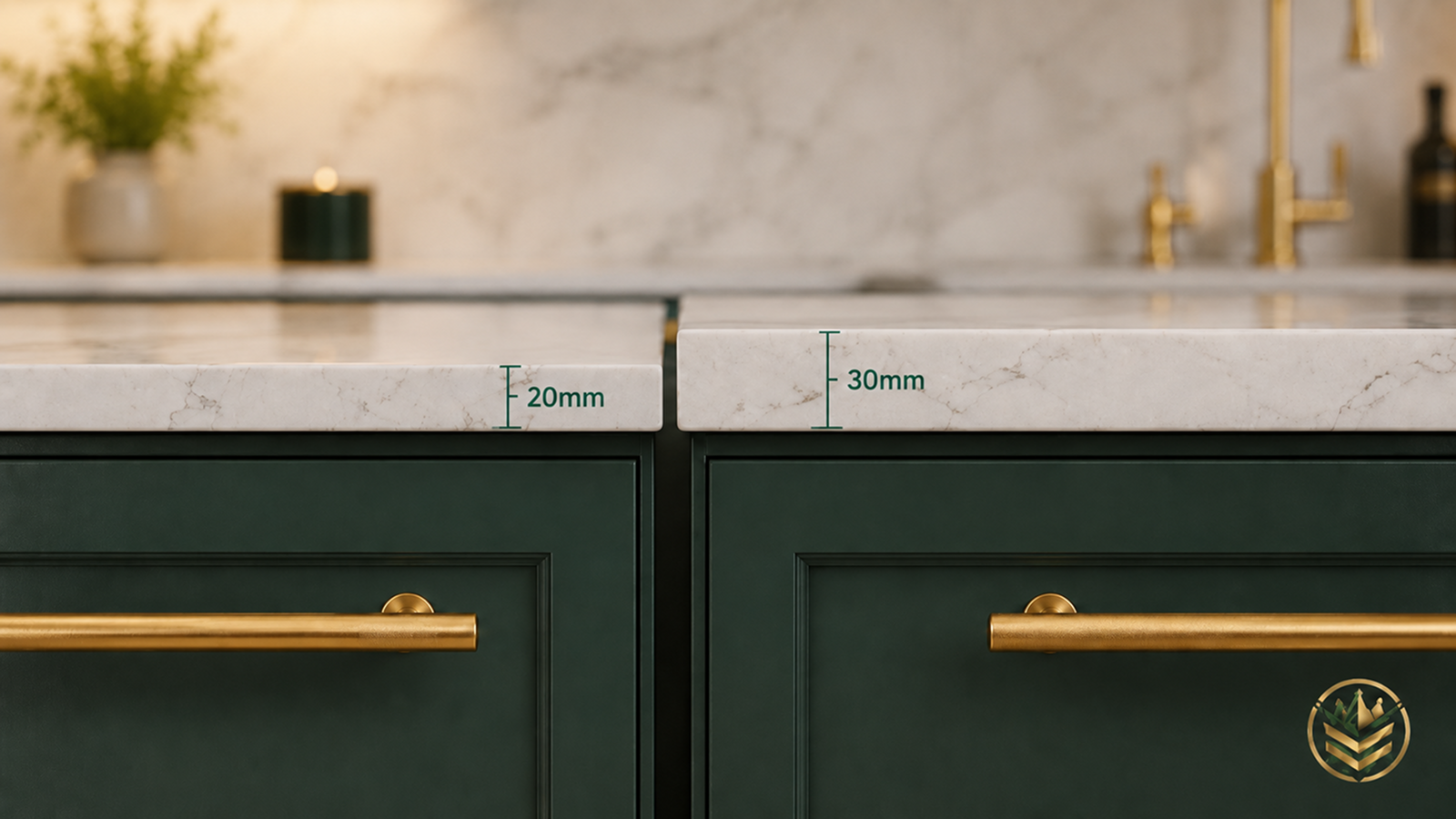
Choosing between 20mm and 30mm quartz worktops can feel like a small detail until you see the two profiles side by side. A 20mm worktop has a slimmer, sharper look. A 30mm worktop has a thicker, more solid appearance.
Both can look high-end, both can work in busy kitchens, and both can be used successfully when the kitchen is measured, fabricated and supported properly.
However, deciding on which is better for you fully depends on your kitchen style, budget, island size, cabinet support, edge detail, sink and hob setup, and how much visual weight you want from the worktop.
Quick Guide: 20mm Quartz or 30mm Quartz?
If you don’t want to get into all the details, here’s the bare minimum you have to know to decide:
- Choose 20mm quartz if you want a slimmer modern look, a lighter surface, neater upstands or a more budget-friendly starting point.
- Choose 30mm quartz if you want a thicker stone profile, a more traditional finish, a large island, a seating overhang or more edge-detail options.
- Ask for both to be quoted if you are unsure, because the final fitted price depends on the full kitchen layout, not thickness alone.
At MonoLux, we offer both thicknesses in a variety of colours and effects at some of the most affordable rates. You can browse our quartz worktop prices and colours, then use your layout details to compare the fitted quote more accurately.
What Do 20mm and 30mm Quartz Worktops Mean?
The numbers refer to the thickness of the quartz slab. A 20mm quartz worktop is 20 millimetres thick, while a 30mm quartz worktop is 30 millimetres thick. The difference is only 10mm, but it can change the way the whole kitchen feels.
It does not mean 30mm quartz is automatically of better quality. It also does not mean 20mm quartz is weak. The quartz colour, slab quality, fabrication, support and installation all matter.
In UK kitchens, 20mm and 30mm are the two most common quartz worktop thicknesses. Some materials and specialist surfaces come in other thicknesses, but for most homeowners choosing quartz for a fitted kitchen, the main decision is between these two:
- A 20mm worktop usually looks more understated. It can work well with handleless doors, flat-front cabinets, compact kitchens and simple modern layouts.
- A 30mm worktop gives more visual weight. It can suit shaker cabinets, larger kitchens, farmhouse-style designs, islands and spaces where the worktop is meant to feel like a strong feature.
Quick Comparison: 20mm vs 30mm Quartz Worktops
Here’s a quick look at the main factors around the two thicknesses before we break down what each one means, why it’s important, and which may be better for you.
| Factor | 20mm quartz | 30mm quartz | Buyer note |
| Visible profile | 2cm edge | 3cm edge | 10mm difference |
| Thickness difference | 33% thinner | 50% thicker | The same colour possible |
| Price guide | Baseline | About 10–30% more | Quote same layout |
| Estimated weight | 46–50kg/m² | 69–75kg/m² | Brand-dependent |
| Extra load | Lower | Around +23–25kg/m² | Matters on islands |
| Typical style fit | Modern, handleless | Shaker, classic | Style-led choice |
| Compact kitchens | A slimmer 2cm line | Bolder 3 cm edge | 20mm less dominant |
| Large islands | Slim feature edge | Chunkier island edge | 30mm often suits |
| Breakfast bar overhang | Around 250mm guide | Around 300mm guide | Support may still be needed |
| Hob clearance | Check appliance specs. | More depth available | Manual decides |
| Undermount sinks | Less stone around the cut-out | More stone around the cut-out | Support matters |
| Edge profiles | Straight, softened, bevel | Bullnose, ogee, deeper bevel | 30 mm allows more shaping |
| Upstands | 20mm wall projection | 30mm wall projection | 10mm extra depth |
| Splashbacks | Slimmer wall piece | Thicker wall piece | Check sockets and sills |
| Best fit | Slim modern kitchens | Islands and traditional kitchens | No universal winner |
Now that you have a basic idea of what each one is, how they are different and where each one works better, let’s get into the details.
How Thickness Affects Quartz Worktop Price
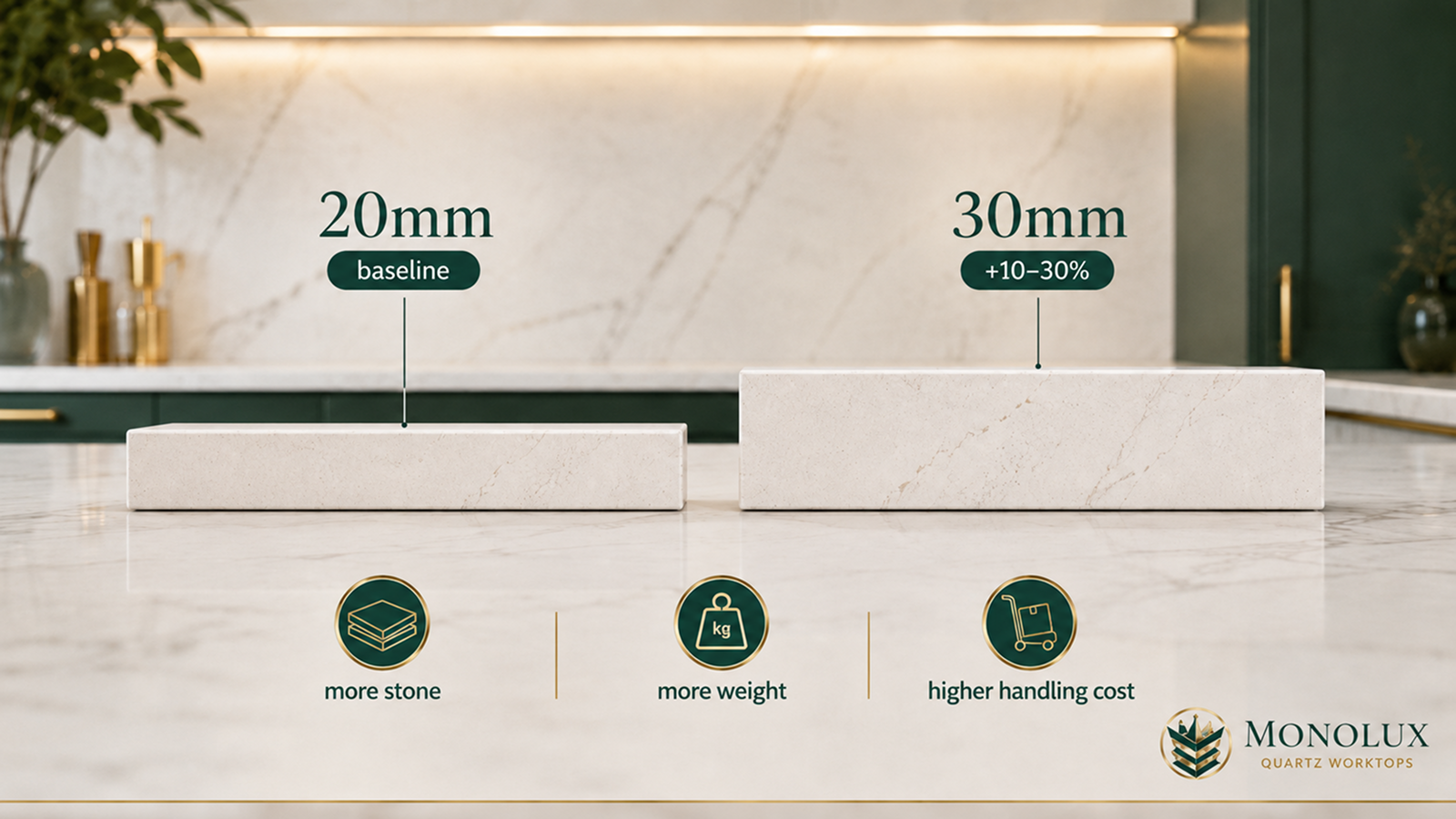
A 30mm quartz worktop usually costs more than the same material in 20mm because it uses more stone and is heavier to handle. That said, the final fitted quote is not based on thickness alone.
A 20mm worktop in a complicated kitchen can still cost more than a 30mm worktop in a simpler layout. The final price can change because of:
- total quartz area
- number of slabs needed
- kitchen shape
- islands and breakfast bars
- finished edges
- sink and hob cut-outs
- tap holes
- drainer grooves
- upstands and splashbacks
- delivery access
- templating and fitting
For example, a small straight run in 30mm quartz may be easier to price than a 20mm L-shaped kitchen with an island, an undermount sink, upstands and extra polished edges.
This is why it is better to compare both thicknesses using the same quartz colour and the same kitchen plan. Ask for a fitted quote that shows what is included, not only a material price.
For a wider price breakdown, read our quartz worktop budget guide, which explains fitted prices, material-only prices, kitchen-size examples and quote factors.
Appearance: Slim Modern Profile vs Thicker Stone Profile
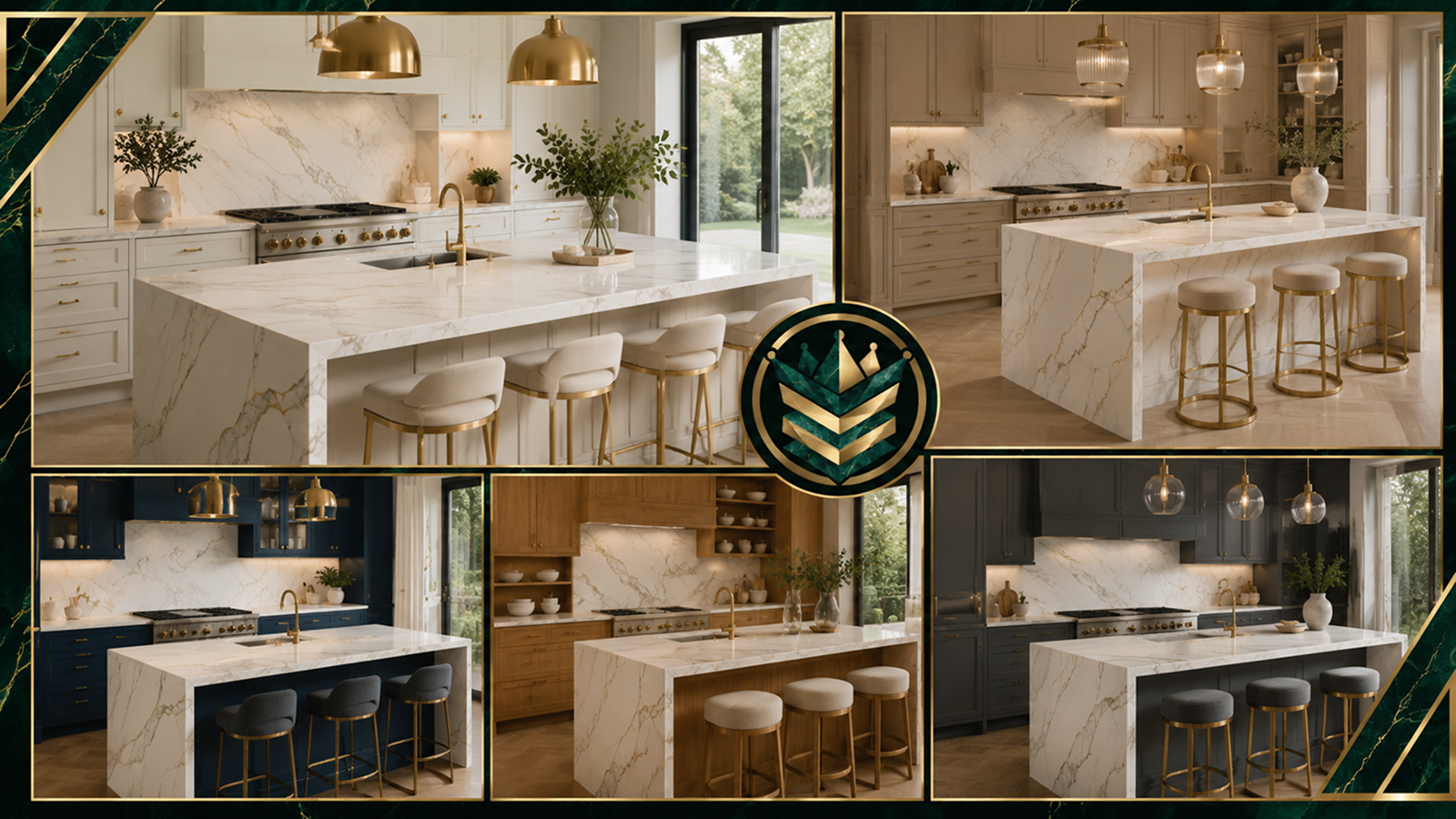
The biggest difference most people notice is visual. A 20mm quartz worktop gives the kitchen a slimmer edge. It works especially well in kitchens with simple cabinet doors, flat panels, handleless units or a lighter design scheme.
In a compact kitchen, 20mm can help the room feel less heavy. The worktop still finishes the space properly, but it does not dominate the cabinets. This can be useful in galley kitchens, smaller L-shaped kitchens and open-plan spaces where the kitchen needs to blend into the room.
A 30mm quartz worktop has a stronger presence. It can make the surface feel more substantial, especially on an island or a long run of cabinets. It often suits shaker kitchens, traditional kitchens, darker cabinets, larger rooms and designs where the worktop is a visible feature.
One of our projects, Aoife Murphy’s Basingstoke kitchen, is a good example of why 20mm quartz can suit a lighter kitchen update. For this project, 20mm Mono Calacatta Gold worked better than a thicker stone profile because the room needed a sharper edge.
The thinner slab gave the kitchen a more finished look, while the Calacatta veining brought in the brighter marble-effect detail Aoife wanted. You can see the finished result in Aoife Murphy’s Basingstoke kitchen update.
Strength, Durability and Daily Use
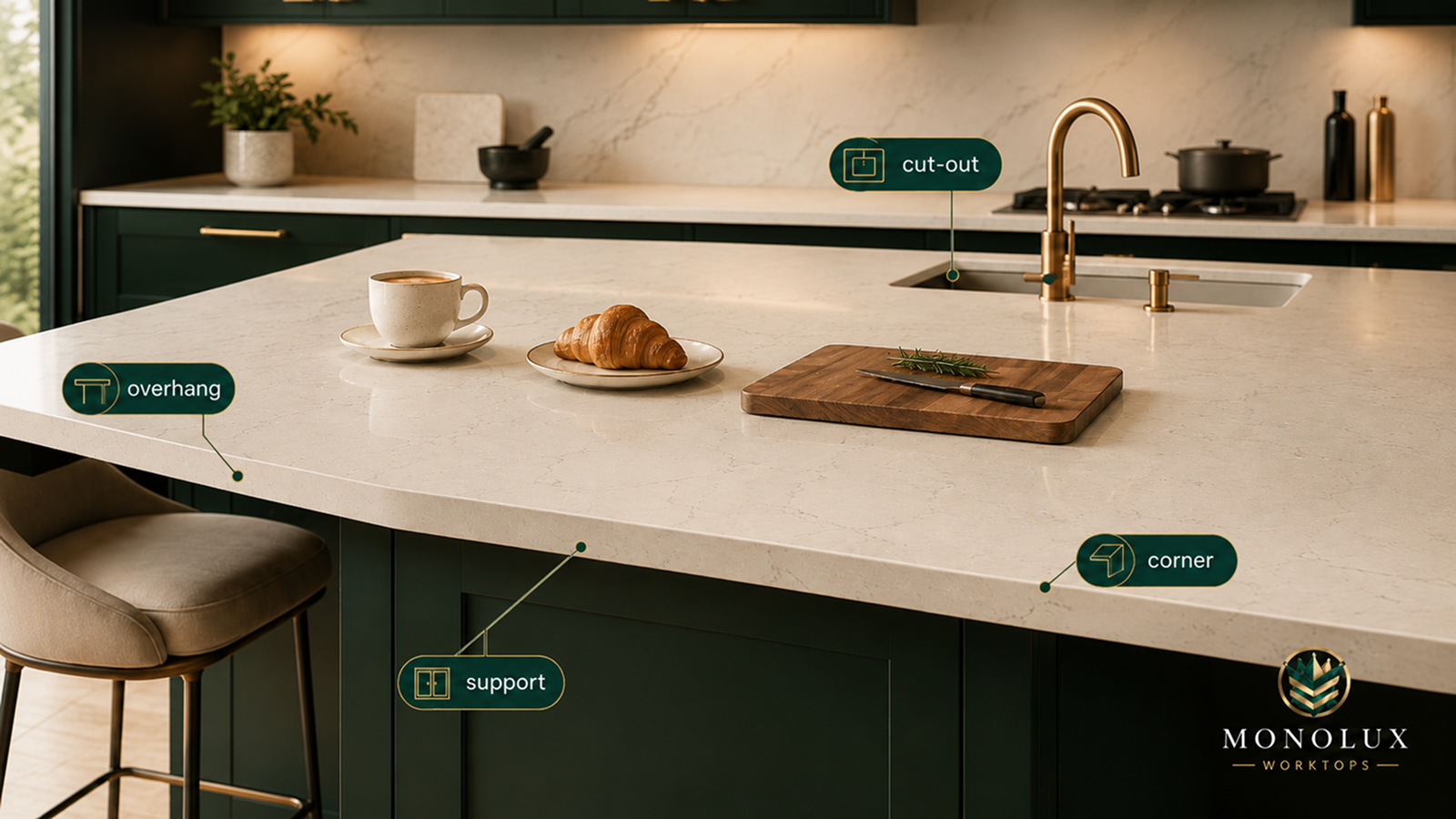
Both 20mm and 30mm quartz can handle normal kitchen use if the worktop is properly fabricated and fitted. What is more important here is how much structural demand the layout puts on the stone.
Where 30mm can be useful:
- Large islands with a thicker visible edge
- Seating overhangs where people may lean on the surface
- Heavier undermount sinks
- More detailed edge profiles, such as bullnose or ogee
- Traditional kitchens where a deeper stone profile suits the cabinets
- Layouts with fewer support points under the quartz
Where 20mm still works well:
- Straight kitchen runs with full cabinet support
- Modern or handleless kitchens
- Smaller kitchens where a thicker edge may feel too heavy
- Matching upstands and splashbacks
- Simple edge profiles
- Family kitchens without large unsupported sections
Basically, chopping, plating food, making coffee and wiping spills are normal jobs for quartz. The things that need more careful consideration are cut-outs, overhangs, exposed corners, cabinet strength and appliance clearance.
A 20mm worktop can be a solid choice in a well-supported kitchen. A 30mm worktop gives more flexibility where the design asks more from the slab.
Islands, Breakfast Bars, Overhangs and Support
Thickness becomes more important when the quartz extends beyond the cabinet base. This often happens on islands, peninsulas and breakfast bars.
A small overhang for a neat cabinet finish is the natural choice. However, a deeper seating overhang needs more thought because people may lean on it, rest their arms on it or catch it with their knees.
| Layout detail | Thickness note |
| Small overhang | 20–40 mm is usually a neat finishing lip |
| Seating overhang | 20mm: around 250mm guide; 30mm: around 300mm guide |
| Large island | Over 3m needs slab planning, join check and access check |
| Waterfall end | Adds one vertical quartz panel per side |
| Narrow cabinet base | 300mm+ overhang usually needs bracket/support review |
| Long unsupported run | Needs bracket/support review before templating |
Large islands can also change the fitting cost because they may need a bigger slab, more people to carry the stone, more careful access planning and more polished edges.
For more details on site preparation and fitting, read our quartz worktop installation guide.
Hobs, Sinks and Cut-Outs
Thickness can also matter around hobs, sinks and other cut-outs. Quartz is cut before fitting, so appliance positions need to be confirmed before fabrication:
Hobs: Some induction, recessed or flush-fit hobs need more space below the surface than a 20mm worktop gives on its own. A common issue is a hob fitted above a built-under oven, where the hob body, oven casing and ventilation gap all compete for the same depth.
Some models need roughly 50–65mm of space below the hob glass, plus any ventilation gap stated in the manual, so the appliance spec should be checked before templating.
Sinks: A top-mounted sink covers more of the cut edge, so the quartz opening is usually simpler. An undermount sink leaves the inside edge on show, so the cut-out needs a polished inner edge, softened corners and accurate support under the bowl.
You can expect around £300 for an AXIX sink detail, £30–£150 for angled or horseshoe drainer grooves, £100 for pan bar grooves, and £200–£300 for a recessed drainer area.
This is also where hidden costs can appear. A quote may include one standard sink and hob cut-out, but not extra tap holes, polished undermount edges, drainer grooves or socket cut-outs.
Our hidden costs of quartz worktop guide explains these extra quotes in more detail.
Edge Profiles, Upstands and Splashbacks
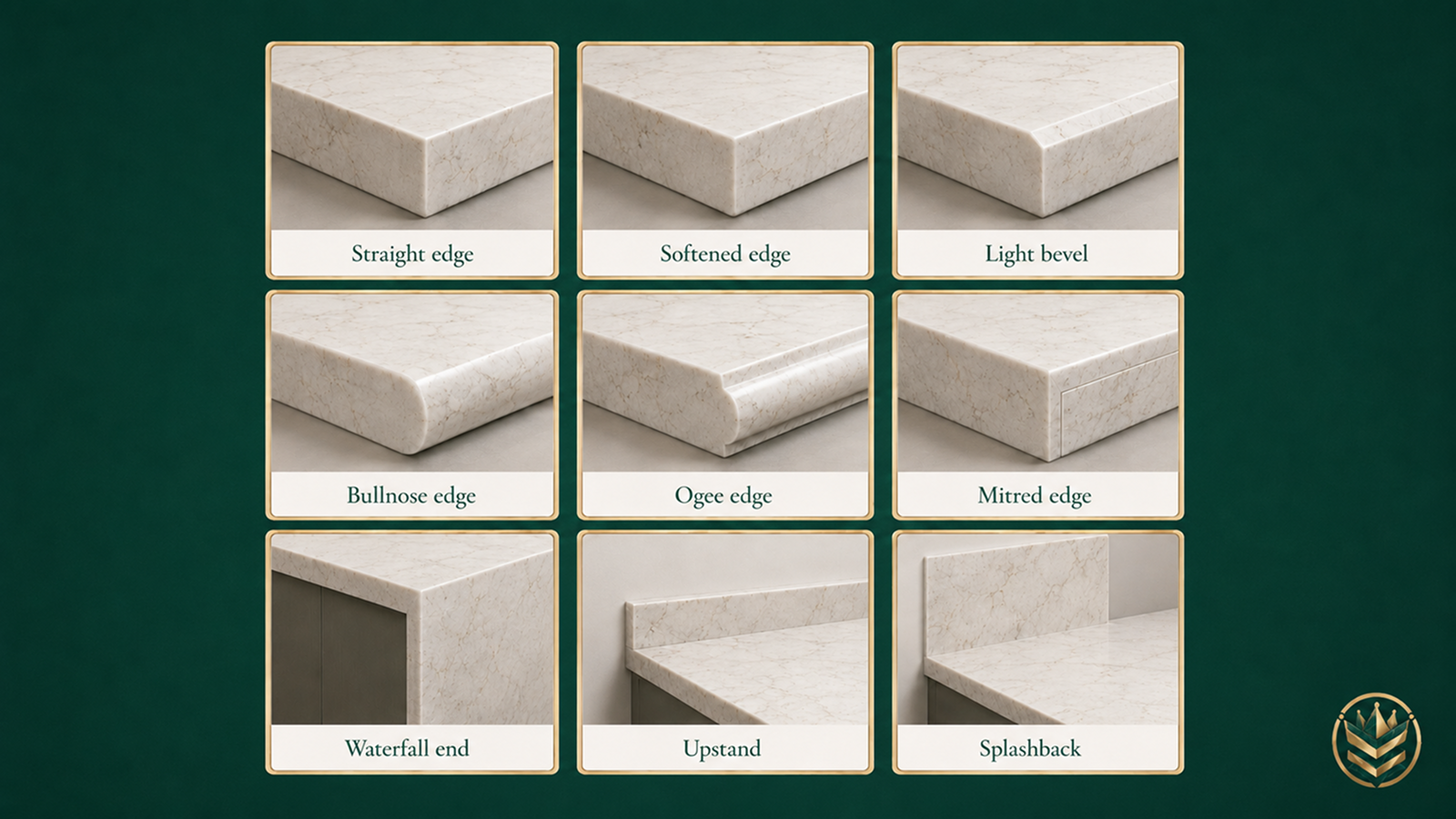
The front edge is one of the easiest places to see the difference between 20mm and 30mm quartz. This is also where the thickness can change the finished style of the kitchen.
Design details to decide before quote approval:
- Straight edge: A square-looking front edge with very little shaping. It suits both 20mm and 30mm quartz, but it works especially well on 20mm because it lets the slim slab look intentional rather than unfinished.
- Softened edge: A straight edge with the sharp corner slightly rounded off. It suits both thicknesses and is a practical choice for family kitchens because exposed corners feel less harsh without changing the overall look much.
- Light bevel: A small angled cut along the top edge. It suits 20 mm or 30 mm quartz, but on 20 mm it gives a bit more definition without making the worktop look decorative or heavy.
- Bullnose edge: A rounded front edge. It usually suits 30mm better because the curve needs enough face depth to look properly shaped rather than shallow.
- Ogee edge: A more traditional curved edge with a decorative profile. It suits 30mm quartz because the extra 10mm gives the profile more room, especially with shaker doors, framed cabinets and classic handles.
- Mitred edge: A joined edge detail that makes the visible front look thicker than the slab itself. It can work with 20mm or 30mm quartz and is useful on islands where you want a deeper feature edge without using the same thickness everywhere.
- Downstand or waterfall end: A vertical quartz piece that runs down the side or front of an island. It can work with either thickness, but it adds extra stone, extra joining and more fabrication time, so it should be priced separately.
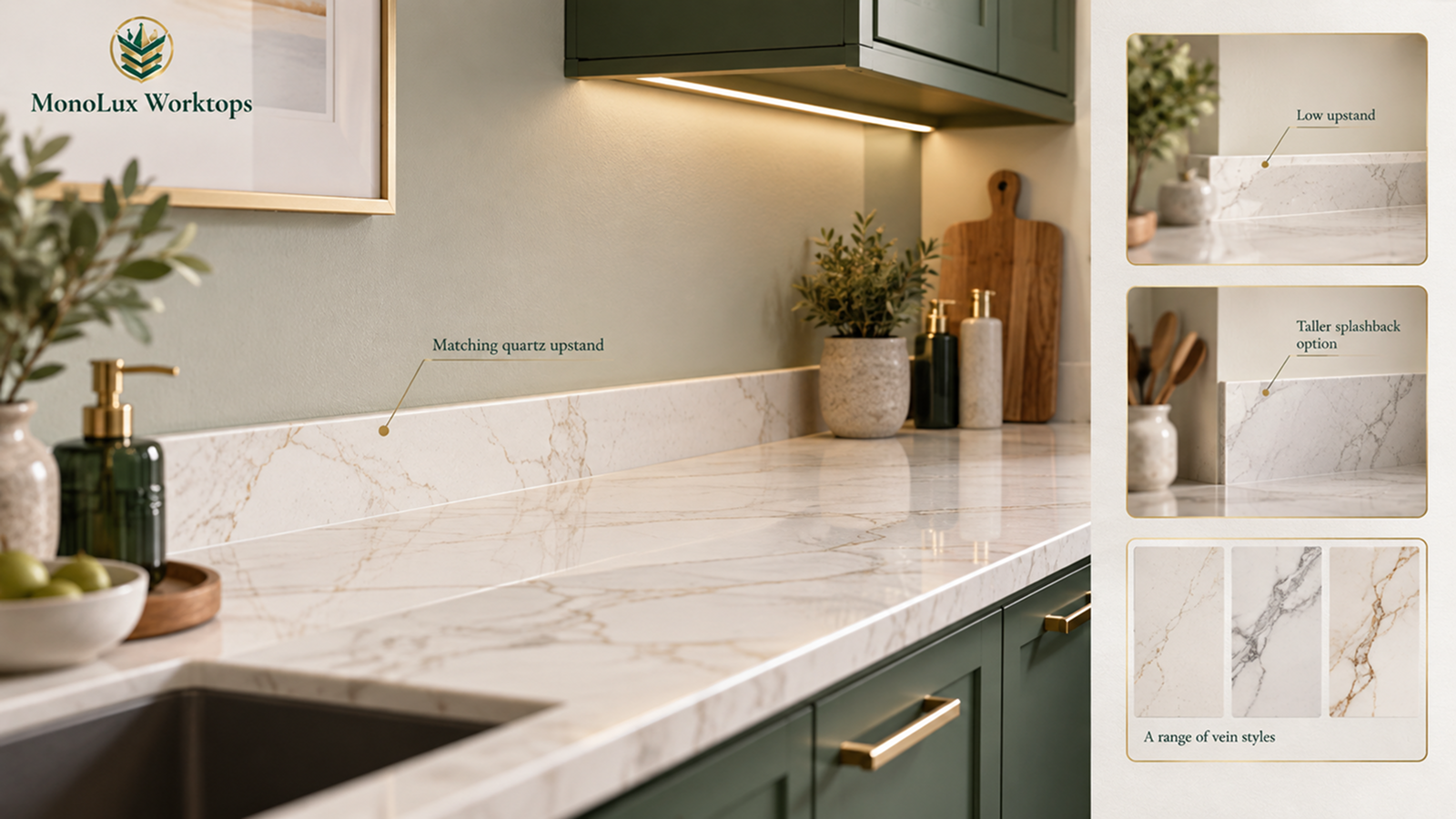
- Upstands: A short quartz strip running up the wall behind the worktop. 20mm is often better because it projects 10mm less than 30mm, which helps around sockets, corners and window returns.
- Splashbacks: A taller quartz wall piece behind the hob or sink area. 20mm is usually easier to work with because it sits flatter against the wall and causes fewer issues around plug sockets, sills and tight wall gaps.
Before approving the quote, ask for the worktop thickness, edge profile, upstands, splashbacks, mitred edges and waterfall panels to be priced as separate details.
Which Thickness Should You Choose: 20mm vs 30mm Quartz Worktops
Now that you have a pretty decent idea of which thickness suits what, here is some final decision guidance to nudge you toward the right decision:
Choose 20mm quartz if:
- You want a slimmer 2 cm edge
- Your kitchen is compact or modern
- You have handleless or flat-front cabinets
- You want matching upstands or splashbacks
- Your layout has good cabinet support
- You want to keep the quote more controlled
Choose 30mm quartz if:
- You prefer a thicker 3 cm stone profile
- You have a large island or breakfast bar
- You want deeper edge shaping
- Your kitchen is shaker, classic or farmhouse-style
- Your design includes a seating overhang
- You want the worktop to feel more substantial
If you are still stuck between the two, ask for both thicknesses to be priced on the same quartz colour and layout. That gives you a fair comparison instead of guessing from material price alone.
Get a Fitted Quote for 20mm or 30mm Quartz from MonoLux
MonoLux supplies both 20mm and 30mm quartz worktops across a wide range of colours and effects, including Calacatta worktops, marble-effect worktops, white, black, grey and sparkle designs.
We source slabs directly, use in-house CNC cutting, offer free samples, and provide some of the most affordable fitted quartz worktop rates for UK homeowners.
Send us your layout, preferred thickness, sink, hob, edge and splashback details, and our expert team will review the quote in only 2 hours before confirmation.
We also offer 5-day installation after templating, so you can move from thickness choice to fitting plan without dragging the process out.
Start with our kitchen worktop online quote and compare your 20mm or 30mm options today!
FAQs
- Is 20mm quartz strong enough for kitchen worktops?
Yes. 20mm quartz works well in many kitchens when the slab is properly supported, cut and fitted. It is especially suited to straight runs, modern cabinets, smaller kitchens and layouts without large unsupported sections. - Is 30mm quartz better than 20mm?
Not automatically. 30mm gives a thicker edge and more flexibility around islands, overhangs and shaped profiles. 20mm can be better for slim modern kitchens, upstands, splashbacks and tighter budgets. - Does 30mm quartz cost more than 20mm?
Usually, yes. 30mm uses more material and adds more weight, so it often costs more than the same colour in 20mm. The final fitted quote still depends on layout, cut-outs and extras. - Which quartz thickness is best for a kitchen island?
30mm is often chosen for larger islands because it gives a stronger-looking edge and more confidence around seating overhangs. A 20mm island can still work well with the right support and slab plan. - Do induction hobs need 30mm quartz?
Some do, but not all. The hob manual should be checked before templating, especially with recessed hobs, flush-fit hobs or a hob above a built-under oven. - Is 20mm or 30mm better for upstands and splashbacks?
20mm is usually neater for upstands and splashbacks because it projects 10mm less from the wall than 30mm. That helps around sockets, corners, window returns and tight wall spaces.