
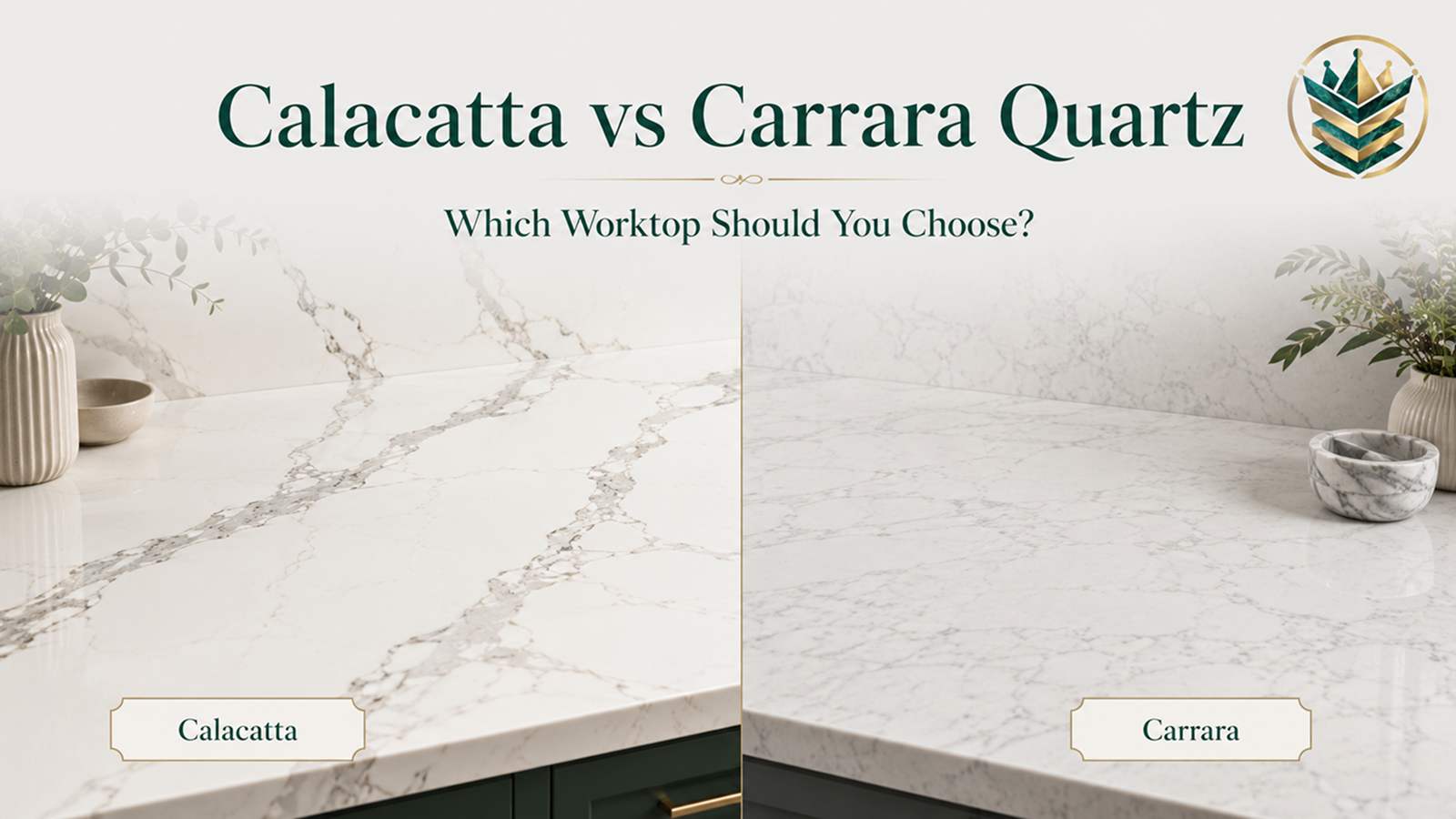
Calacatta and Carrara quartz both give you a marble-effect worktop, but they suit different kitchens.
Calacatta quartz is usually the bolder option. It works well when the worktop is meant to become a feature, especially on a kitchen island, splashback or long open-plan run.
Carrara quartz is usually the softer option. It works well when you want a bright worktop that sits quietly with the cabinets, flooring and wall colour.
Since quartz worktop cost changes with size, thickness, cut-outs, upstands and splashbacks, it is worth comparing the look and the layout together before choosing samples.
This guide compares Calacatta vs Carrara quartz in practical terms so you can choose samples with a clearer idea of what will work in your kitchen.
Quick Answer: Calacatta vs Carrara Quartz
Choose Calacatta quartz if you want a brighter, bolder marble-effect worktop with stronger veining.
Choose Carrara quartz if you want a softer white or grey marble-effect surface with finer movement.
Quick buying guide:
- Best for large islands: Calacatta quartz, because larger surfaces give the veining more room.
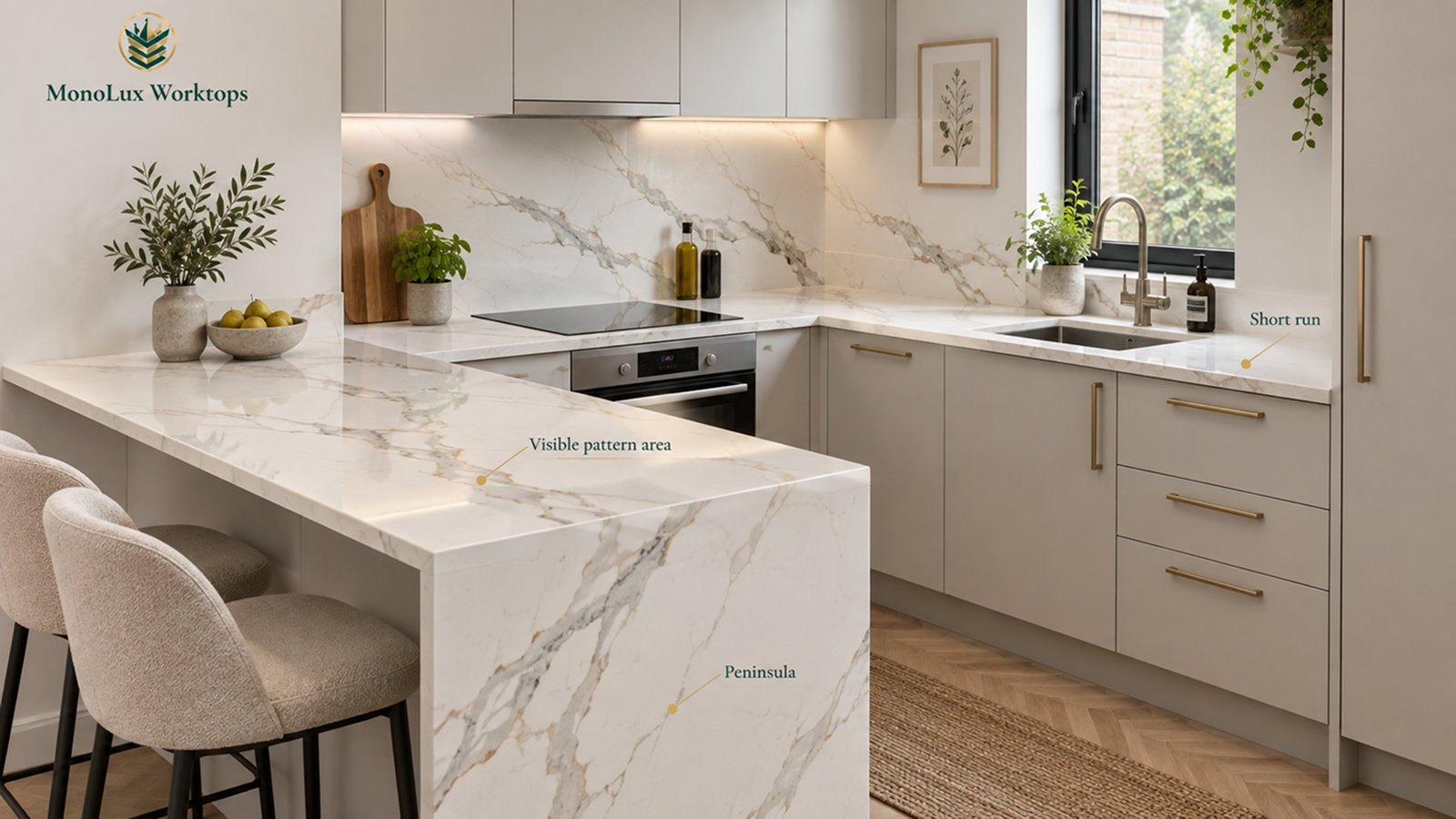
- Best for smaller kitchens: Carrara quartz or soft grey-veined Calacatta, because heavy veining can look busy across short runs.
- Best for dark cabinets: Calacatta quartz if you want strong contrast; Carrara quartz if you want to soften the scheme.
- Best for shaker, oak or cream kitchens: Carrara quartz or a subtle Calacatta, because the worktop has to work with cabinet detail and warmer undertones.
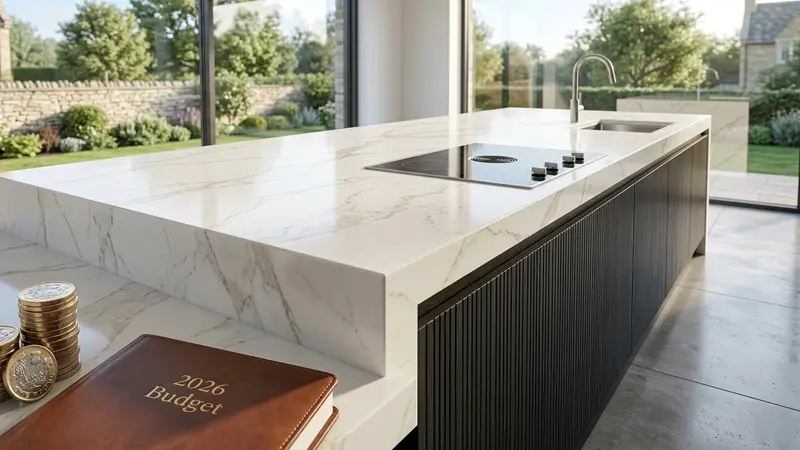
- Budget note: As a rough UK guide, fitted quartz worktops usually range from about £1,500 to £4,000+, depending on size, layout and features.
Simpler kitchens tend to sit around £1,500–£2,000+, while medium layouts are often £2,000–£3,000+. Larger kitchens with islands, splashbacks or premium designs can reach £3,000–£4,500+ or more. - Sample note: for Calacatta, check where the main veins will land. For Carrara, check the undertone beside your cabinet door.
The rest of this guide explains those points in more detail, including cost, alternatives, daily care and how to compare samples before you request a fitted quote.
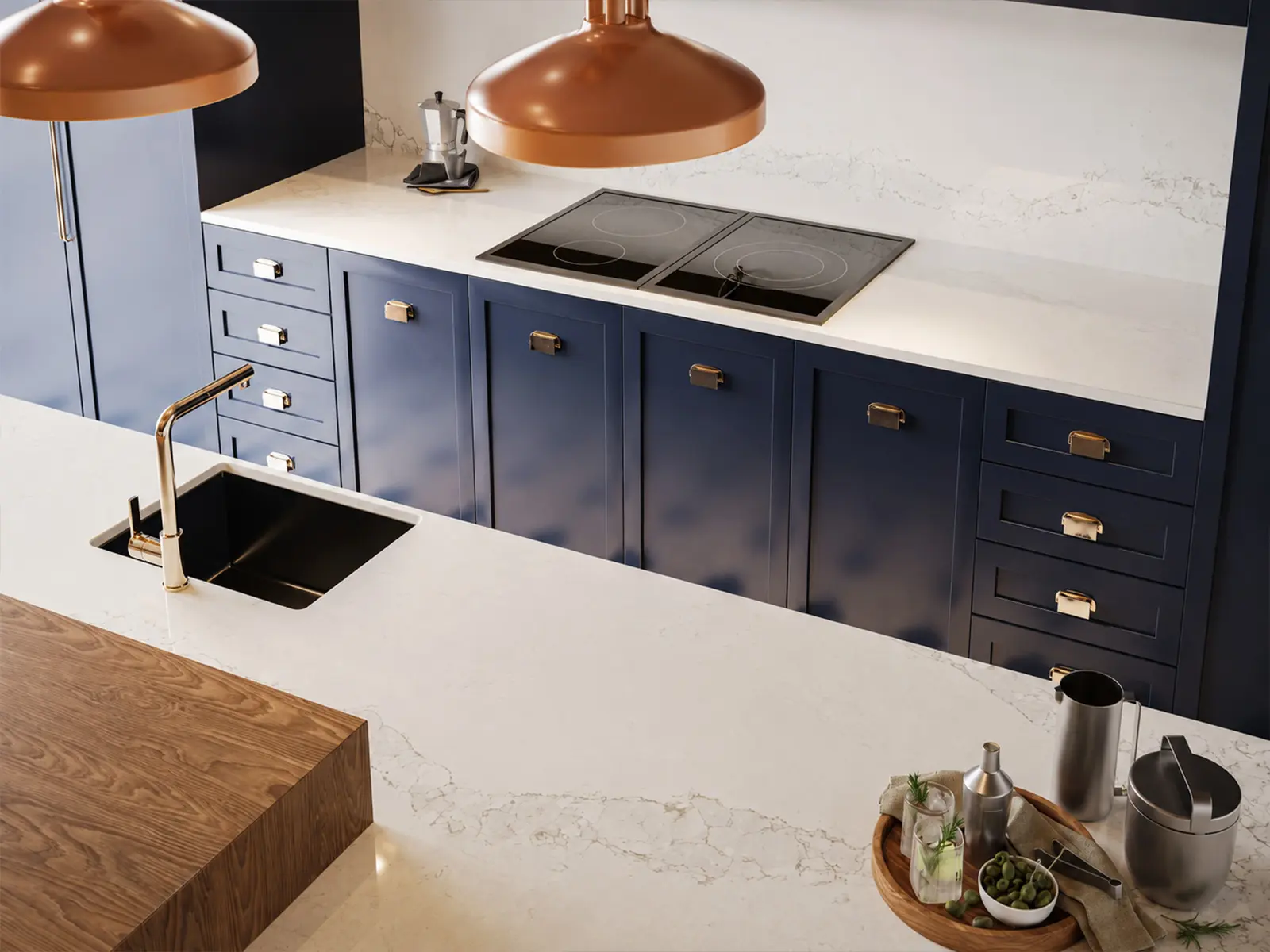
White Carrara-style quartz worktops with navy cabinets, brass handles and a soft marble-effect quartz splashback.
What Is Calacatta Quartz?
Calacatta quartz is a marble-effect quartz style with a bright white or warm white base and stronger veining. The veins are usually larger and more spaced out than Carrara-style quartz. Depending on the design, they may be grey, gold, bronze, black or mixed.
The main reason buyers choose Calacatta quartz is visual impact. It gives the kitchen a stronger stone look and can make the worktop one of the main design features in the room. That works especially well in kitchens where the cabinets, flooring and wall colours are fairly simple.
Calacatta quartz is often a good match for:
- large islands
- waterfall ends
- full-height splashbacks
- long open-plan worktop runs
- dark cabinets
- handleless kitchens
- plain floors
- kitchens that need more movement
The risk is scale. A dramatic vein can look excellent across a wide island, but the same pattern may look too busy if it is broken across a small sink run, corner section or compact L-shaped layout.
Calacatta does not always mean bold gold veining. Some grey-veined Calacatta styles are much softer. Those designs can sit between Carrara and statement Calacatta, giving the kitchen a brighter base without too much contrast.
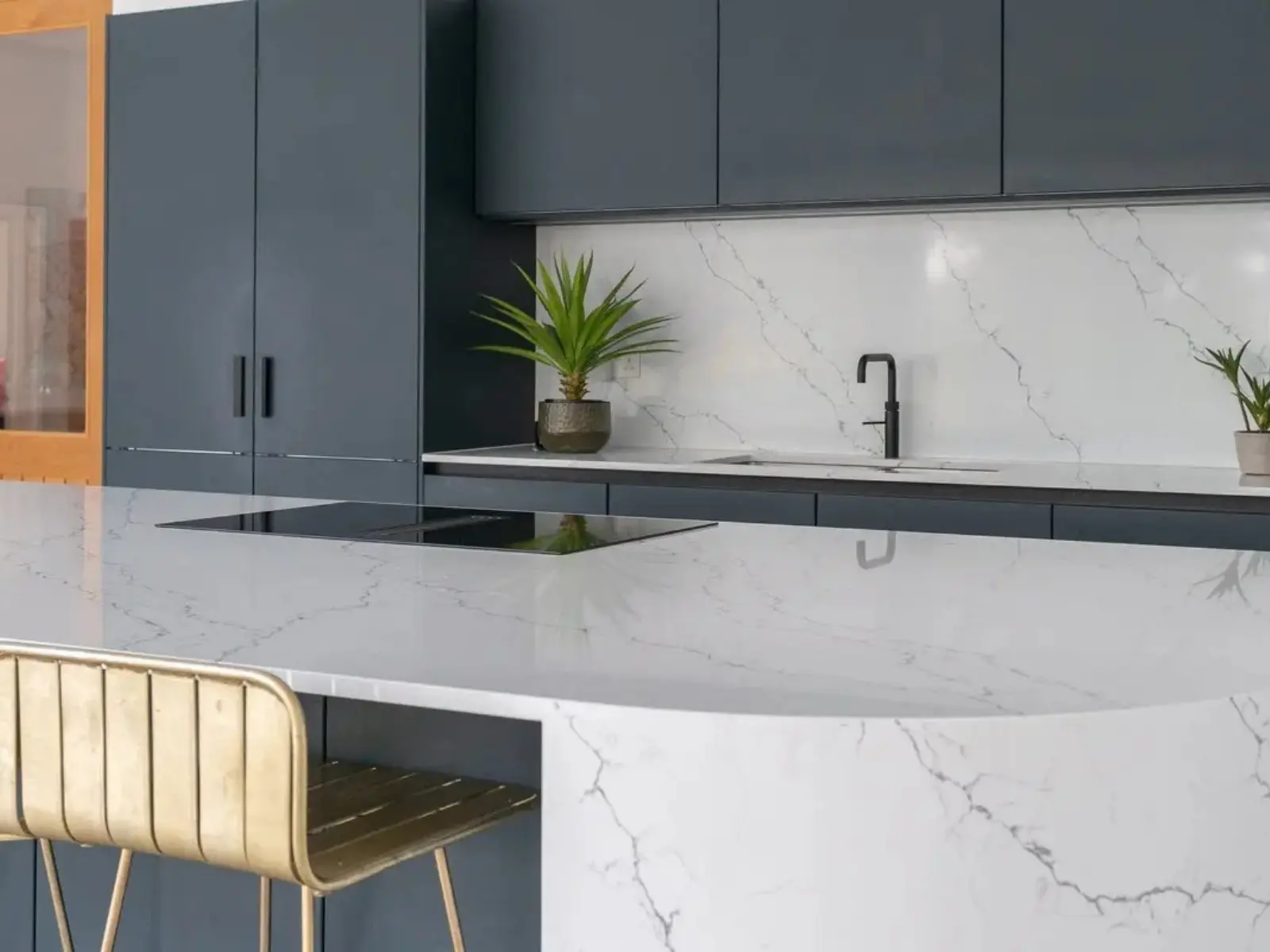
Soft grey-veined Carrara quartz worktop on a modern kitchen island with matching marble-effect quartz splashback.
What Is Carrara Quartz?
Carrara quartz is a softer marble-effect quartz style. It is inspired by Carrara marble, a white or blue-grey marble associated with the Carrara area of Tuscany, but Carrara quartz itself is engineered quartz rather than natural marble.
In kitchen worktops, the Carrara look usually means a white, off-white, light grey or blue-grey inspired base with fine grey veining. The movement is normally softer and more even than Calacatta, so it suits kitchens where the worktop is not meant to dominate the room.
Carrara quartz is often a good match for:
- shaker kitchens
- compact L-shaped layouts
- galley kitchens
- light oak cabinets
- soft grey units
- cream or putty cabinets
- traditional kitchens
- patterned floors or wall tiles
- family kitchens that need a clean, calm surface
Carrara-style quartz is useful when the buyer likes marble-effect worktops but does not want a strong statement pattern. It adds movement, but it usually stays more controlled than Calacatta.
Note: Carrara is the correct spelling. Some buyers search for “Carrera quartz”, but Carrara is the style name.
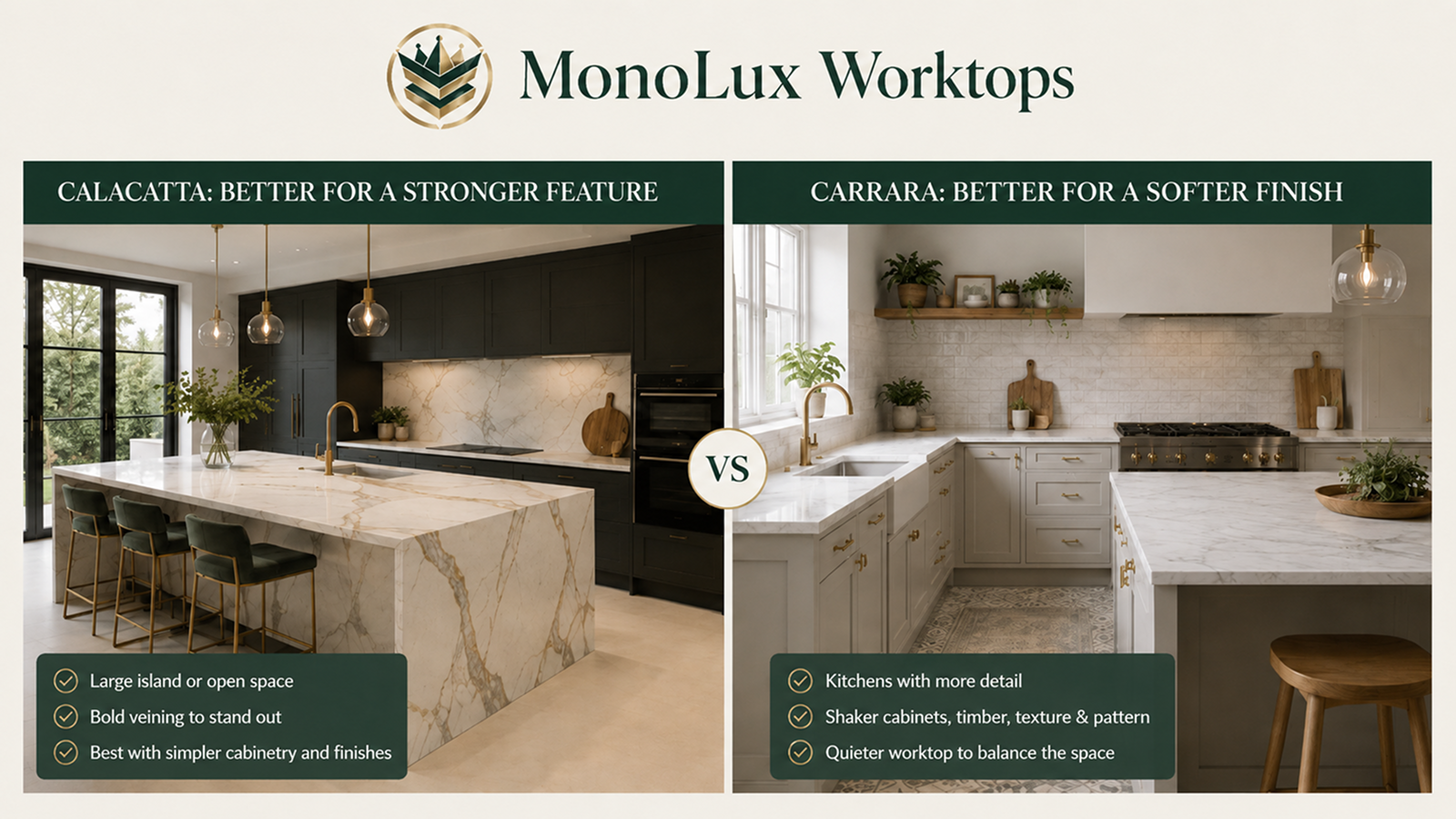
Which One Suits Your Kitchen Layout?
The better choice depends on where the quartz will sit. A kitchen island, a short L-shaped run and a full-height splashback all show patterns differently.
Choose Calacatta for a Stronger Feature
Calacatta quartz is usually better when the worktop has space to show its veining. A large island is the clearest example. The larger surface lets the pattern travel, so the quartz looks deliberate rather than crowded.
Calacatta also works well with dark cabinets because the white base creates contrast. Navy, charcoal, black and deep green units can all pair well with Calacatta, especially if the rest of the kitchen is simple.
Good fit: large island, plain slab doors, simple flooring, dark cabinets, brass or black handles, full-height splashback.
Watchpoint: on a small worktop run, strong veining may be interrupted by the sink, hob or joins. Ask to see larger images or slab views if the pattern is a major part of the choice.
Choose Carrara for a Softer Finish
Carrara quartz is usually better when the kitchen already has enough detail. Shaker cabinet frames, oak grain, patterned flooring, open shelving and textured tiles all add movement. A quieter worktop helps stop the kitchen from looking overloaded.
Carrara-style quartz is also useful in smaller kitchens. It keeps the room bright without adding heavy contrast across short surfaces.
Good fit: shaker doors, cream cabinets, light oak, soft grey units, smaller kitchens, classic kitchens, and busy floors.
Watch point: in a very plain modern kitchen, Carrara may look too quiet. A softer Calacatta can add more pattern without going all the way to a bold statement design.
Use Cabinet Colour as a Quick Filter
Cabinet colour is one of the quickest ways to narrow down your quartz choice. It helps you decide whether you need contrast, warmth or a softer blend between surfaces.
- Navy or charcoal cabinets: Calacatta gives stronger contrast. Carrara creates a softer look.
- Light oak cabinets: Carrara and soft grey-veined Calacatta both usually pair well with the warmth of the wood.
- High-gloss white cabinets: Carrara keeps the look clean. Calacatta adds stronger movement.
- Soft green or putty cabinets: grey-veined Calacatta or Carrara-style quartz usually works better than very high contrast.
- Cream cabinets: check the sample carefully, because some bright white quartz can make cream doors look yellow.
Is Calacatta Quartz More Expensive Than Carrara Quartz?
Calacatta quartz is often more expensive than Carrara quartz, but the fitted quote is not decided by the style name alone.
As a broad UK planning guide, fitted quartz worktops often sit around £1,500 to £4,000+, depending on kitchen size, layout, material choice and fitting details. Smaller simple kitchens may cost around £1,500 to £2,000+.
Medium kitchens often cost around £2,000 to £3,000+. Larger kitchens with islands, splashbacks or premium designs can move toward £3,000 to £4,500+, with some feature-led layouts going higher.
Calacatta often moves a quote upward because stronger veining, premium ranges, large islands and vein placement can add material and fabrication planning.
Calacatta costs can rise with:
- premium marble-effect designs
- large island sections
- full-height splashbacks
- waterfall ends
- thicker profiles
- extra polished edges
- more careful slab planning
Carrara-style quartz is often easier to keep in lower or middle quote ranges because the pattern is usually softer and less complex.
Carrara costs can still rise with:
- larger total surface area
- L-shaped or U-shaped layouts
- undermount sink cut-outs
- hob cut-outs
- upstands
- splashbacks
- awkward access
- 30mm thickness
So the answer is not simply “Calacatta costs more”. A large Carrara-style kitchen with an island and several cut-outs can cost more than a compact Calacatta worktop with a simpler layout.
For a full cost breakdown, read: Quartz Worktop Budget Guide
Durability, Cleaning & Daily Use of Calacatta vs Carrara Quartz: Is There a Difference?
Calacatta quartz and Carrara quartz are both quartz worktops, so the daily-use difference is mostly visual. What you want to know is which one shows crumbs, water marks, fingerprints or small spills more clearly in your kitchen.
Engineered quartz is commonly made from quartz crystals mixed with resins and pigments. It is generally chosen for kitchens because it is non-porous, consistent and easier to clean than natural marble.
It still needs sensible care, especially around heat and harsh cleaners.
Best practices:
- wipe with warm water, mild soap and a soft cloth
- clean coloured spills soon after they happen
- use chopping boards
- use trivets for hot pans
- use mats under air fryers and other hot appliances
- dry around the sink after heavy use
Avoid:
- hot pans directly on the quartz
- cutting straight on the worktop
- abrasive pads
- harsh chemical cleaners
- dragging heavy appliances across the surface
- leaving strong spills sitting for long periods
Can you put a hot cup of tea or coffee on quartz?
A mug is usually much less risky than a hot pan, baking tray or air fryer. Coasters are still a good habit, especially on polished white quartz.
Natural marble can stain and etch more easily, and it usually needs more careful sealing and cleaning. For a fuller marble-look comparison, read our marble-effect quartz vs real marble guide.
Best Alternatives to Carrara and Calacatta Quartz
You do not have to choose the boldest Calacatta or the quietest Carrara. Many buyers end up somewhere between the two, especially if they like a marble-effect surface but need it to work with a specific cabinet colour, island size or budget.
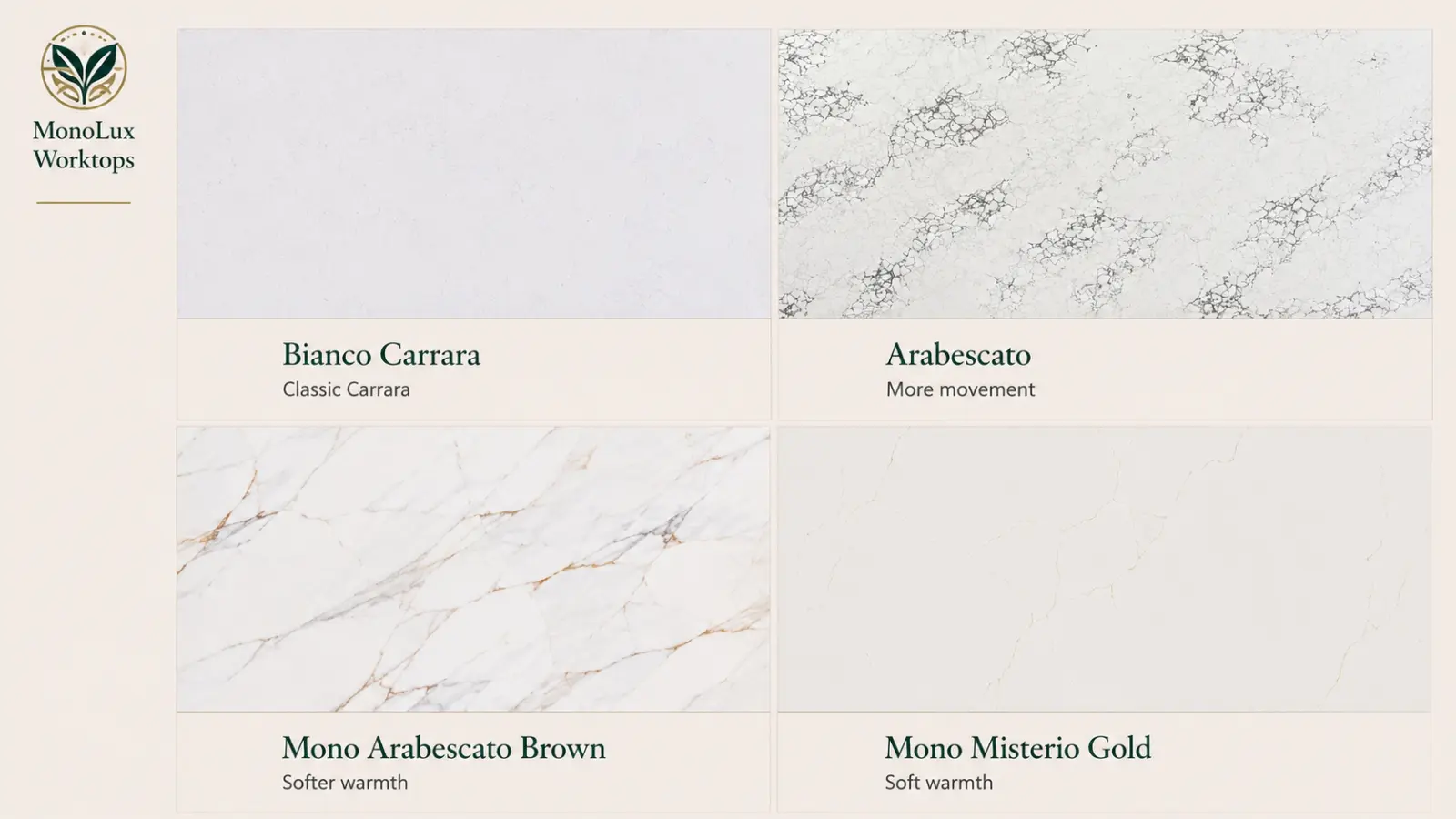
Which Quartz Looks Most Like Carrara?
The closest Carrara-style quartz options usually have a soft white or light grey base with fine grey veining. Start here if you want a quiet marble-effect look.
Good options to compare:
- Bianco Carrara: the clearest Carrara-style starting point.
- Arabescato: more movement than classic Carrara, but still softer than bold Calacatta.
- Misterio Gold: useful if you want a softer marble look with warmer detail.
- Arabescato Brown: good if you want a softer marble-effect quartz with warmer brown veining rather than a cool grey Carrara look.
Which Quartz Looks Most Like Calacatta?
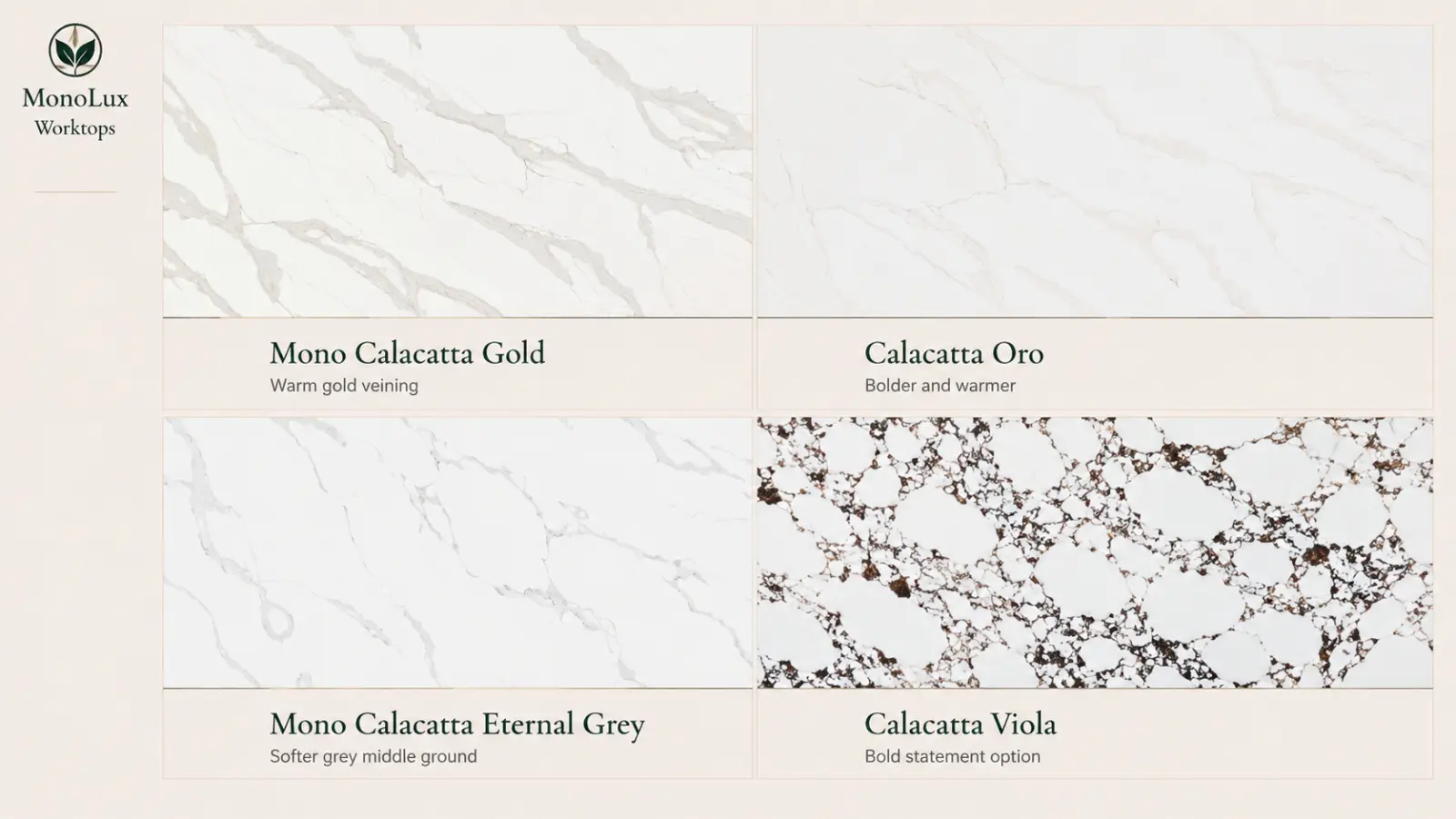
The closest Calacatta-style quartz options usually have a brighter base and more visible veining. Start here if you want the worktop to become a bigger part of the kitchen design.
Good options to compare:
- Calacatta Gold: good for a warmer Calacatta look.
- Calacatta Gold Superior: stronger movement than a softer gold-veined option.
- Calacatta Oro: bolder and warmer, especially for islands or splashbacks.
- Calacatta Eternal Grey: a softer grey-veined Calacatta that sits between Carrara and bold Calacatta.
- Calacatta Luna: useful if you want brightness with lighter grey movement.
- Calacatta Viola: a much stronger statement choice.
If you are stuck between the two styles, compare one Carrara-style sample, one bold Calacatta sample and one softer grey-veined Calacatta sample at home. That usually makes the choice clearer than looking at ten similar whites online.
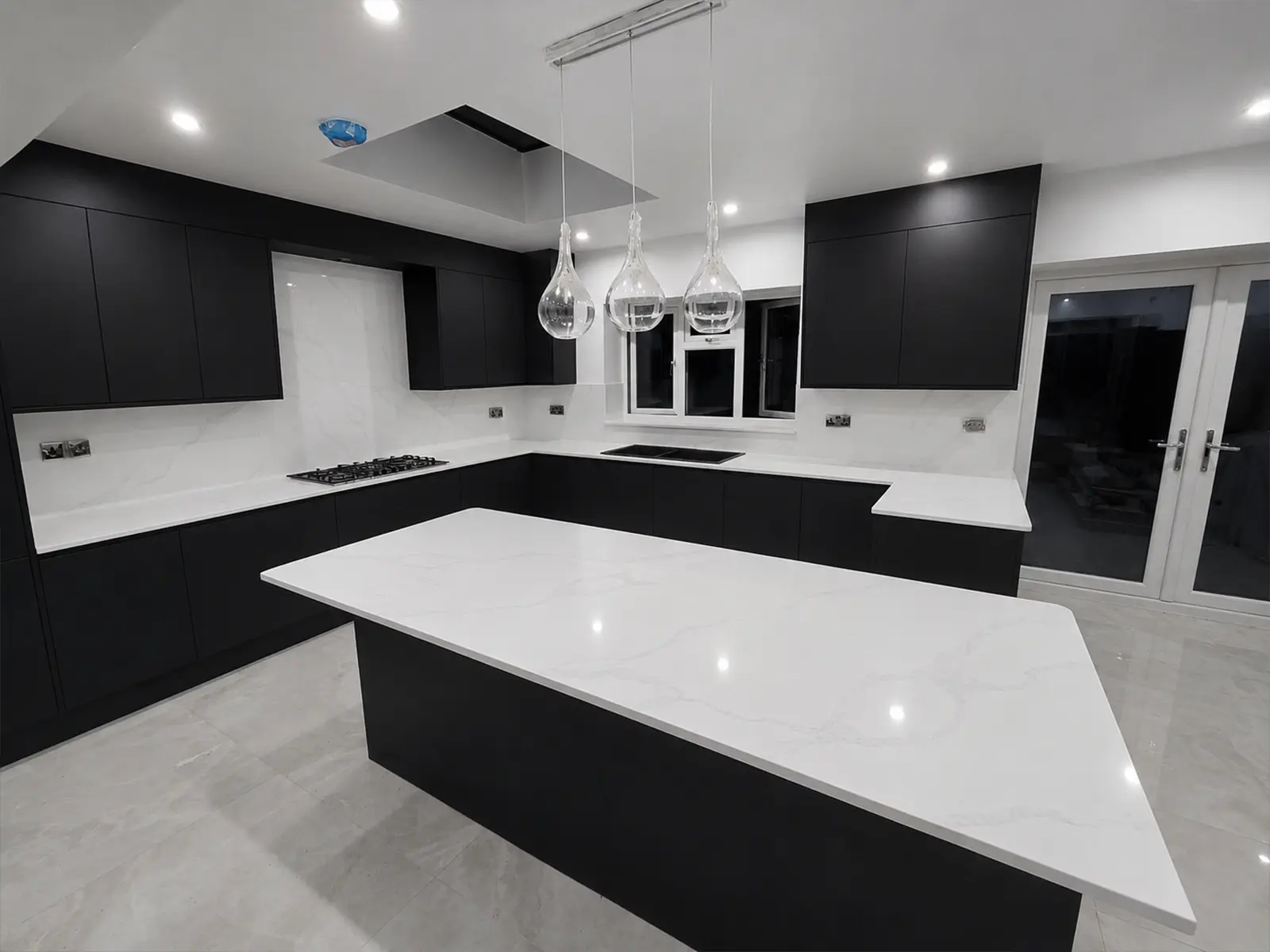
Large Calacatta quartz worktop island with black cabinets, showing a bold marble-effect quartz kitchen design.
How We Chose Between Calacatta and Carrara Quartz for Nadia’s Guildford Kitchen
Nadia’s Guildford kitchen is a useful example of why Calacatta does not have to mean loud or overdesigned. We chose Calacatta Eternal Grey quartz worktop for her kitchen, a bright white quartz with soft grey veining, alongside deep charcoal cabinetry and a large island.
The lighter quartz created contrast against the darker cabinets, while the grey veining kept the surface connected to the rest of the room. The project also included surrounding runs, a hob splashback and a soft rounded edge detail, so the quartz had to work across more than one surface.
This is a good example for buyers comparing Carrara and Calacatta because it sits in the middle. It is brighter and more feature-led than a very quiet Carrara-style quartz but softer than a heavy gold or black-veined Calacatta.
Read the story here: Nadia’s Guildford Kitchen: A Quartz Detail That Changed Everything
Ready to Compare Calacatta and Carrara-Style Quartz?
As mentioned above, samples are the best way to choose the right quartz for your kitchen. A Calacatta or Carrara-style surface can look different once it is placed beside your cabinet doors, flooring, handles, splashback and kitchen lighting.
MonoLux offers free samples across an extensive quartz range, including bold Calacatta quartz worktops and softer Carrara-style options such as Bianco Carrara quartz.
With MonoLux, you get:
- Quartz worktops from £89/sqm, with the final fitted quote based on the full kitchen details.
- A 2-hour expert quote review so your layout, material choice and fitting details can be checked before confirmation.
- Direct slab sourcing from selected suppliers in Spain, Italy, China and the Middle East.
- In-house CNC fabrication for cutting, polishing, edge profiles, sink cut-outs and hob cut-outs.
- 5-day installation available after templating on suitable projects.
- Showroom and warehouse visits if you want to compare surfaces in person.
- 20+ years of industry experience across stone and quartz worktop projects.
Once you have compared your samples, use the Online Worktop Quote Tool to add your measurements, preferred quartz, thickness, sink cut-outs, hob cut-outs and splashback details.
FAQs
- Is Calacatta or Carrara quartz better?
Calacatta quartz is better for a feature worktop with stronger veining. Carrara quartz is better for a softer marble-effect surface. The right choice depends on kitchen size, cabinet colour, light and budget. - What is the difference between Calacatta quartz and Carrara quartz?
Calacatta quartz usually has a brighter base with larger, more dramatic veins. Carrara quartz usually has a softer white or grey base with finer grey veining. Calacatta is more feature-led. Carrara is usually more understated. - Which is more expensive, Carrara or Calacatta quartz?
Calacatta quartz is often more expensive than Carrara-style quartz because the designs are usually bolder and more premium. The final fitted price still depends on layout, thickness, cut-outs, joins, splashbacks, upstands and fitting. - Is Calacatta quartz cheap?
Calacatta quartz is not usually the cheapest quartz style. Simple whites, soft greys and quieter Carrara-style designs may be easier to keep in a lower quote band. The finished price depends on the full project, not just the stone name. - Why is Calacatta quartz so expensive?
Calacatta quartz can cost more because stronger veining, premium designs, large islands, splashbacks and vein placement can add material and fabrication work. - Which quartz looks most like Carrara?
Bianco Carrara is the first option to compare for a Carrara-style quartz look. Arabescato, soft white marble-effect quartz and lighter grey-veined Calacatta designs can also work. - Which quartz looks most like Calacatta?
Mono Calacatta Gold, Calacatta Oro, Mono Calacatta Eternal Grey, Mono Calacatta Luna and Calacatta Viola are useful Calacatta-style options to compare, depending on how bold or soft you want the veining to look. - Is Carrara quartz good quality?
Carrara quartz can be of good quality if the slab, templating, cutting and fitting are handled well. The quality depends on the material and fabrication, not only the Carrara-style name. - Is Calacatta quartz still in style?
Yes. Calacatta quartz still works well for islands, splashbacks and kitchens with simple cabinets. Softer grey-veined Calacatta is usually safer for classic rooms, while stronger gold or high-contrast designs suit feature kitchens. - What should you avoid with quartz worktops?
Avoid hot pans directly on quartz, harsh chemical cleaners, abrasive pads, direct chopping and dragging heavy items across the surface. Use trivets, chopping boards, mild soap and a soft cloth for daily care. - Can you put a hot cup of coffee on quartz?
A hot cup of coffee is usually much less risky than a hot pan or baking tray. Coasters are still a good habit, especially on polished white quartz.