
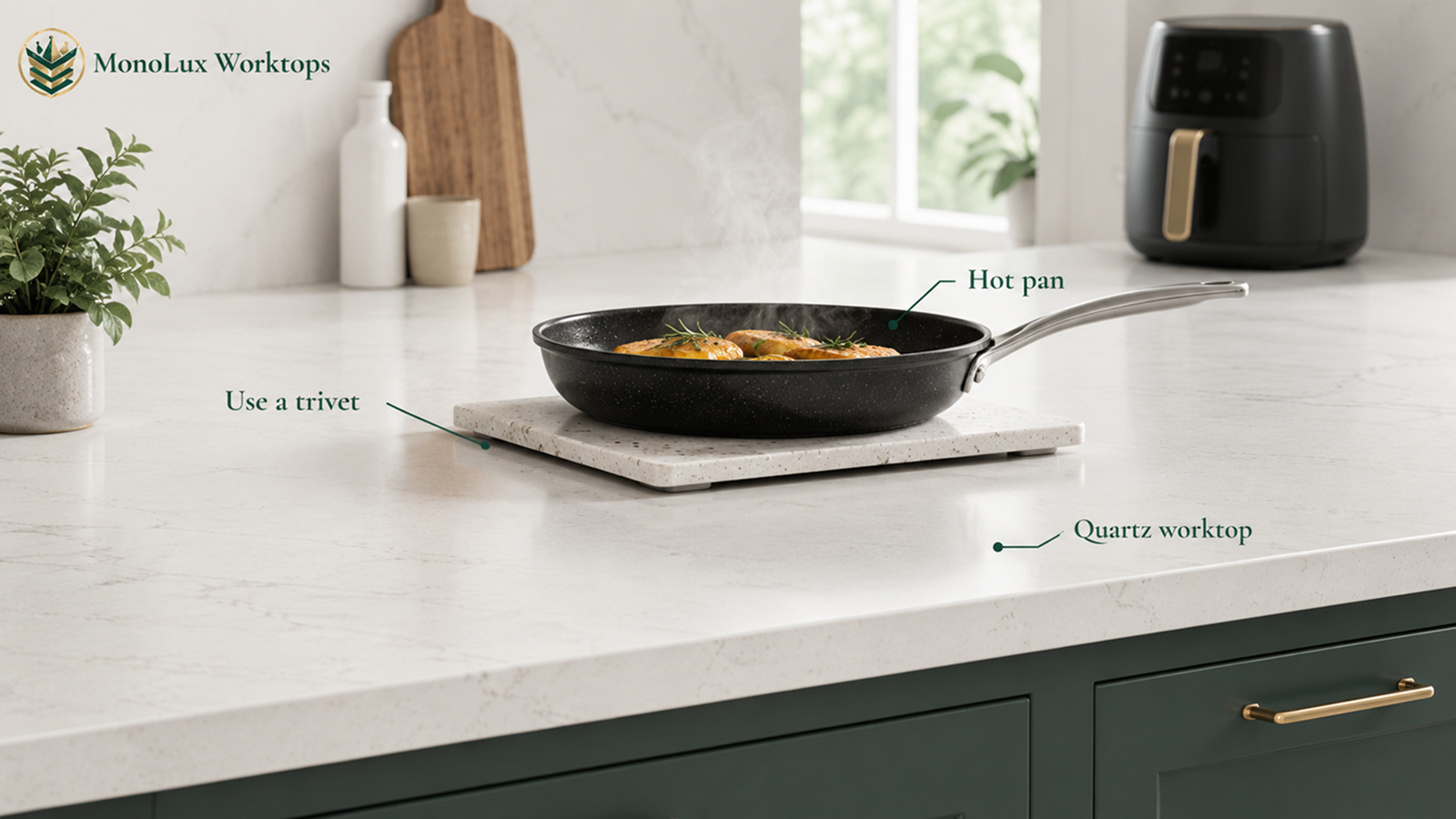
Very hot pans and oven trays should not be placed directly on a quartz worktop. Quartz handles everyday kitchen heat well, but direct or concentrated heat can still mark the surface or create stress, so a stable trivet or other suitable heat barrier is the safer habit.
That same principle applies to our quartz worktops, but countertop appliances need a little more thought because their heat reaches the surface in different ways. An air fryer, slow cooker and coffee machine do not all heat the worktop in the same place or for the same length of time.
Quick Answer: Can You Put Hot Pans on Quartz Worktops?
Very hot cookware and countertop appliances do not all heat the surface in the same way. Give pans and oven trays a protected place to land, and use appliances that stay on the worktop according to their placement instructions.
- Hot pan from the hob → Put it on a stable trivet or heat-safe board rather than directly on the quartz.
- Roasting tray or oven dish → Prepare a protected landing area before taking it out of the oven.
- Air fryer, slow cooker or coffee machine → Follow the appliance manual as well as the care guidance for your quartz brand.
- Hot removable basket or drawer → Treat it separately from the appliance body and place it on a heat-safe surface.
- Heat mark or crack → Let the area cool naturally and arrange an assessment before trying abrasive cleaners or DIY repair products.
Is Quartz Heat Resistant?
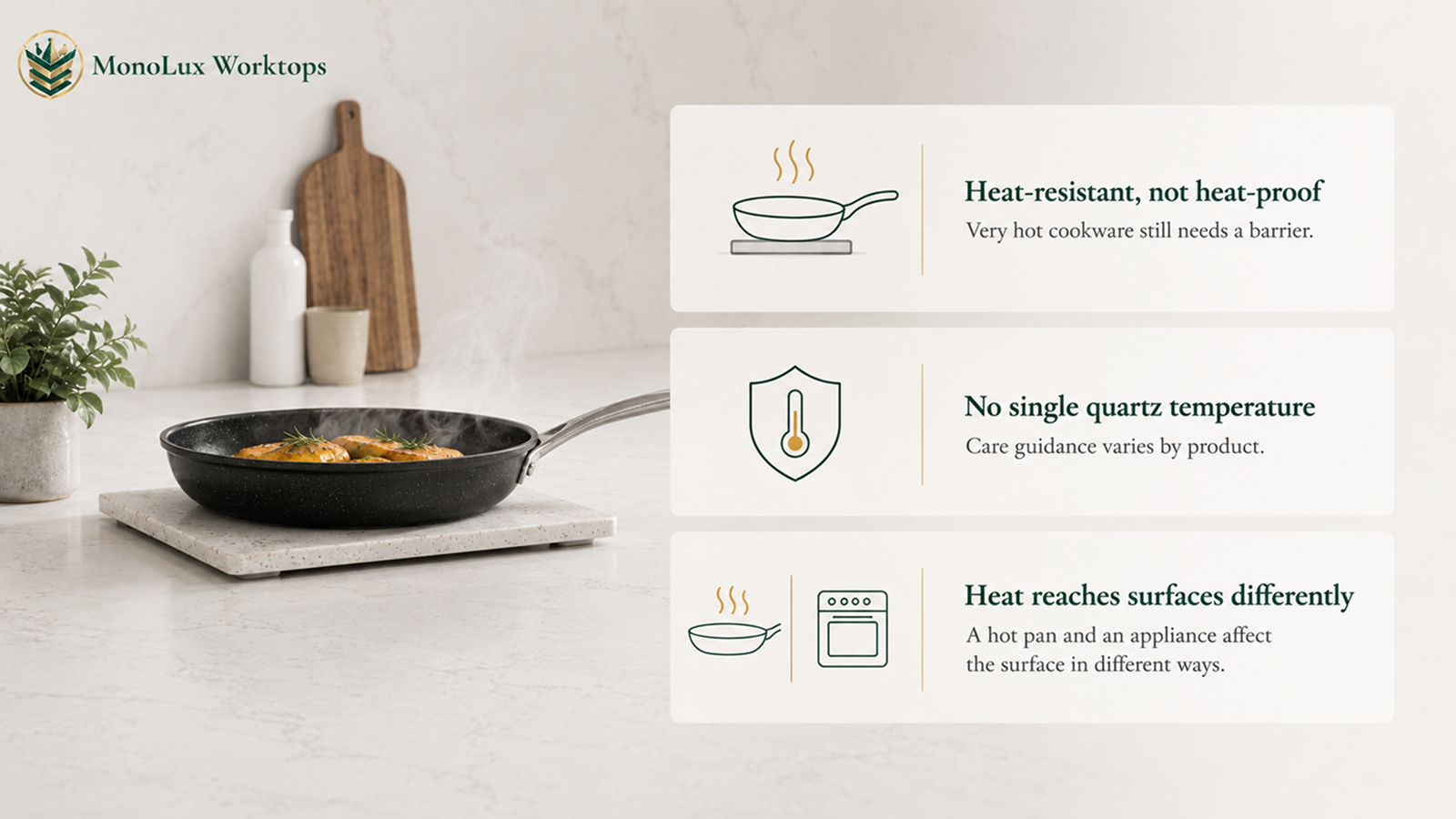
Quartz worktops are heat-resistant, but that description should not be read as permission to place very hot cookware anywhere on the surface.
Heat-resistant is not heat-proof. Direct, sustained or sudden heating can still affect a quartz worktop, so very hot cookware should be kept off the bare surface with a suitable trivet or heat barrier. That way, you can protect your worktop without relying on a temperature figure that may not apply to the installed product.
There is no single quartz temperature. Different quartz products use different formulations, testing methods and care instructions. A temperature published for one product should not be turned into a limit for every quartz surface.
How the heat reaches the worktop also matters. A hot pan creates intense contact in one small area, while a countertop appliance may apply lower heat for much longer. Rapid local heating can also cause one part of the surface to change temperature faster than the surrounding area.
What Should You Put Under Hot Pans and Roasting Trays?
A pan that has just come off the hob should be placed on a stable trivet, hot pad, or heat-safe board. The same applies to roasting trays, casserole dishes and ovenware that have just come out of the oven. Our quartz care and cleaning guide follows the same basic rule around hot cookware.
A good heat barrier should be:
- Large enough for the whole base. A small trivet is not much help if part of a wide roasting tray still rests directly on the quartz.
- Stable under the weight. Heavy cookware should sit flat rather than rocking, sliding or balancing on something too small.
- Ready before you need it. Decide where a hot pan or roasting tray will land before taking it off the hob or out of the oven, especially around islands and narrow worktop runs.
There is no reliable universal rule such as “a pan is fine for a few seconds”. Pan temperatures, base materials and quartz products differ, so it makes more sense to prepare the trivet before lifting the cookware rather than trying to judge a safe contact time after the fact.
Can You Use Air Fryers, Slow Cookers and Coffee Machines on Quartz?
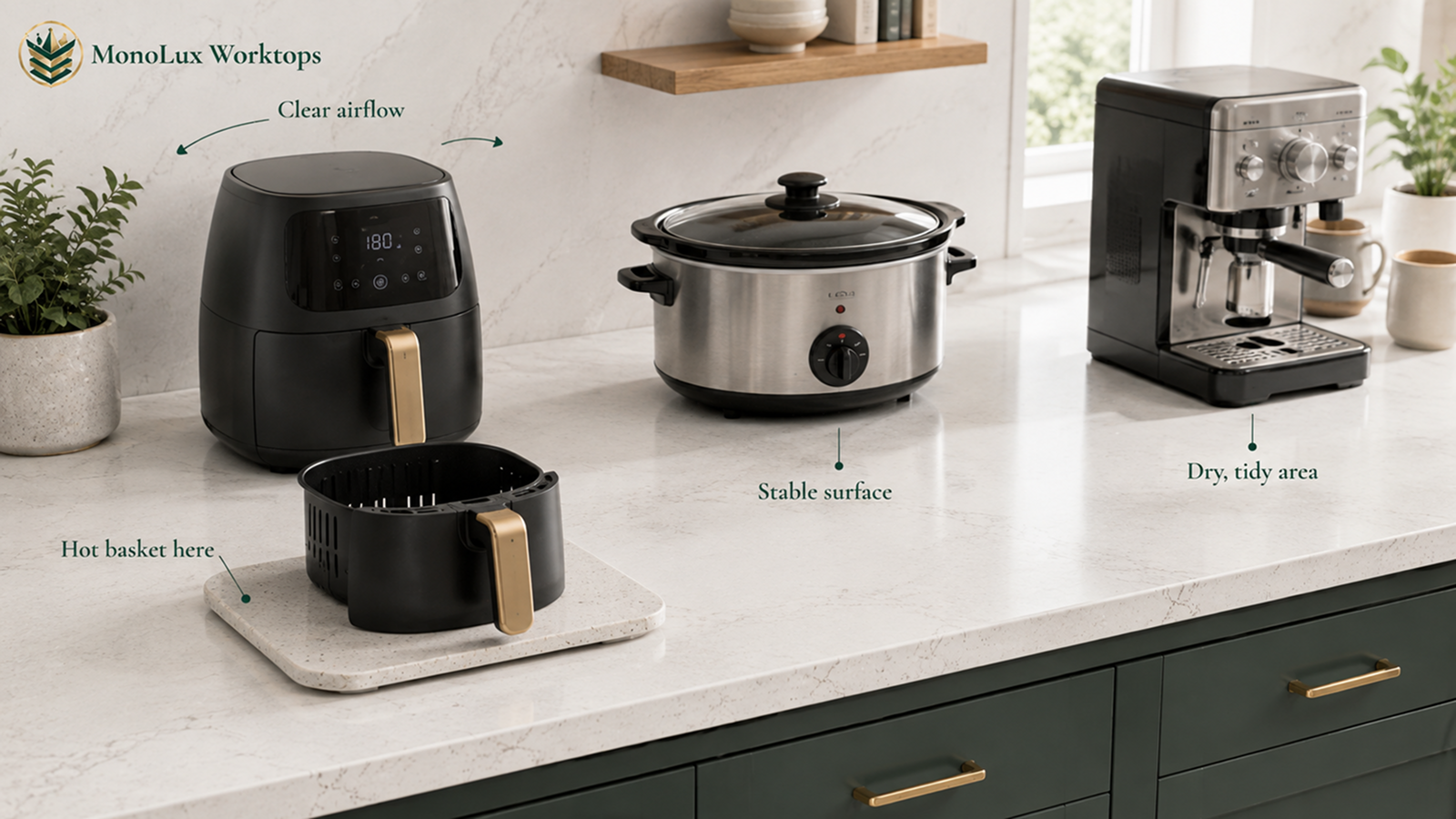
Yes, many countertop appliances can be used on quartz, but it all depends on the appliance itself. The important details are the heat beneath the unit, where hot air exits, how long it runs, and what the manufacturer says about the surface underneath.
Air Fryers on Quartz Worktops
An air fryer can expose the worktop to heat in several ways. Depending on the model, the body may sit on raised feet, hot air may leave through a rear or upper exhaust, and the removable basket or drawer can be much hotter than the area underneath the appliance.
We recommend treating an air fryer as a sustained-heat appliance rather than assuming it is harmless because the housing feels cooler than a frying pan. The base, feet, exhaust position and length of use all affect how heat reaches the area around and beneath it.
Some models are designed with feet or bases intended for heat-resistant work surfaces, and Ninja’s CRISPi guidance specifically states that its heat-resistant feet allow use on quartz and several other surfaces.
That is a good example of why a blanket rule that every air fryer needs a mat would be misleading.
Keep the feet, air intake and exhaust clear, and give the hot basket or drawer its own protected landing place. The cooking temperature shown on the appliance is not the same as the temperature reaching the worktop underneath it.
Slow Cookers on Quartz Worktops
A slow cooker presents a different problem because it can sit in the same place for hours. Some current Crock-Pot manuals warn that certain surfaces may not withstand prolonged heat and advise using a hot pad or trivet on heat-sensitive surfaces.
Follow the manual for your exact model rather than treating a slow cooker like a briefly hot saucepan. A stable barrier may be appropriate, but it should not interfere with the appliance’s feet or ventilation.
Coffee Machines on Quartz Worktops
Coffee machines are typically more about stable placement, residual heat, steam, and hot-water spills than about direct pan-style contact. Sage’s appliance guidance calls for a stable, level, dry and heat-resistant surface and advises against operating the machine in an enclosed space.
Keep the machine in a dry, stable area with the ventilation space required by its manual. Wipe hot-water or coffee spills promptly, and avoid placing hot removable parts directly on the quartz.
Do You Need an Appliance Mat?
An appliance mat is not automatically the right answer for every air fryer or cooker. It needs to be heat-rated, stable and compatible with the appliance without blocking feet, air intakes or hot-air outlets.
What Does Quartz Heat Damage Look Like?
Quartz heat damage does not always look the same. Depending on the quartz product and the type of exposure, a surface may show a mark, local discolouration, scorching or a crack.
Those symptoms do not prove the cause on their own. A crack near a cut-out, for example, can have several possible causes. Correct planning around sinks, hobs, joins and support is covered in our quartz worktop installation guide, so it is better to have the worktop assessed rather than assume heat was responsible.
Some surface problems may be treatable, while others need professional repair or a different remedy, so avoid turning one visible symptom into a DIY diagnosis. Our guide to quartz worktop durability covers cracks, chips, and other types of damage in more detail.
What Should You Do If You Find a Heat Mark or Crack?
If you notice a new mark or crack after heat exposure, stop using the affected area until you have checked it. Let the quartz return to room temperature naturally rather than cooling it quickly with cold water.
- Remove the hot item safely.
- Let the area cool on its own.
- Take clear photographs from close-up and from a little farther away.
- Find the quartz brand or product name if you have it.
- Avoid abrasive pads, harsh chemicals and unverified repair kits.
- Contact the fabricator or supplier for assessment.
Once the area has cooled, stick to gentle cleaning rather than trying to polish, sand or chemically treat the mark yourself. If you are unsure what caused the damage, photographs and the quartz product details will give the fabricator much more to work with during an assessment.
Need Help With a Quartz Worktop?
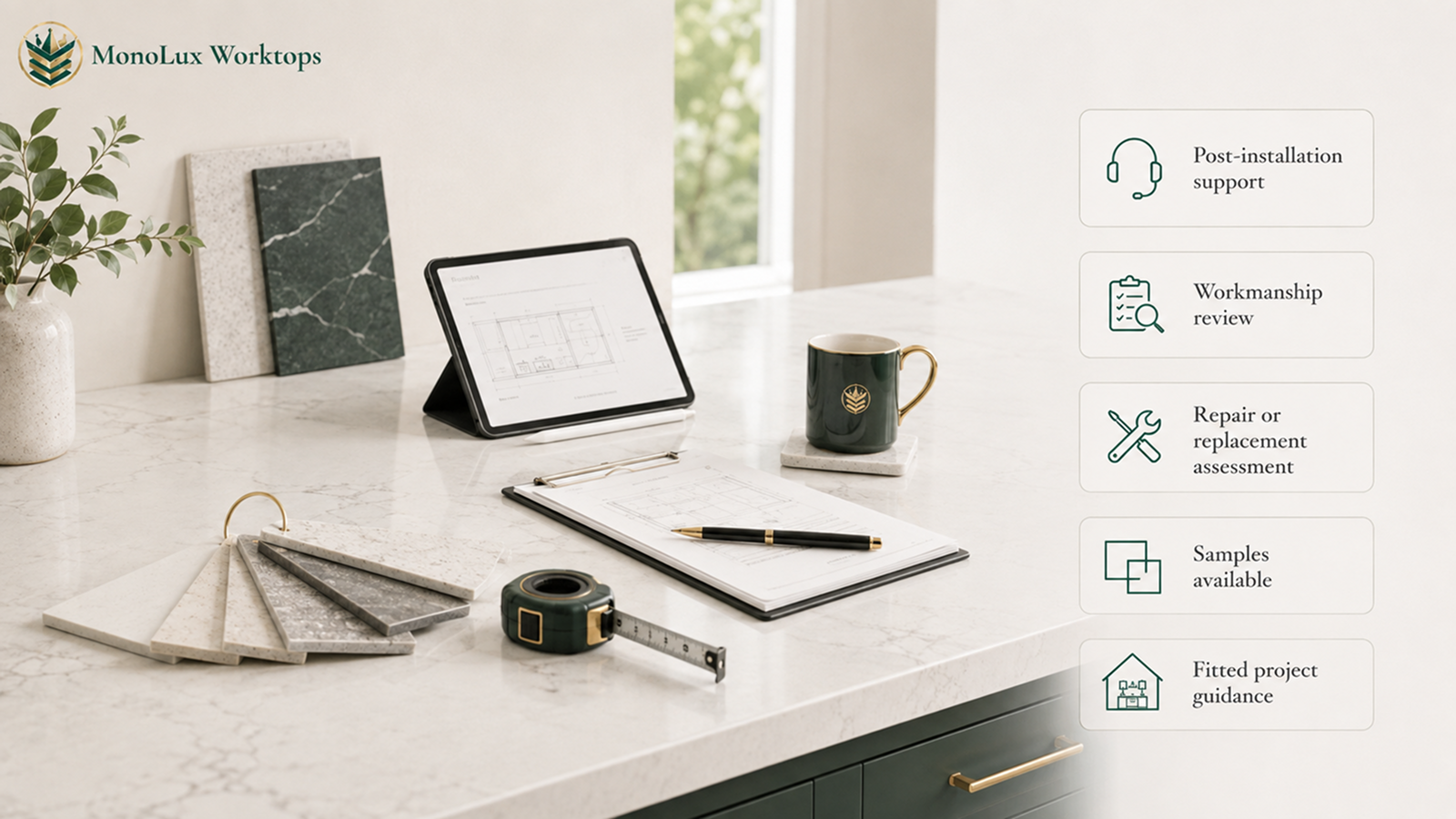
If you already have a MonoLux worktop and are concerned about a mark, crack or fitting issue, send us clear photographs and your order details so we can review the problem.
Our current support and fitting service can include:
- 30-day post-installation support for eligible products, damage, fitting or workmanship concerns.
- 60-day workmanship support for eligible fitting issues.
- Repair, adjustment, replacement or reinstallation where an accepted MonoLux fault requires it.
- Selected lifetime warranty cover for manufacturing and workmanship defects under normal domestic use.
- Templating, fabrication, supply, delivery and professional installation for new projects.
- Free samples on eligible products before you make your final choice.
If you are planning a new kitchen, our guide on how to buy kitchen worktops explains the process from choosing your quartz to templating and installation. You can then browse our quartz worktops and use our quartz worktop price calculator for an initial estimate.
FAQs
- Can you put a hot cup of tea on a quartz worktop?
A hot mug retains heat far less intensely than cookware straight from a hob or oven, so the risk is lower. Still, avoid using that as proof that every hot item is harmless to every quartz product. - What can I put under an air fryer on quartz?
Use a stable, heat-rated barrier only if it complies with the appliance’s instructions and does not block the feet, intake, or exhaust areas. Some models are designed to sit directly on suitable heat-resistant surfaces, so check the exact manual first. - Can a toaster sit on a quartz worktop?
A toaster can usually sit on a suitable kitchen surface, but its manual should still guide placement and ventilation. Keep hot removable trays or parts off the bare quartz and do not block openings around the appliance. - Does thicker quartz resist heat better?
There is no good basis for treating 30mm quartz as universally more heat-resistant than 20mm quartz. Thickness affects appearance, weight, support and fitting decisions instead. Our 20mm vs 30mm quartz worktops guide explains those differences in detail. - Can heat damage to quartz be repaired?
Some heat-related marks or damage may be repairable, while others require a different remedy. Let a fabricator assess the surface before you sand, polish, or apply a repair product yourself.