
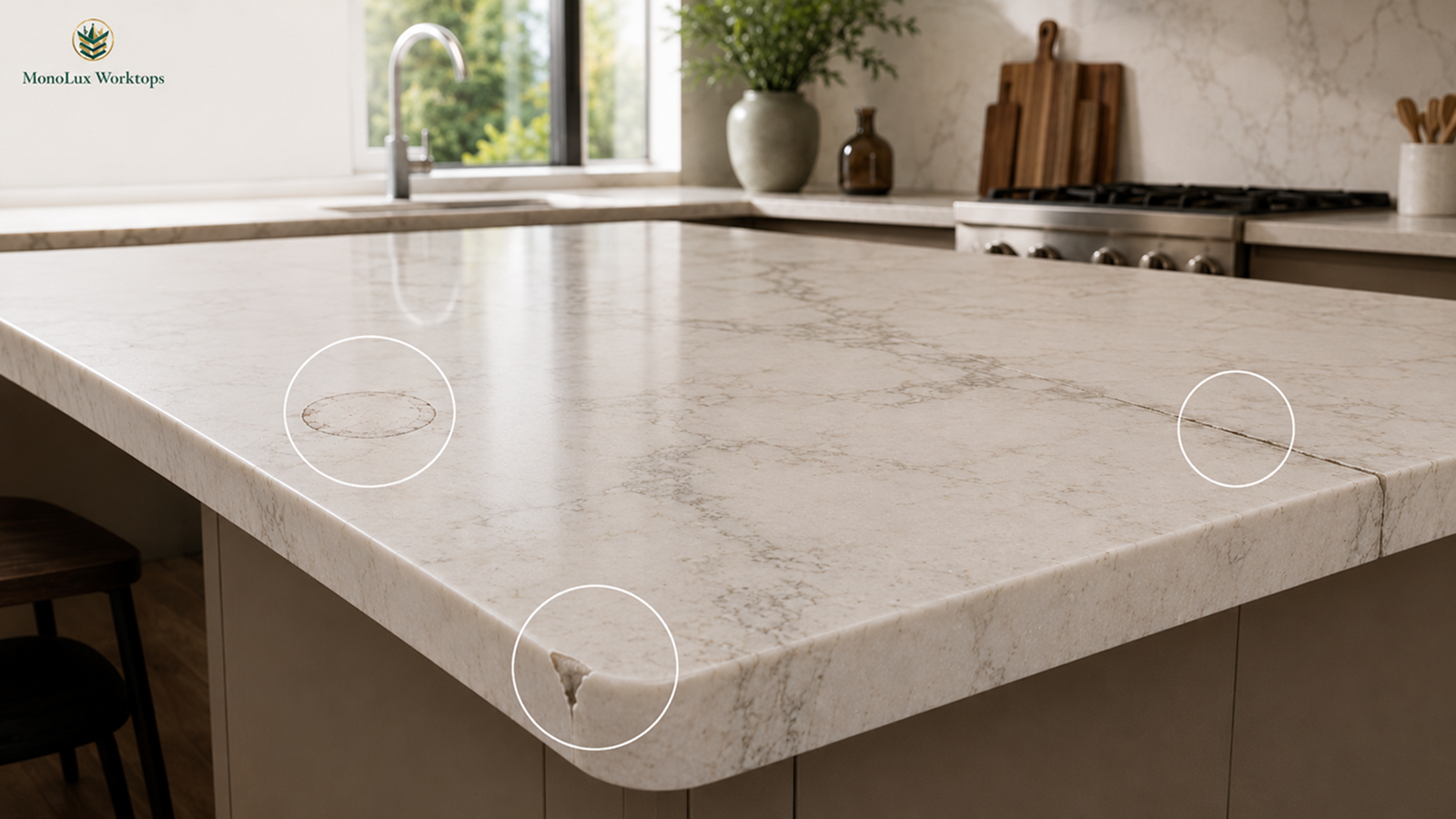
Quartz worktops are resistant to many everyday stains and scratches, but they can still be marked or damaged. A dull patch may be dried residue rather than a stain, a pale line may be metal transfer rather than a scratch, and a line near a join may be a seam issue rather than a crack.
The first step is to identify what you are actually seeing. Stains, scratches, chips and structural cracks have different causes and need different responses.
Quick answer: Do quartz worktops stain, scratch or crack?
Quartz worktops can develop stains, scratches, chips and cracks, but each type of damage has different causes and needs a different response. The main thing is to identify the problem before trying to clean, repair or replace anything.
- Stains and residue: some marks that look permanent are actually limescale, soap film, food residue or metal transfer.
- Scratches: direct cutting, grit and abrasive cleaning can leave visible marks or alter the finish.
- Chips: exposed edges and corners are more vulnerable to hard knocks, especially around busy sinks and preparation areas.
- Cracks: impact, heat changes, movement, support and fabrication around cut-outs or joins can all be relevant.
- Repairs: some minor damage may be repairable, while cracks, movement or seam problems are better assessed by a fabricator.
What Causes Scratches and Chips on Quartz Worktops?
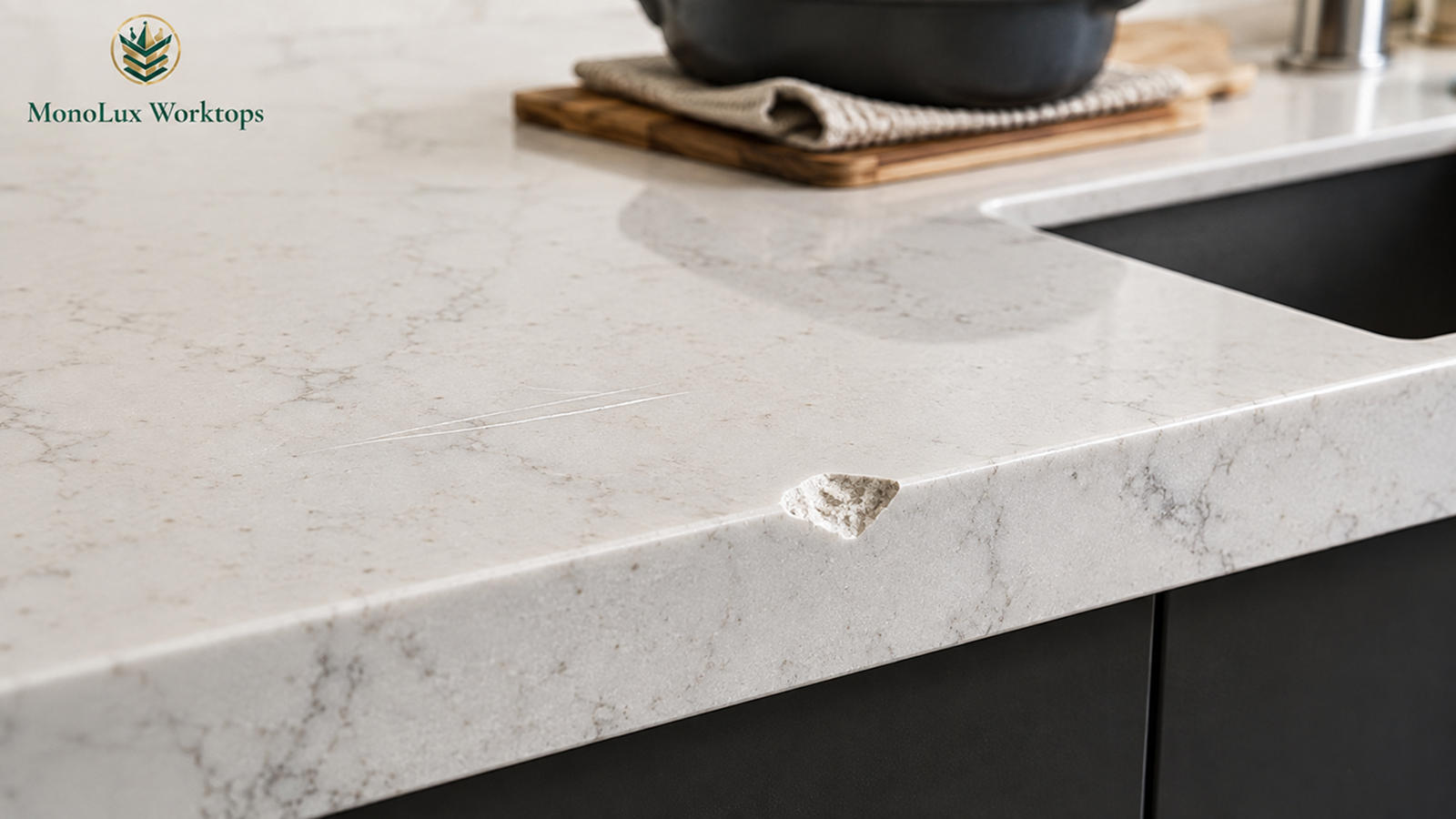
Scratches usually affect the face or finish of the worktop, while chips involve a small piece breaking away from an edge or corner. They tend to come from different kinds of contact, so it helps to treat them separately.
Scratches and transfer marks
Quartz is scratch-resistant, not scratchproof. Cambria’s care guidance advises using a chopping board rather than cutting directly on the worktop, and manufacturer guidance also warns against abrasive pads that can mark or alter the finish.
A visible line is not always a true scratch. Metal from a pan, tray or utensil can transfer onto the surface and leave a streak that looks like damage. Clean the area first, then check it again once it is dry. A groove that remains and catches a fingernail is more likely to be physical damage than a removable transfer mark.
Colour and finish can also affect how easy a mark is to notice. A dark, plain or highly uniform worktop may show fingerprints, residue or fine marks more clearly than a busier pattern. Our black quartz worktop care guide explains why these marks are more visible, but this does not make dark quartz physically weaker.
Edge chips
Chips usually happen at exposed edges and corners, where a hard knock can remove a small piece of quartz. Sink edges and busy preparation areas can be more exposed simply because heavy pans, plates and other objects are handled there more often.
Some small chips can be assessed for repair, but the result depends on the size, location, pattern and finish. A repair may make the damage less noticeable without making the area look identical to the original slab.
What Causes Cracks In Quartz Worktops?
A crack can develop for several reasons, and its appearance alone does not tell you the cause. Impact, rapid temperature changes, movement in the supporting units, uneven support and fabrication around cut-outs or joins can all be relevant.
The Silestone design and installation manual, for example, treats sink and hob openings, internal corners, joint positions and support as planned fabrication details.
A sink or hob cut-out interrupts the slab, so the shape of the opening, nearby joins and support underneath need to be planned around the specific product and kitchen layout. The same applies to large islands and overhangs. Support requirements change with the slab, thickness and layout, so one fixed rule cannot be applied to every installation.
A line near a join also needs a closer look before it is called a crack. Quartz worktops are often fitted in several sections, which means a visible seam can be part of the installation. Movement, separation, a raised edge or a line spreading beyond the joint is a stronger reason to ask the fabricator to inspect it.
Heat can also contribute to damage. Several manufacturers warn about rapid temperature changes and direct contact with hot cookware. Use a trivet rather than putting hot pans directly on the worktop. Our guide to hot pans on quartz worktops covers this in more detail.
For more detail on templating, cut-outs, joins and support, see our quartz worktop installation guide.
What Should You Do If You Find Damage?

If the issue could still be residue or transfer, start with the exact care guidance for your quartz brand. Once that basic check fails, repeated experiments can make the problem harder to assess.
A sensible next-step sequence is:
- Clean the area using the manufacturer’s normal method.
- Rinse and dry it fully.
- Take one close photo and one wider photo showing where the mark sits on the worktop.
- Note any recent impact, heat exposure, cabinet work or appliance replacement.
- Stop scraping, sanding, polishing or trying stronger chemicals if the mark remains.
- Contact the original fabricator or another stone professional for chips, opening cracks, movement, raised seams or persistent changes to the finish.
Some minor chips and localised surface damage may be repairable, but that is something to assess from the actual defect. Structural movement, opening cracks and damage around cut-outs need more care than a small cosmetic chip.
How Can You Reduce the Risk of Damage?
Most prevention is simple. Use a chopping board instead of cutting directly on the quartz. Keep abrasive pads away from the surface and follow the slab manufacturer’s cleaning instructions. Put hot cookware on a trivet and avoid heavy knocks to exposed edges.
The less visible part is the fabrication underneath. Islands, sink and hob openings, joins and overhangs should be planned around the specific slab and kitchen structure rather than treated as standard dimensions that work in every layout.
If you are still planning a new kitchen, you can compare our current range of quartz worktops and discuss the layout before fabrication starts.
Buy Quartz Worktops Without Worry!

A good quartz layout starts before the slab is cut. Sink and hob openings, joins, edge profiles, overhangs and support all need to work with the kitchen underneath them.
At MonoLux, we can review your layout, template the kitchen and fabricate the quartz in-house using CNC equipment. We can prepare sink and hob cut-outs, edge profiles, joins, upstands and splashbacks, then handle delivery and fitting.
You can also compare full slabs at our Southall showroom and warehouse or request free samples on eligible products before choosing a design.
Our service does not stop once your worktops are fitted. You get 30 days of post-installation support for genuine product, fitting or workmanship concerns, plus 60 days of workmanship cover for issues such as joint separation, fitting adjustments, installation-related chips and adhesive problems.
If we confirm that a problem was caused by our supply, fabrication or installation, approved remedial work is carried out at no extra cost. Selected quartz and stone installations also come with a lifetime warranty against manufacturing and workmanship defects, subject to the applicable terms and exclusions.
For an initial fitted estimate, use our quartz worktop price calculator. Add your layout, thickness, cut-outs and other details so we can review the project properly before fabrication.
FAQs
- Can a chipped quartz worktop be repaired?
Some small chips can be assessed for repair, especially around accessible edges. The final appearance depends on the chip, colour, pattern and finish, so a repair should not be treated as a guaranteed invisible fix. - Are 30 mm quartz worktops less likely to crack than 20 mm?
Not by thickness alone. Support, cut-outs, cabinet stability, slab type and layout all affect structural performance. Our 20mm vs 30mm quartz worktop guide explains how thickness relates to support, islands, overhangs and cut-outs. - Do dark quartz worktops show scratches more clearly?
They can show fine marks, fingerprints and residue more clearly, especially on plain finishes. That affects visibility rather than physical scratch resistance. Our black quartz care guide covers dark-surface marks in more detail. - How long do quartz worktops last?
There is no reliable single lifespan that applies to every quartz worktop. Product, installation, support, use and care all matter. Manufacturer warranty periods also vary and should not be treated as a prediction of service life. - Should I use a quartz repair kit myself?
Normal manufacturer-approved cleaning is a reasonable first check. For chips, cracks, movement, finish damage or seam problems, get the area assessed before sanding, polishing, filling it with resin or trying stronger chemicals.