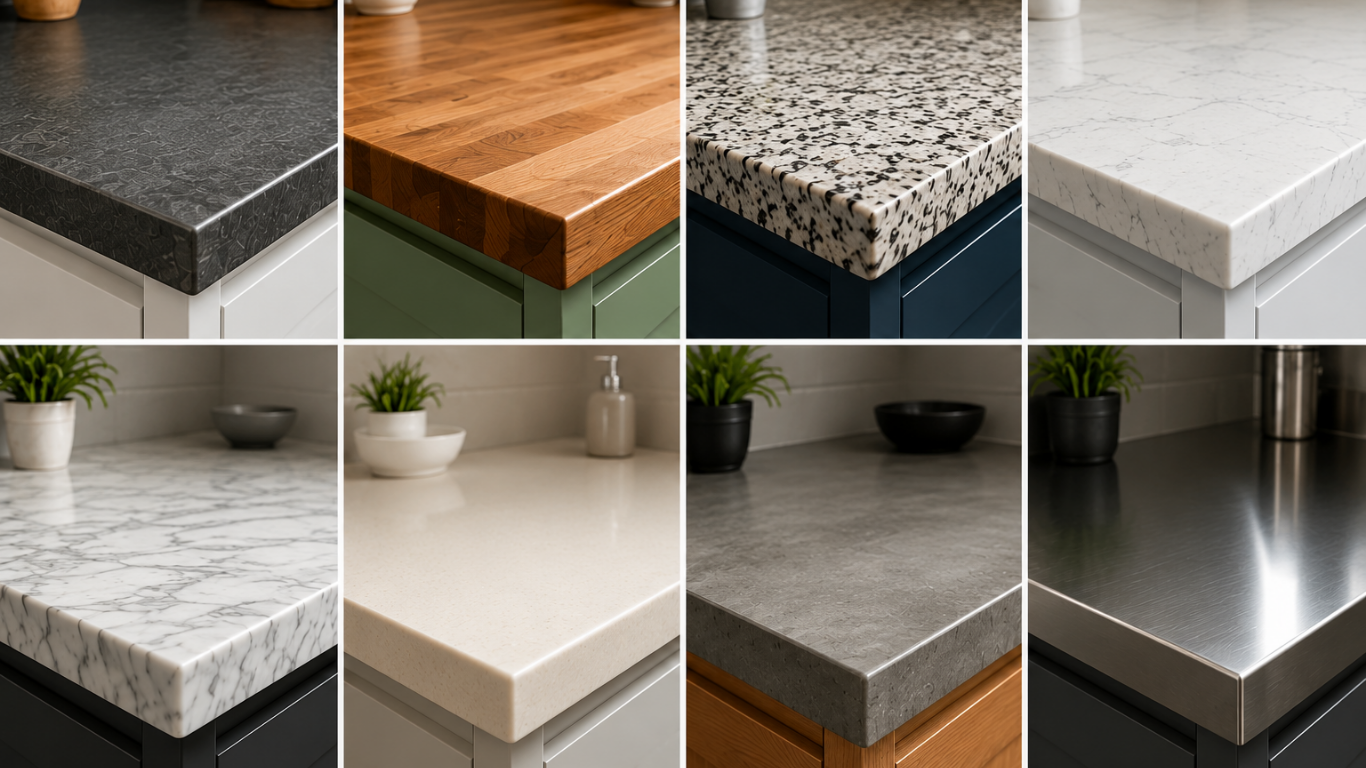

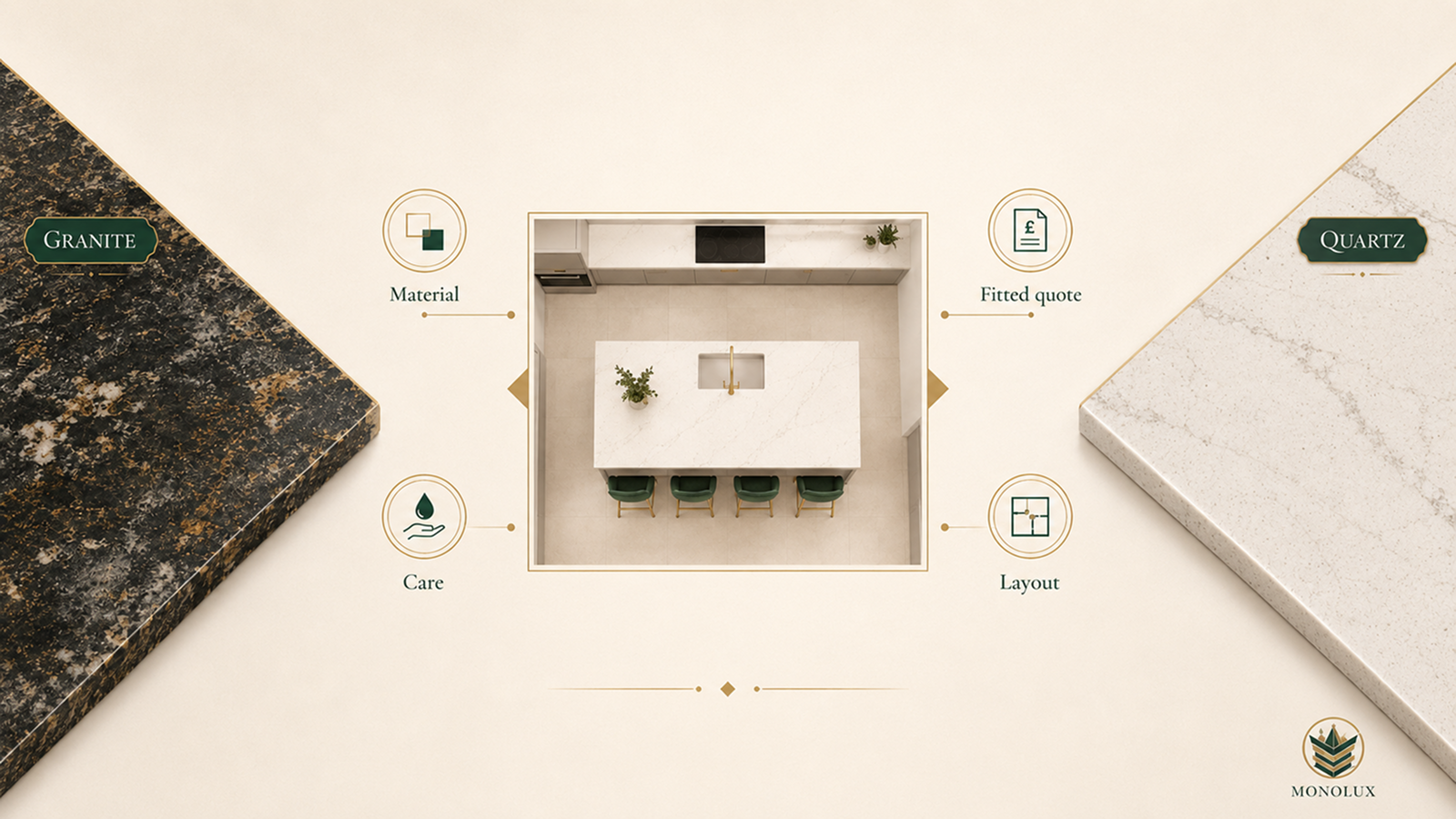
Granite and quartz are two of the most popular premium worktop choices for UK kitchens. Both can look high-end, both can last for years, and both can add a strong finish to the room. The difference is in how they are priced, fitted, maintained and used day to day.
For most homeowners, the first question is “Does granite or quartz cost more?”
Quartz is often slightly cheaper per square metre, but the final fitted quote depends on more than the material itself. Slab choice, kitchen layout, cut-outs, joins, edge details, upstands, splashbacks and access can all change the price. A simple straight run will not price the same as an L-shaped kitchen, a large island or a layout with several custom cuts.
This guide compares granite and quartz worktop prices in the UK, then looks at fitting costs, maintenance, durability, design control and quote extras so you can decide which surface makes more sense for your kitchen.
Quick Answer: Should You Choose Quartz or Granite?
For many UK kitchens, quartz is the more practical option. It is usually slightly lower on average fitted cost, does not need routine sealing and gives you more control over colour and pattern. That makes it a strong choice for busy homes, modern kitchen designs and anyone who wants a stone-look surface without extra upkeep.
Granite still has a place. It is a natural stone; every slab is different, and it handles heat very well. It can make sense if you want a one-off natural surface and are happy to keep an eye on sealing and care.
The right choice typically comes down to five things:
- Your fitted quote, not only the slab price
- How your layout uses each slab
- The number of cut-outs, joins and extras
- How much maintenance do you want later
- The final look you want across the worktops, island and splashbacks
In simple terms, quartz usually suits homeowners who want a more predictable fitted price, easier care and a consistent finish. Granite usually suits buyers who love natural variation and are comfortable with the extra care that natural stone may need.
Granite vs Quartz Worktop Prices in the UK
Worktop prices vary by supplier, stone choice, thickness, finish, region and fitting details. Still, the guide prices below give a useful starting point for comparing granite and quartz.
| Cost item | Quartz | Granite | What this means |
| Supply-only 5m run | around £800 | around £850 | Material only, before fitting |
| Fitted price per m² | around £200–£550 | around £270–£600 | A wider guide for supplied and fitted worktops |
| Average fitted price | around £375/m² | around £435/m² | Useful for early budgeting |
| Typical 4–5m kitchen | around £1,800–£3,000 | around £2,100–£3,500 | Depends heavily on layout and extras |
| Premium options | higher | higher, especially rare slabs | Unusual colours and patterns can raise the quote |
Quartz is often slightly cheaper on average, especially in standard and mid-range designs. Granite can cost more when the slab is rare, highly patterned or harder to source. That said, the cheapest granite is not always more expensive than the cheapest quartz, and a premium quartz can cost more than a standard granite.
The main point is that the material price is only part of the quote. A fitted kitchen worktop price usually includes templating, fabrication, polishing, delivery and installation. Sink cut-outs, hob cut-outs, drainer grooves, edge profiles, splashbacks and upstands can all change the final number. For a full quartz-only breakdown, see our quartz worktop budget guide.
Why Similar Worktop Prices Can Lead to Different Fitted Quotes
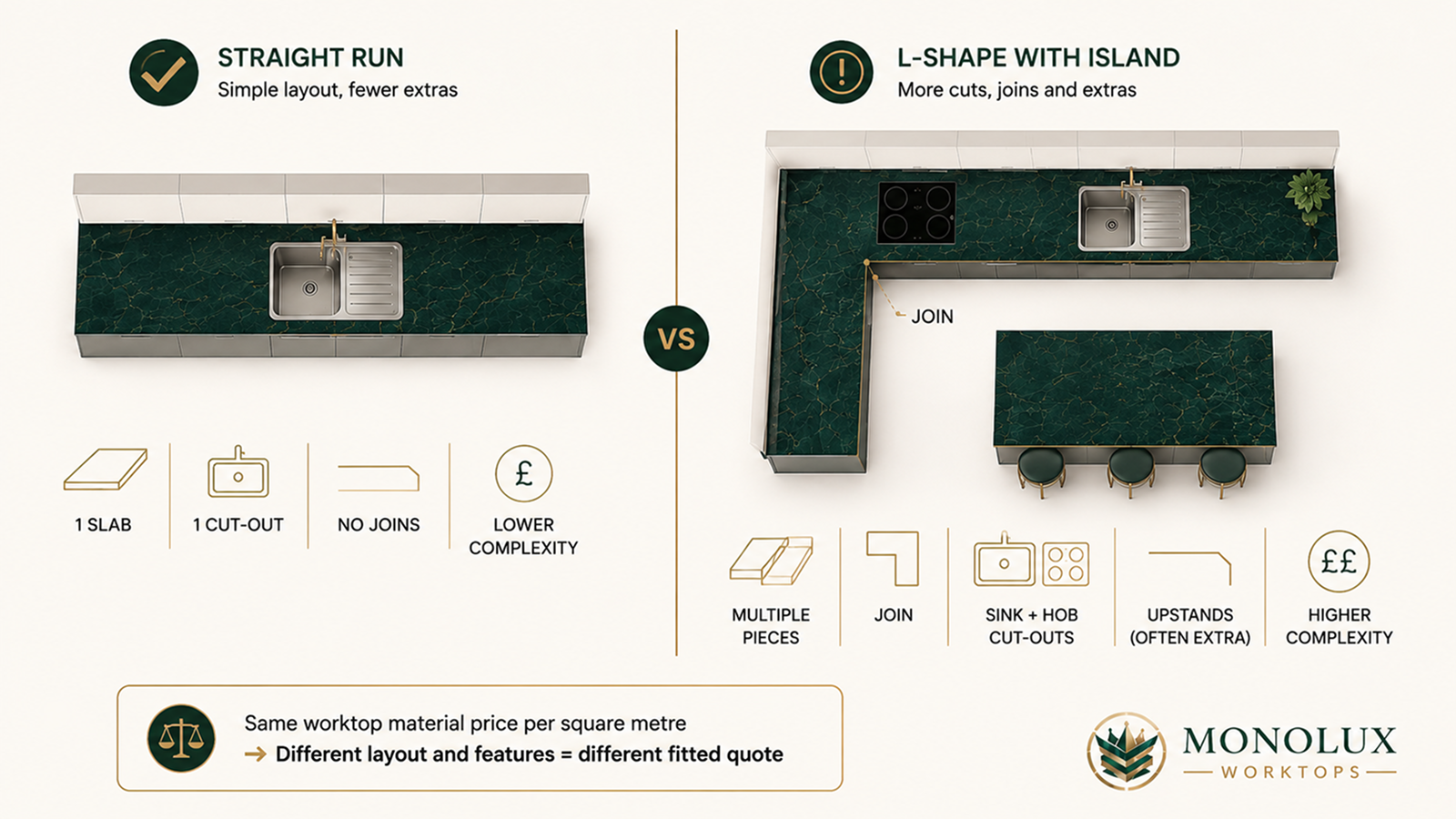
A granite slab and a quartz slab can look close in price, but the fitted kitchen quote can still come out very differently. The reason is slab use. Your supplier has to work out how the material will be cut, where the joins will go, how much waste is left, and how much fabrication is needed before the worktop can be fitted.
A straight 3m run is usually simple. The material can often be cut from one piece, with fewer joins and less handling. An L-shaped kitchen needs more planning because the corner has to be measured, cut and joined neatly. Add a large island, undermount sink, drainer grooves or full-height splashback, and the quote changes again.
This is where granite and quartz can behave differently in pricing. Granite slabs can sometimes be larger, so a certain layout may need fewer pieces. That can reduce waste in some kitchens. Quartz has a different advantage, as the colour and pattern are more consistent, which can make it easier to match worktops, islands, upstands and splashbacks across the whole room.
For example:
| Kitchen layout | Why the quote can change |
| Straight run | Usually simpler to template, cut and fit |
| L-shaped kitchen | Corner join, slab planning and pattern direction matter |
| Kitchen island | Larger pieces may need more careful slab planning |
| Undermount sink | Polished cut-out adds fabrication time |
| Full-height splashback | Adds extra material, cutting and fitting |
| Tight access flat | Delivery and handling may need more planning |
This is why two kitchens with the same amount of worktop surface can have different prices. The better comparison is not only quartz versus granite by square metre. It is how each material works with your exact layout.
How Natural Granite and Engineered Quartz Differ
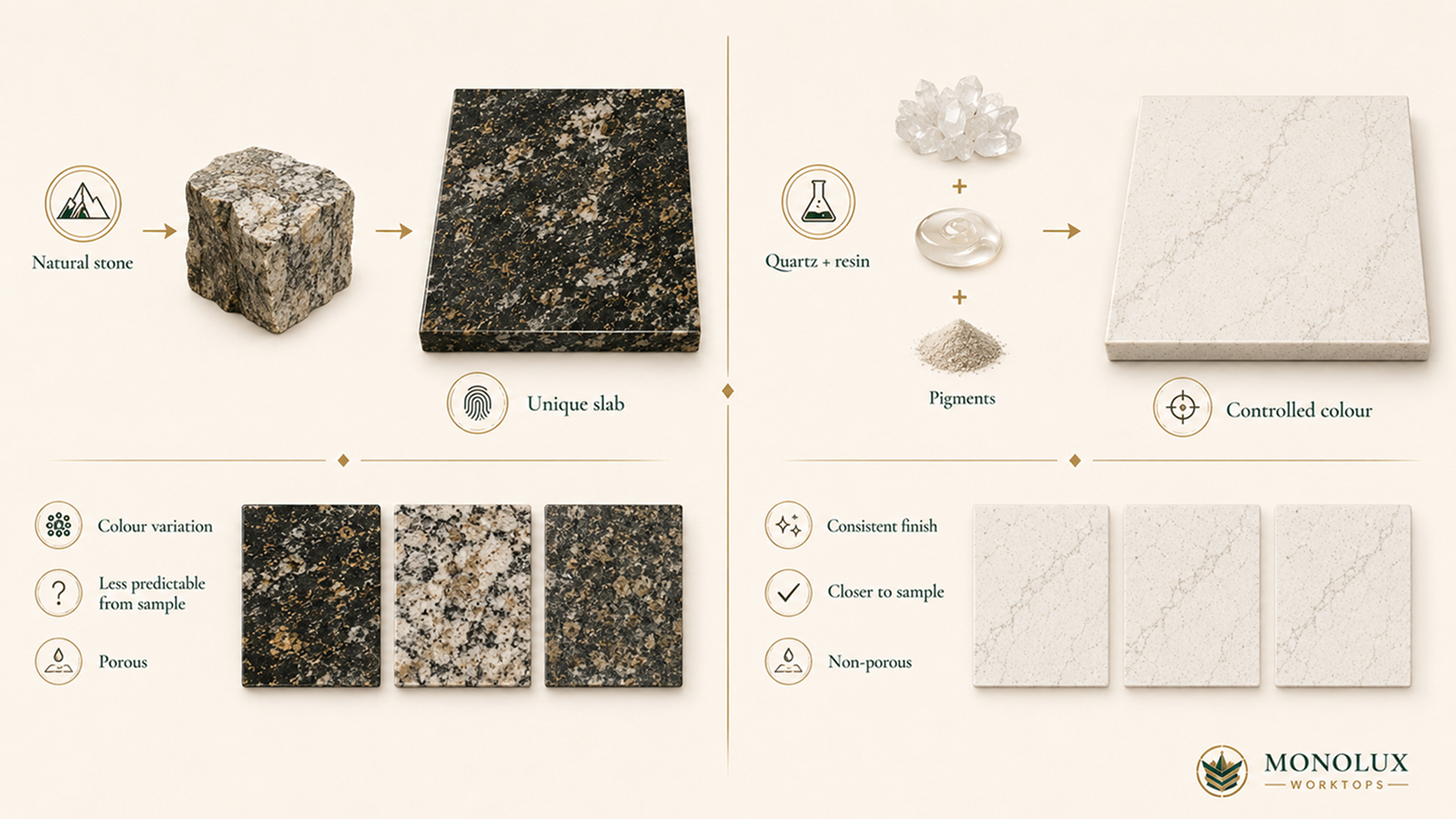
Granite and quartz are both stone worktop choices, but they are not made or controlled in the same way. That difference affects price, appearance, maintenance and how predictable the finished kitchen will look.
Granite Is a Natural Stone Slab
Granite is quarried from natural stone, cut into slabs and polished for use as a kitchen worktop. Each slab has its own mix of minerals, colours, flecks and movement, so the finished surface can feel more individual.
That natural variation is one of granite’s main appeals. It can work well in kitchens where the homeowner wants a one-off slab with visible character. The trade-off is that small samples may not show the full pattern. A slab can have darker patches, stronger movement or mineral details that are not obvious from a small piece.
This can also affect the price. More unusual granite colours, rare patterns and harder-to-source slabs usually cost more than standard granite options.
Quartz is Engineered for consistency.
Quartz worktops are made from natural quartz combined with resin and pigments, then formed into slabs. This gives the surface a more consistent colour and pattern than most natural stone.
For many kitchens, that consistency is a practical benefit. It makes it easier to match worktops with an island, upstands or splashbacks. It also helps homeowners choose from samples with more confidence because the finished surface is usually closer to the selected design.
Quartz is also non-porous, so it does not need routine sealing. That is one reason it is often chosen for busy kitchens where the worktop needs to be easy to wipe, simple to care for and visually consistent across the whole room.
Fitted Cost Comparison: Templating, Fabrication and Installation
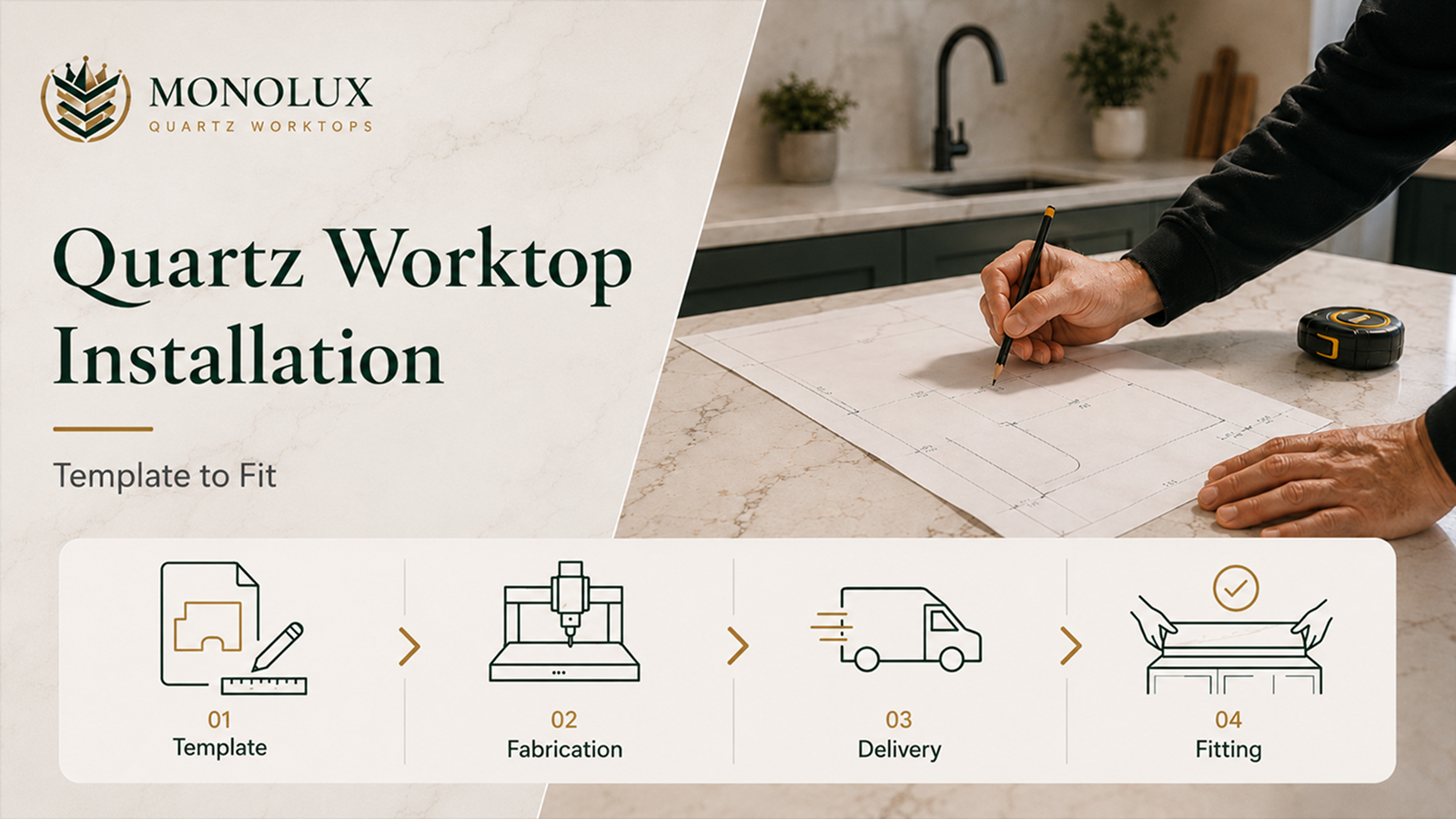
A fitted worktop quote includes more than the stone surface. For both granite and quartz, the supplier has to measure the kitchen, plan the slab cuts, polish visible edges, prepare cut-outs, deliver the pieces and fit them safely on site.
That is why a fitted price can look very different from a material-only price. A quartz slab and a granite slab may be close in cost, but the work needed around the slab can change the final quote.
The table below gives typical UK quote items to check. Treat these as guide examples, not a fixed price list.
| Quote item | Typical cost guide | Why it matters |
| Templating and fitting | often included in fitted quotes, but can be around £900+ where itemised | Covers measuring, planning and fitting |
| Extra worktop piece | around £100+ | More pieces mean more handling and fitting time |
| Hob cut-out | around £100–£180 | Needed for most fitted kitchens |
| Sink cut-out | around £70–£150 | Price depends on sink type |
| Polished undermount sink cut-out | around £150–£205+ | The visible edge needs polishing |
| Tap hole | around £20–£40 | Small cost, but should still be listed |
| Drainer grooves | around £150–£165+ | Adds fabrication time |
| Rounded corners | from around £15–£50+ | Depends on the shape and finish |
| Upstands | usually priced separately | Adds material, cutting and fitting |
| Full-height splashback | can add hundreds | Uses much more stone than an upstand |
Before comparing granite and quartz quotes, check that both quotes include the same work. One quote may include templating, cut-outs and fitting, while another may show a lower headline price but charge extras later.
Maintenance Costs: Sealing, Cleaning and Long-Term Care
The first quote is only one part of the cost comparison. Granite and quartz also differ in how much care they need after installation.
Quartz does not need routine sealing. For most kitchens, that means no extra sealing appointments and no repeat sealing costs to plan for. You still need sensible daily care, but the worktop itself is non-porous, so spills are easier to manage.
Granite is different. It is a natural porous stone, so it usually needs sealing to help protect it from oil, wine, coffee, sauces and watermarks. Some homeowners use DIY stone sealers, while others pay for professional resealing.
Over a longer period, like 10 years, that can add roughly £400–£600, depending on the surface, use and resealing approach.
| Maintenance item | Quartz | Granite |
| Sealing and resealing | No routine sealing cost in normal use | Usually needs seal checks, with resealing adding roughly £400–£600 over 10 years |
| Daily cleaning | Soft cloth and mild cleaner | Soft cloth and mild cleaner |
| Spill resistance | Strong because the surface is non-porous | Good if properly sealed |
| Risk from oil, wine and coffee | Lower with normal care | Higher if the seal is weak |
| Heat habits | Use trivets for hot pans and trays | More heat-tolerant, but care is still sensible |
| Long-term effort | Lower | More regular checking |
For a busy kitchen, quartz is usually the easier option. It suits homes where the worktop has to deal with cooking, packed lunches, drinks, children using the island and everyday spills without adding another maintenance job to the list.
Durability and Repair Risk: Which Surface Suits Daily Use?
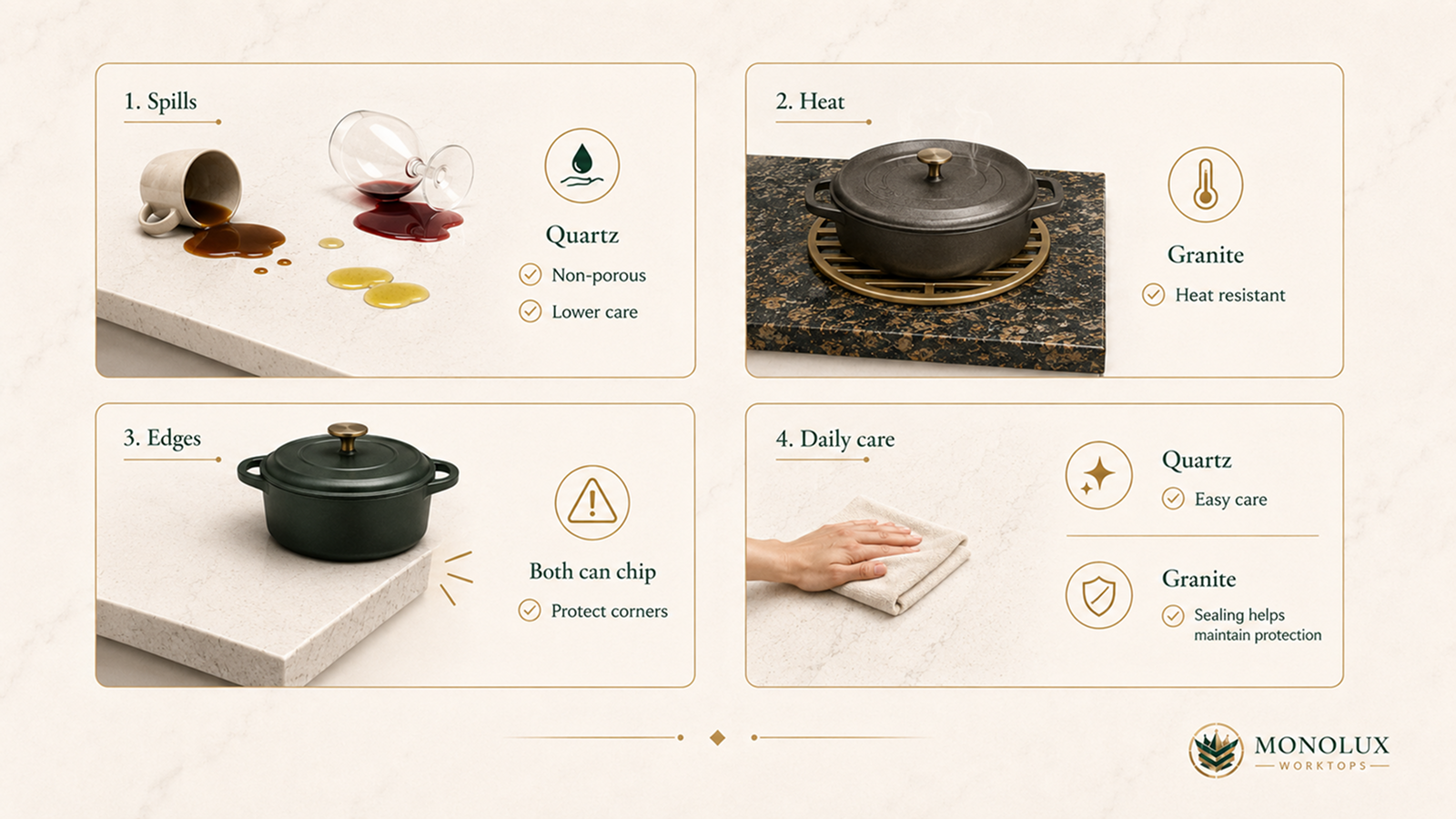
Quartz and granite are both durable enough for normal kitchen use, but they handle different risks in different ways. The best choice depends on how the kitchen is used, not only how hard the surface feels.
Heat and Hot Pans
Granite has a stronger heat performance. It is a natural stone and can handle heat better than quartz in most kitchens.
Quartz is durable, but direct high heat can damage the resin content. Hot pans, oven trays and heated appliances should sit on a trivet or heat mat. This does not make quartz fragile, but it does mean heat habits matter.
Stains and Spills
Quartz usually has the advantage for stains because it is non-porous. Coffee, wine, oil and sauces are less likely to soak into the surface, especially if they are wiped up soon after use.
Granite can also perform well, but it depends more on sealing. If the seal is weak, old or uneven, spills can become more of a problem.
Chips, Cracks, and Repairs
Both materials can chip if a heavy object hits an exposed edge. Corners, sink edges, island overhangs and thin exposed sections need the most care.
Small chips can sometimes be repaired, but the result is not always invisible. Plain or subtle quartz can be easier to disguise than a complex pattern, while granite repairs have to work around natural movement and mineral variation.
Design Choice: Natural Character or a More Controlled Finish?
Granite and quartz can both look premium, but they create a different kind of kitchen finish. Granite gives you natural variation. Quartz gives you more control over colour, pattern and matching.
| Design priority | Better fit | Why |
| One-off natural stone | Granite | Every slab has its own movement, flecks and mineral pattern |
| Predictable colour | Quartz | The surface is engineered, so samples are usually closer to the finished result |
| Matching an island with worktop runs | Quartz | Consistent patterning makes the full kitchen easier to coordinate |
| Dramatic natural movement | Granite | Some slabs have bold natural veining and mineral variation |
| Marble-look surfaces | Quartz | Marble-effect quartz gives a similar look with lower routine care |
| Subtle modern finishes | Quartz | Plain, veined, sparkle and stone-effect options are easier to control |
| Traditional or farmhouse kitchens | Granite or quartz | Granite adds natural character, while softer quartz designs can keep the room brighter |
| Smaller kitchens | Quartz | Lighter and more consistent designs can stop the worktop from feeling too busy |
The better design choice for your taste depends on how much control you want over the finished kitchen.
Choose granite if you want the worktop to feel natural, individual and less predictable from slab to slab.
Choose quartz if you want the colour, veining and finish to be easier to match across worktop runs, islands, upstands and splashbacks.
Quartz is also a good option if you like the look of marble but want something easier to look after day-to-day, which you can read more about in our marble-effect quartz vs real marble guide.
Which Gives Better Value for a £3,000 Kitchen Worktop Budget?
A £3,000 budget can cover many medium quartz worktop projects in the UK, but it depends on how the quote is built. It can also cover some granite projects, though there is usually less room for premium slabs, polished sink details or large splashbacks.
The examples below are not fixed-price promises. They show how a typical worktop budget can be used once material, fabrication, fitting and common extras are included.
Scenario 1: Medium Kitchen with Standard Quartz
This is often the strongest use of a £3,000 budget, which includes a practical quartz choice, a standard edge, one hob cut-out, one sink cut-out and upstands rather than a full-height splashback.
| Quote item | Example allowance |
| Quartz material and fabrication | £1,250–£1,650 |
| Templating, delivery and fitting | £650–£900 |
| Hob cut-out | £70–£150 |
| Standard sink cut-out | £70–£150 |
| Tap hole | £20–£40 |
| Upstands | £250–£450 |
| Estimated total | £2,310–£3,340 |
This kind of quote can sit around £3,000 if the homeowner chooses a standard or mid-range quartz and keeps the layout fairly simple. If the quote starts to climb, the easiest places to control cost are usually the slab choice, splashback height and sink detail.
Scenario 2: Medium Kitchen with Standard Granite
A standard granite can also work within a £3,000 budget, but the quote has less room to stretch. The slab choice matters more because rare colours and stronger natural movement can raise the price quickly.
| Quote item | Example allowance |
| Granite material and fabrication | £1,500–£2,000 |
| Templating, delivery and fitting | £700–£1,000 |
| Hob cut-out | £70–£150 |
| Standard sink cut-out | £70–£150 |
| Tap hole | £20–£40 |
| Upstands | £250–£500 |
| Initial sealing or aftercare allowance | £150–£300 or £150–£300 (if not included) |
| Estimated total | £2,610–£3,990 |
Granite can come out close to £3,000 if the layout is simple and the stone is a standard option. The budget is more likely to be pushed over if the homeowner chooses a rarer slab, adds more stone pieces, or needs extra finishing.
Scenario 3: Quartz with Upgraded Sink and Splashback Details
A quartz quote can move above £3,000 if more design features are added. The worktop material may still be affordable, but extra fabrication and extra stone can change the total.
| Quote item | Example allowance |
| Quartz material and fabrication | £1,500–£2,000 |
| Templating, delivery and fitting | £700–£950 |
| Hob cut-out | £70–£150 |
| Polished undermount sink cut-out | £150–£205+ |
| Tap hole | £20–£40 |
| Drainer grooves | £100–£200 |
| Full-height splashback or larger stone splash area | £500–£1,000+ |
| Estimated total | £3,040–£4,545+ |
This is where a £3,000 quartz budget becomes tight. The upgrade is not only the quartz itself. It is the polished sink opening, drainer grooves and extra splashback material. If the budget needs to stay near £3,000, an upstand is usually more cost-friendly than a full-height quartz splashback.
Scenario 4: Granite with a Rarer Slab or More Complex Layout
Granite can become expensive quickly if the chosen slab is rarer, the layout needs more pieces, or the kitchen includes an island, an undermount sink or extra splashback work.
| Quote item | Example allowance |
| Granite material and fabrication | £2,000–£2,700+ |
| Templating, delivery and fitting | £800–£1,100 |
| Hob cut-out | £70–£150 |
| Polished undermount sink cut-out | £150–£205+ |
| Tap hole | £20–£40 |
| Upstands or splashback allowance | £300–£900+ |
| Initial sealing or aftercare allowance | £0–£150 or £150–£300 (if not included) |
| Estimated total | £3,340–£5,245+ |
This is where granite usually moves beyond a £3,000 budget. The natural slab may be beautiful, but the combination of rarer material, extra stone and more fabrication can raise the final quote.
Which Worktop Is Better for L-Shaped Kitchens, Islands and Custom Cuts?
Layout can change the quote as much as the material. The main issue is how efficiently each slab can be cut, where joins sit and how visible the finished pieces will be.
| Layout detail | Quartz advantage | Granite advantage |
| L-shaped kitchens | More consistent patterning can make joins easier to plan visually | Larger slabs can sometimes reduce waste if the layout suits the stone |
| Islands | Easier to match with perimeter worktops, upstands and splashbacks | Natural variation can make the island feel like a one-off feature |
| Undermount sinks | Consistent colour helps polished cut-outs look controlled | Works well, but natural movement can make cut-out areas less predictable |
| Custom cuts | Good for coordinated designs with taps, hobs, sockets and curves | Can work well, but slab movement and waste need careful planning |
For simple layouts, quartz and granite can both work well. For kitchens with several joins, an island or matching splashbacks, quartz often gives more control over the final look. Granite can still be a decent choice if the slab size, pattern and layout line up well.
Choose Quartz if / Choose Granite if
The better value choice depends on how you want the kitchen to look and how much care you want to put into the surface later.
| Choose quartz if… | Choose granite if… |
| You want lower routine care | You want natural stone character |
| You do not want routine sealing | You are happy to keep up with sealing checks |
| You want a more predictable finish | You like natural variation from slab to slab |
| You want the island, upstands and worktops to match closely | You want the worktop to feel more individual |
| You have a busy family kitchen | You cook heavily, and heat resistance matters most |
| You are working with a tighter budget | You have room for a rarer stone or extra care |
Before choosing, compare fitted quotes rather than slab prices alone. Check that templating, fitting, cut-outs, joins, upstands and VAT are included. For a fuller breakdown of quartz extras, read our quartz worktop hidden costs article.
Choosing Quartz? Get the Worktop You Want for Less With MonoLux
If quartz feels like the right choice, MonoLux is one of the best and most affordable places to buy a quartz worktop in the UK.
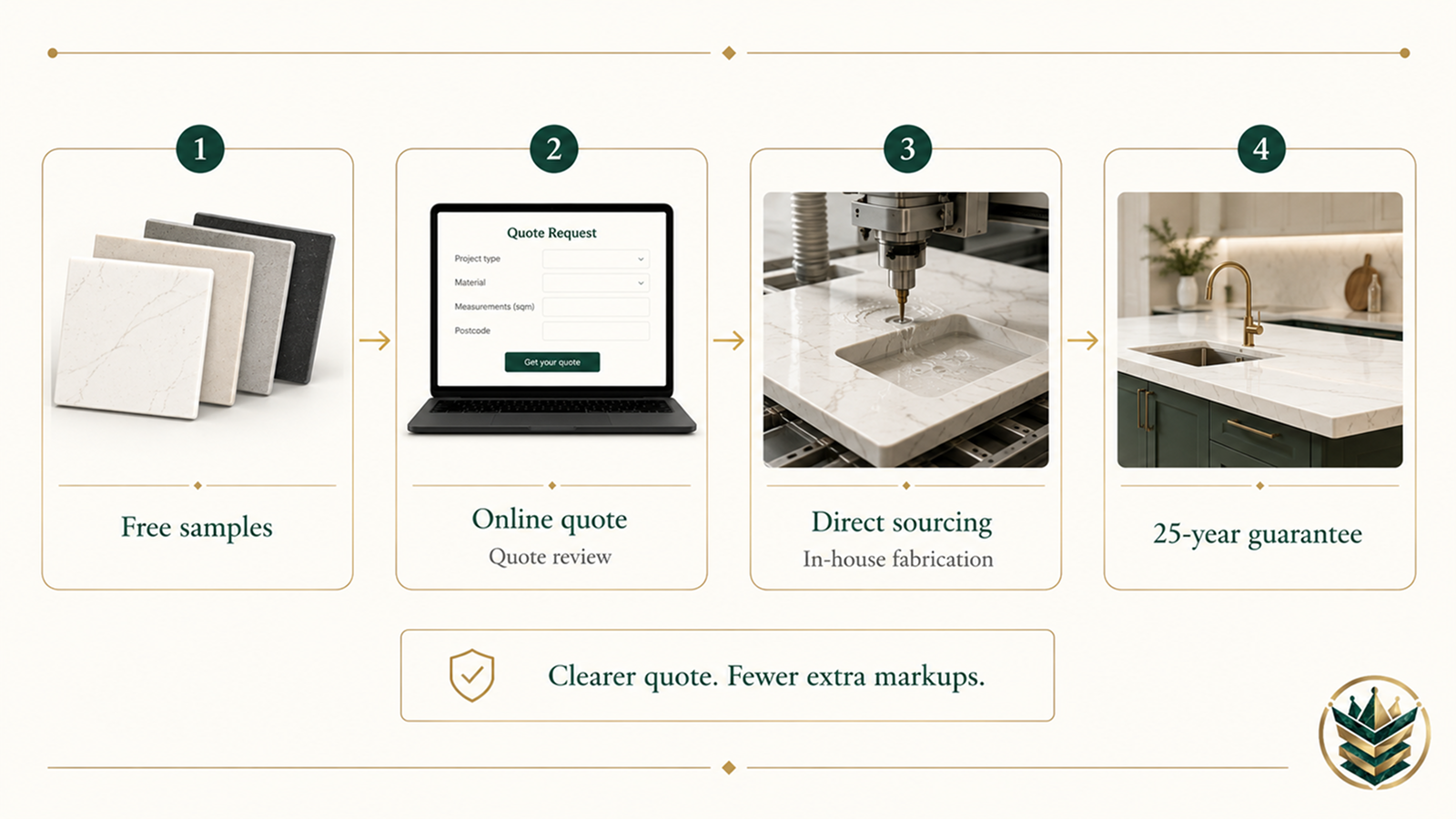
With MonoLux, you can:
- Compare quartz worktops from £89/sqm
- Order free samples before choosing
- Use our online quote tool for a quick starting estimate
- Get your quote reviewed by our team in under 2 hours
- Visit our showroom and warehouse to view slabs in person
- Benefit from direct slab sourcing and in-house CNC fabrication
- Get support with cut-outs, edges, upstands and splashbacks
- Receive a 25-year quality guarantee
- Get a one-week rapid fix pledge for installation or product-quality issues
Our pricing stays competitive because we source slabs directly and handle fabrication in-house, which helps reduce extra markups and keeps the quote easier to understand. That’s why Frederick, one of our customers who initially wanted granite, ended up happier choosing one of our quartz worktops
How we helped Frederick choose the right worktop material:
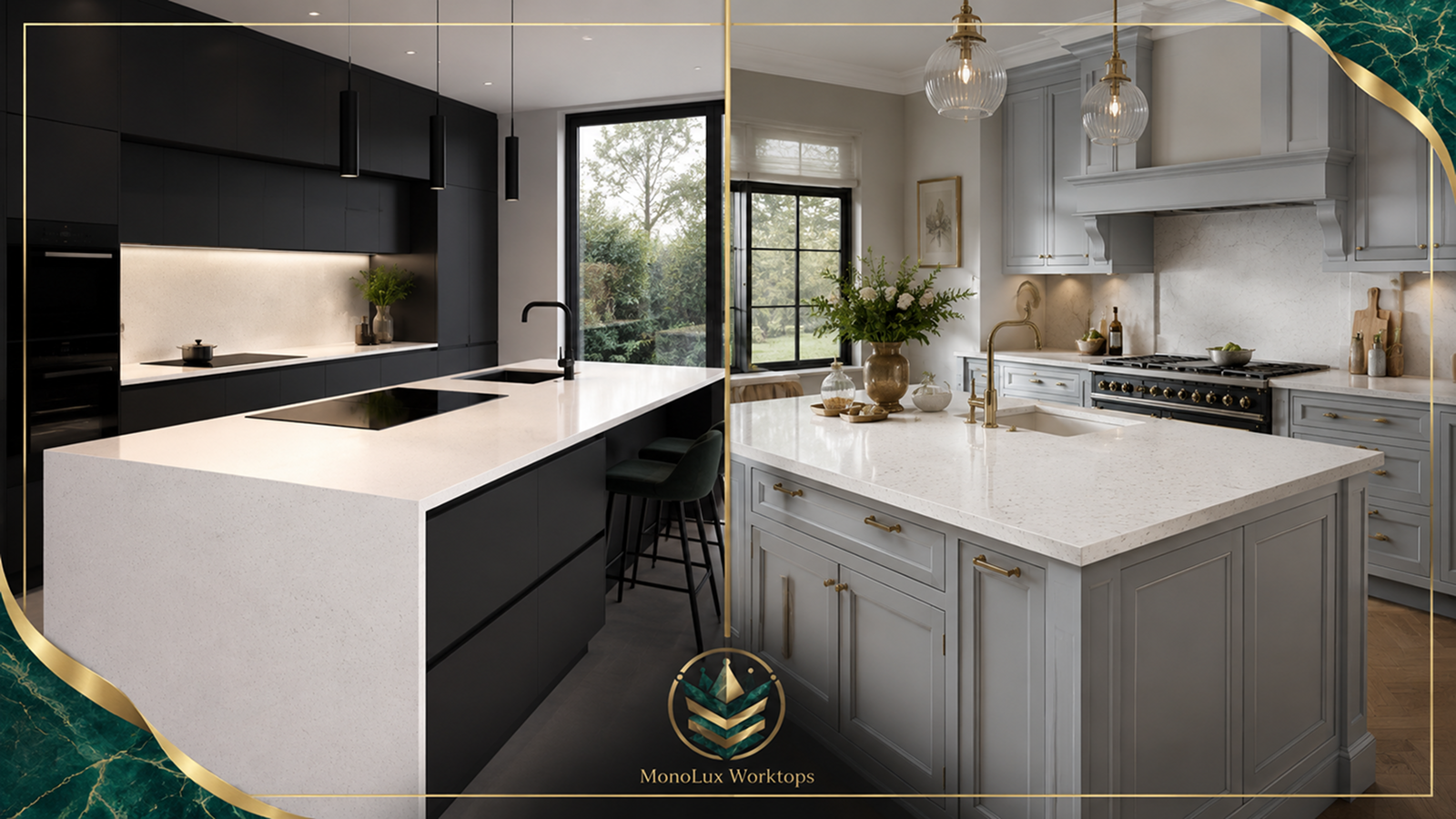
Frederick first asked us about granite for his St Albans kitchen, but after looking at the layout, grey shaker cabinets and how the space would be used day to day, we recommended Mono Capri White quartz instead.
The lighter quartz gave the kitchen a brighter finish, worked neatly around the central pillar and kept the final result practical for daily use. You can read Frederick’s story and see the finished kitchen here: Frederick Fairfax’s St Albans kitchen.
Start with our online quote tool or browse our quartz worktops page to compare colours, finishes, and prices and order free samples.
FAQs
- Is granite cheaper than quartz in the UK?
Not always. Quartz is often slightly lower on average per square metre, but standard granite can still be competitively priced. Rare granite, complex layouts and extra finishing can push granite higher. - Which is better value, granite or quartz?
Quartz often gives better everyday value because it needs less routine care, does not need sealing and offers a more predictable finish. Granite suits buyers who want natural stone character and accept extra upkeep. - Does quartz cost more to install than granite?
Not usually by material alone. Installation cost depends more on layout, cut-outs, joins, edge profiles, access and splashbacks. A simple granite job can cost less than a complex quartz job, and vice versa. - Does granite need sealing?
Granite usually needs sealing because it is a porous natural stone. Sealing helps protect against oil, wine, coffee and sauces. Quartz does not need routine sealing. - Is quartz easier to maintain than granite?
Quartz is usually easier to maintain because it is non-porous and does not need routine sealing. Granite is still manageable, but it needs more attention around sealing and suitable cleaning products. - Which lasts longer, granite or quartz?
Both can last for many years with proper fitting and sensible care. Granite is known for natural durability, while quartz is hard-wearing and practical. The bigger difference is care level, not lifespan alone. - Which is better for a busy family kitchen?
Quartz is usually better for a busy family kitchen because it handles spills well, wipes easily and does not need sealing. Granite can work too, but it asks for more care over time. - Which worktop looks more expensive?
Both can look premium. Granite has natural depth and one-off variation. Quartz can look refined and consistent, especially in marble-effect, white, black and subtly veined designs. The best choice depends on the kitchen style. - Can quartz look like granite or marble?
Yes. Quartz comes in granite-style, marble-effect style, sparkle, plain and stone-effect designs. It will not be a natural one-off slab, but it can give a similar look with easier routine care. - Should I choose granite or quartz for a kitchen island?
Choose granite if you want a natural feature slab. Choose quartz if you want better control over colour, veining and matching with the rest of the kitchen. Add cut-outs to the fitted quote.