
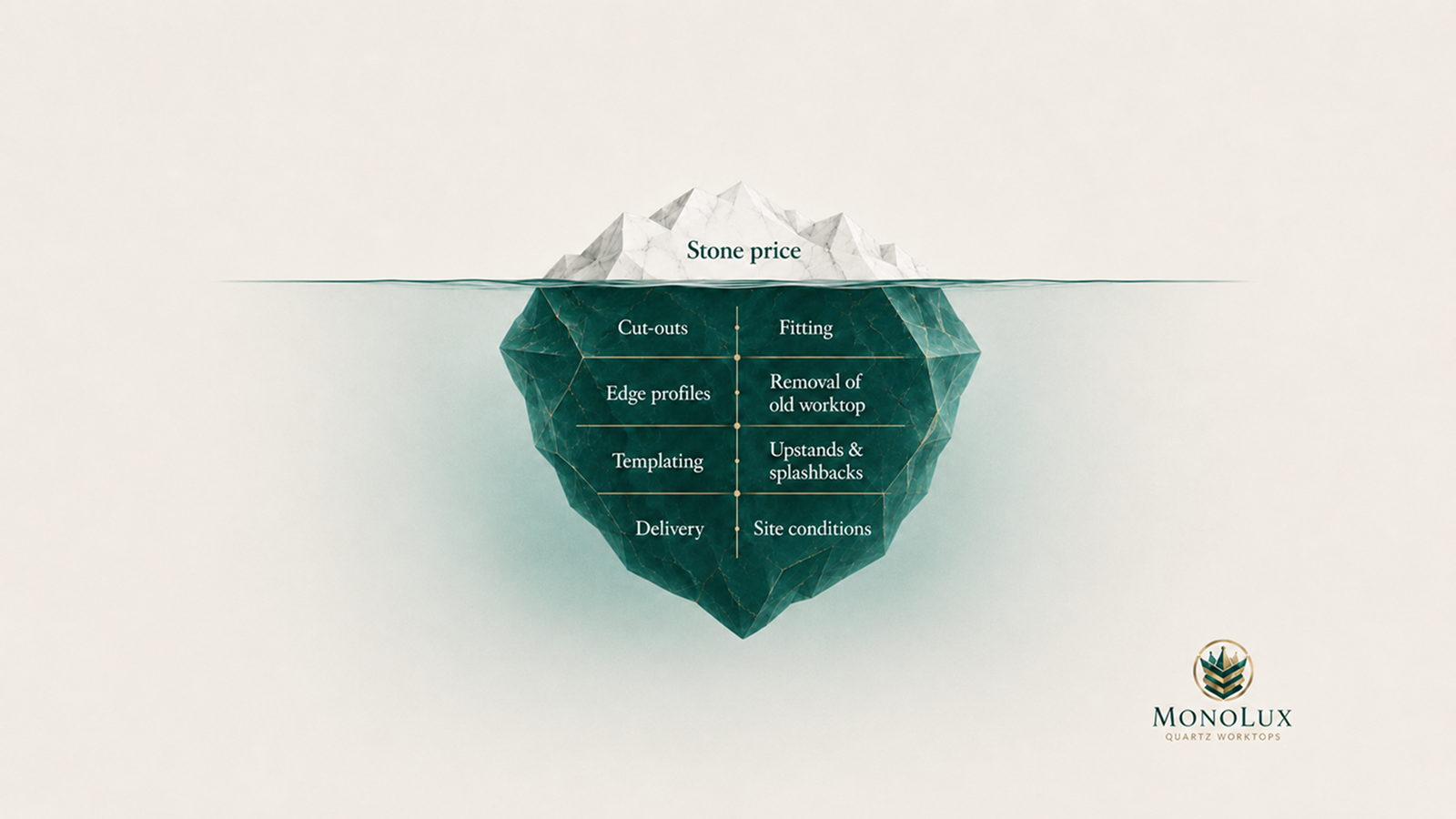
Most quartz worktop quotes start with a material price. While checking the quartz worktop price is a good starting point, it is not the same as the cost of a fully fitted kitchen worktop. By the time the quote includes sink and hob cut-outs, tap holes, edge finish, upstands, splashbacks, templating, delivery, fitting and sometimes old-worktop removal, two quotes that looked similar at first can end up far apart.
This is where many buyers get caught. One supplier may include templating and fitting from the start. Another may show a lower square-metre price, then add fabrication and site details later. On paper, the cheaper quote can look better. In practice, it may only be cheaper because it has not included the full job yet.
This guide breaks down the hidden costs of quartz kitchen worktops so you can read quotes more carefully before committing. It also explains which extras are normal, which ones depend on your kitchen layout, and which questions to ask before comparing one supplier against another.
Quick Checklist: Quartz Worktop Extras to Check Before You Compare Quotes
Before you judge one quartz worktop quote against another, check what is actually included. A low material price can still become a higher fitted price once the workshop and installation details are added.
The main extras to look for are:
- Sink cut-outs: Especially if you want an undermount sink, as the exposed stone edge usually needs polishing.
- Hob cut-outs: Standard hob openings may be priced separately from the quartz material.
- Tap holes and socket cut-outs: Small details, but they still need accurate drilling.
- Drainer grooves: Useful beside the sink, but they take extra workshop time.
- Edge profiles: A simple edge may be included, while ogee, shark nose, bullnose or other shaped edges can add cost.
- 20 mm or 30 mm thickness: Thicker quartz usually changes the material cost, weight and handling.
- Templating: The visit where the final measurements are taken before the slab is cut.
- Delivery and fitting: Heavy quartz needs careful transport and proper installation.
- Old worktop removal: Some quotes include it, some treat it as a separate job.
- Upstands and splashbacks: These use extra quartz and add more cutting and fitting.
- Joins and extra slab use: Larger layouts, islands and awkward corners can increase waste or require another slab.
- Cabinet levelling or support work: Older units may need adjustment before quartz can be fitted safely.
A good quote should not leave you guessing about these items. It should show what is included, what counts as an extra, and which parts may still change after templating.
Why the Lowest Quote Is Not Always the Cheapest
Some quartz quotes are built in stages. The first number may cover the slab and basic cutting. The rest is added once the supplier has your kitchen plan, sink type, hob position, edge choice and fitting details.
It also helps to check how the price has been shown. Some suppliers talk about price per square metre, which refers to the surface area of the quartz. Others use price per metre, which can mean a standard-depth run of worktop. Those two figures are hard to compare unless the depth, thickness and fitting details match.
A lower starting figure can be useful, but only if you know what has been included so far. Before choosing the lower price, ask both suppliers for the same breakdown. You want to know what has been priced now, what will be added after templating, and what is outside the quote.
We cover the difference between price per metre and price per square metre in more detail in our guide to quartz worktop costs in the UK, along with material-only vs fitted prices, kitchen-size examples, quote factors and ways to keep the final cost under control. Here, we are focusing on the smaller line items that can push a quote up after the first estimate.
Sink, Hob and Tap Cut-Out Charges
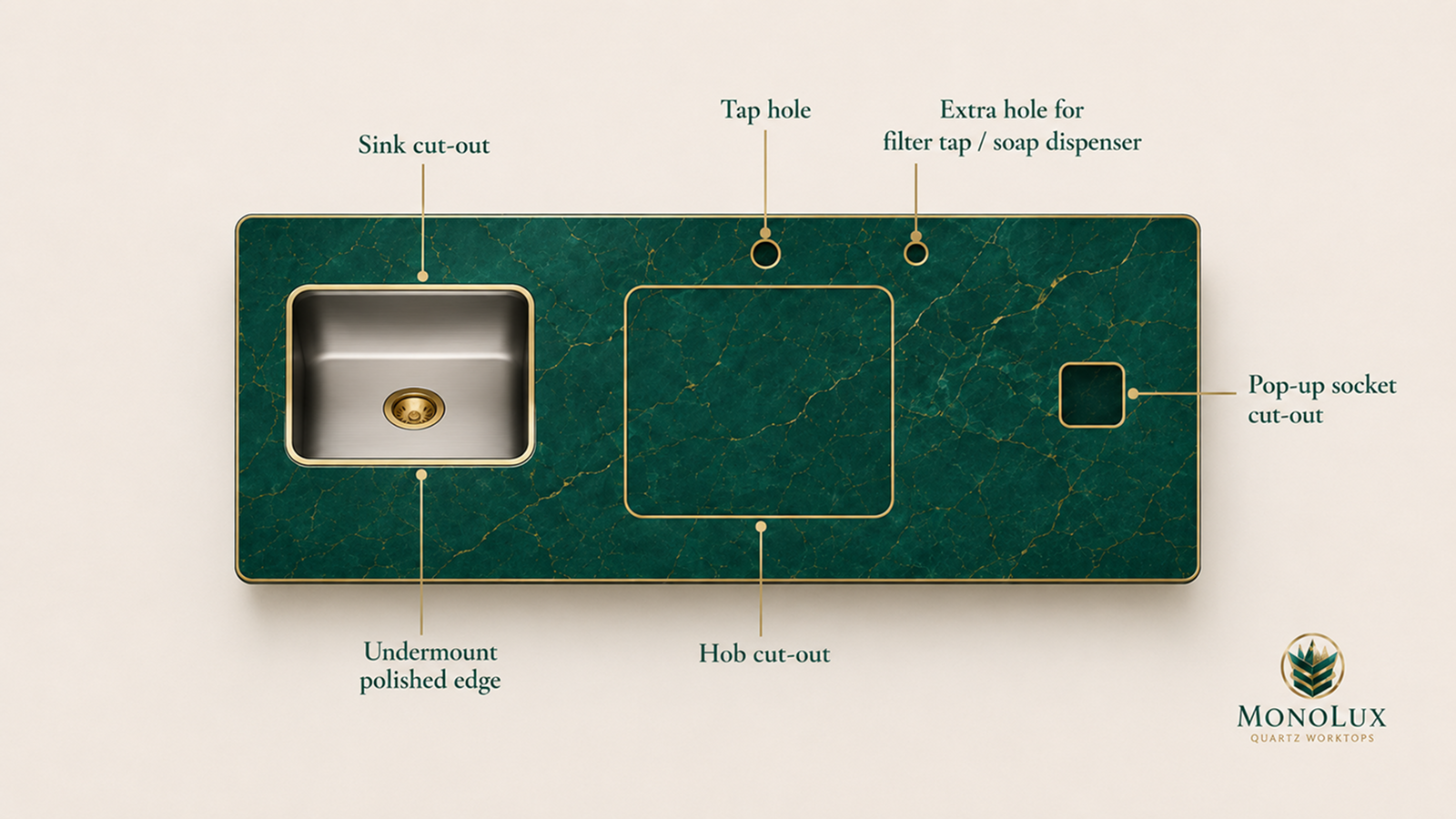
Cut-outs are one of the first extras to check on a quartz worktop quote. The slab has to be cut for the sink, hob and tap before it can be fitted, and those cuts are usually priced as fabrication work rather than material.
The sink type is rather important here. A top-mounted sink sits over the cut edge, so the opening does not need the same visible finish. An undermount sink leaves the inside edge of the quartz exposed, which means that edge has to be cut neatly and polished properly.
Hob cut-outs are similar. The opening has to match the appliance size, and the quartz needs enough support around it so the worktop does not become weak around a narrow strip of stone.
Tap holes and socket cut-outs can sound minor, but they should still be listed. They need accurate drilling, especially if the tap, filter tap, soap dispenser, or pop-up socket has already been chosen.
Before approving a quote, check:
- How many sink, hob and tap cut-outs are included
- If undermount sink polishing is included
- If extra holes for filter taps, waste switches or sockets cost more
- If appliance templates are needed before fabrication
A quote that includes one standard sink and hob opening may not cover every hole your final kitchen needs.
Drainer Grooves and Other Sink-Area Details
Drainer grooves are easy to miss in a quartz worktop quote because they feel like part of the sink area. In practice, they are extra fabrication work.
They are cut into the quartz beside the sink, usually at a slight fall so water can run back towards the bowl. The grooves also need to be finished neatly, because they sit on one of the most visible and used parts of the worktop.
They make the most sense with an undermount sink, where the whole sink area is meant to look built-in. In a kitchen with a top-mounted sink, a separate draining tray, or a dishwasher doing most of the work, they may not be worth the extra cost.
Before adding them, check how many grooves are included, where they will sit, and how much counter space they will take up. In a small kitchen, the space beside the sink can be more useful if left flat.
Edge Profiles and Finished Edges
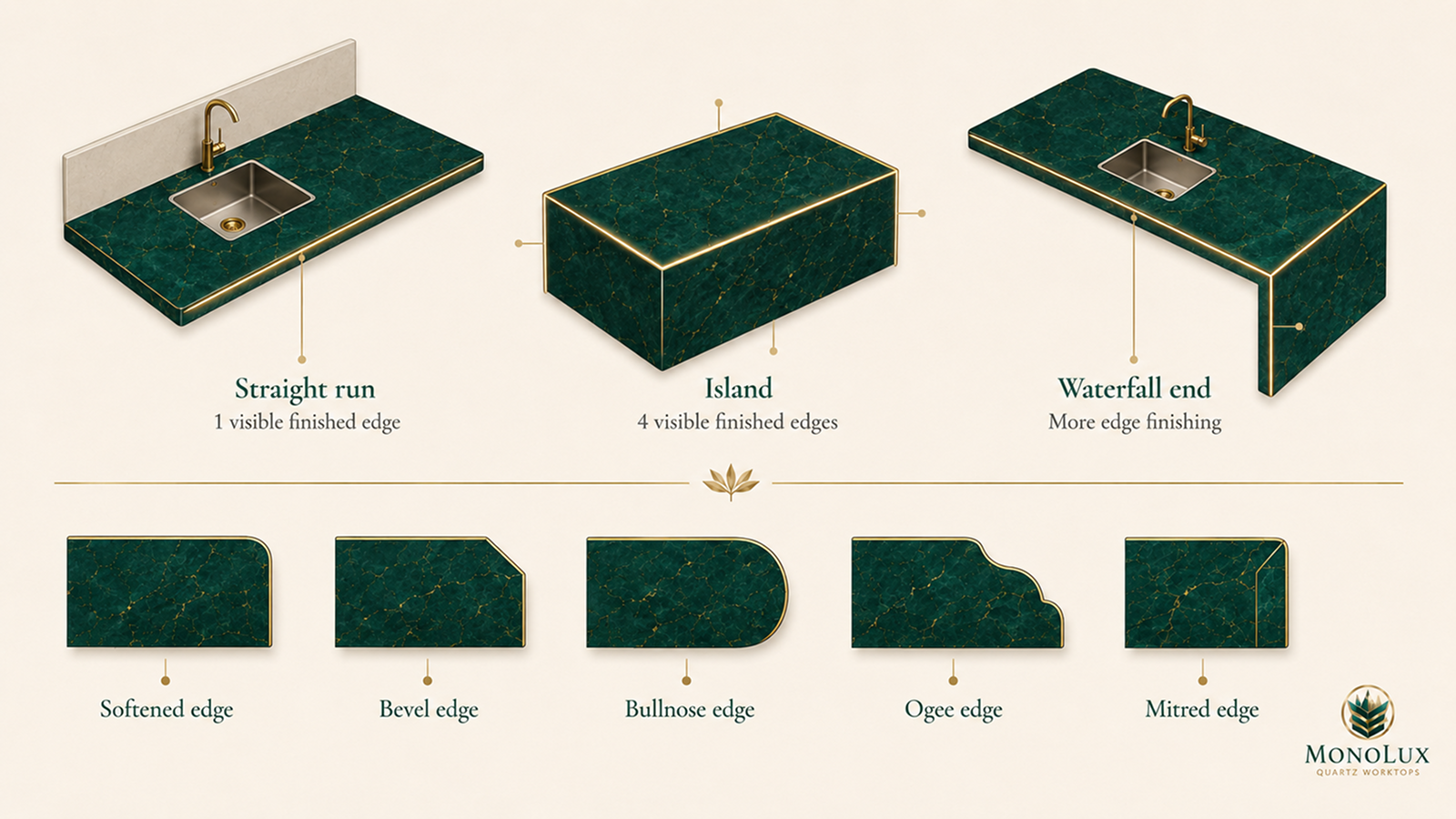
The edge profile is the shape given to the visible side of the quartz. A simple, softened edge is usually the easiest option to price, and it suits most modern kitchens. More shaped edges, such as bullnose, bevel, ogee, shark nose or mitred edges, take more fabrication time and can add to the quote.
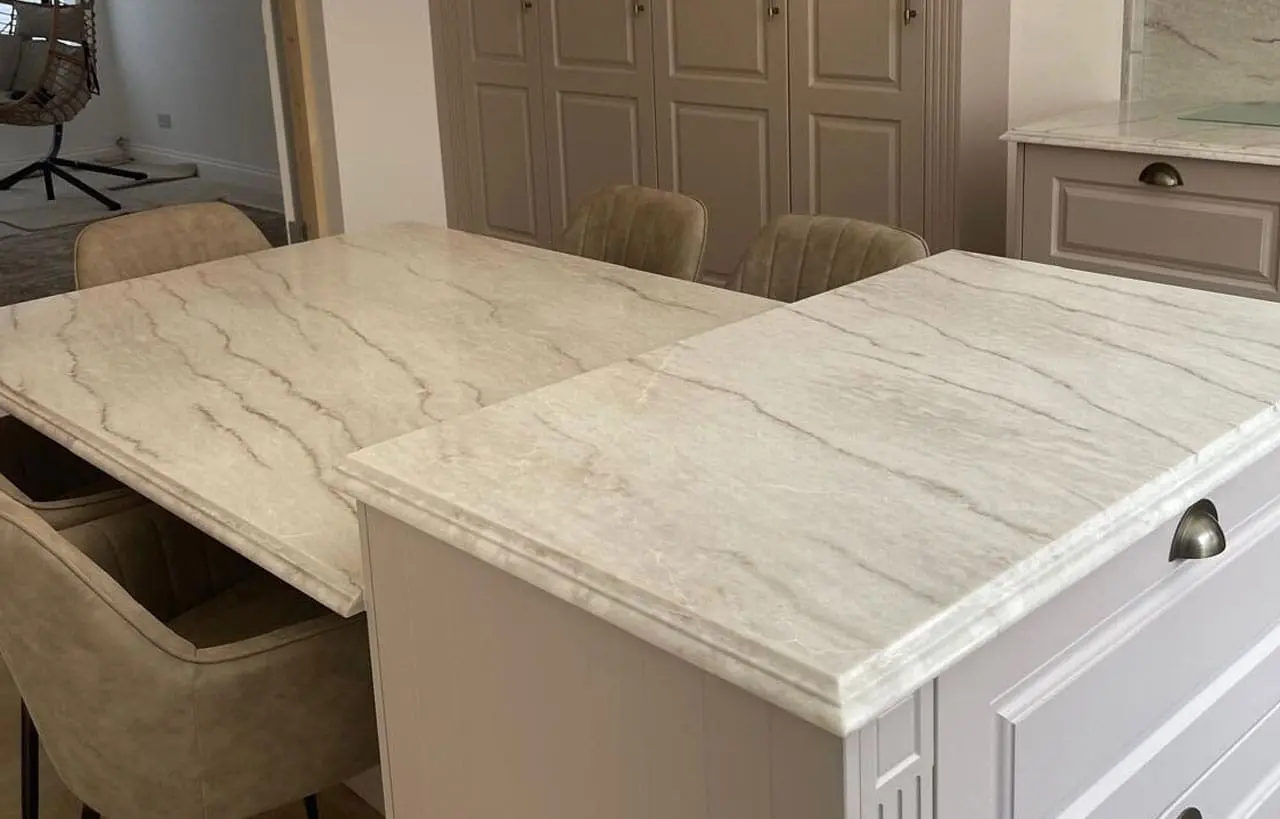
The amount of visible edge also affects the price. A straight run against a wall may only need the front edge polished. An island can need all four sides finished. A breakfast bar, overhang, waterfall end or exposed side panel can add more edge work than the surface area suggests.
That is why an island can raise the fabrication cost even if it does not look especially large on paper. More of the quartz is on show, so more of it has to be shaped and polished.
To keep the quote sensible, choose the edge profile after you know which sides will actually be visible. In many kitchens, a simple softened edge gives the worktop a finished look without making the fabrication more complicated.
20 mm vs 30 mm Quartz Thickness
Thickness can change the quote before you add sink cut-outs, grooves or edge upgrades. A 30 mm quartz worktop uses more material than a 20 mm one, so it usually costs more and is heavier to move and fit.
The choice is partly about appearance. A 30 mm surface has a heavier, more solid look, which can suit larger kitchens, islands and traditional layouts. A 20 mm surface can look sharper and more modern, especially with flat cabinets, handleless doors or a simpler kitchen design.
The extra thickness does not automatically mean the kitchen will work better day to day. For many homes, 20 mm quartz is more than enough. The bigger difference is often visual, so the extra cost is mainly for the thicker profile, added material and handling.
| 20 mm quartz | 30 mm quartz |
| Usually lower cost | Usually higher cost |
| Slimmer profile | Thicker profile |
| Lighter to handle | Heavier to handle |
| Modern look | More solid look |
| Good for many kitchens | Popular for islands |
Ask for both prices before deciding. If the 30 mm version pushes the quote too high, 20 mm may let you keep the quartz colour you want without cutting back on more practical parts of the kitchen, such as the sink, upstands or fitting quality.
For a fuller breakdown, read our guide to 20 mm vs 30 mm quartz worktops, which explains the difference in thickness, price, appearance, strength, edge options and the type of kitchen each one suits best.
Templating and Final Measurements
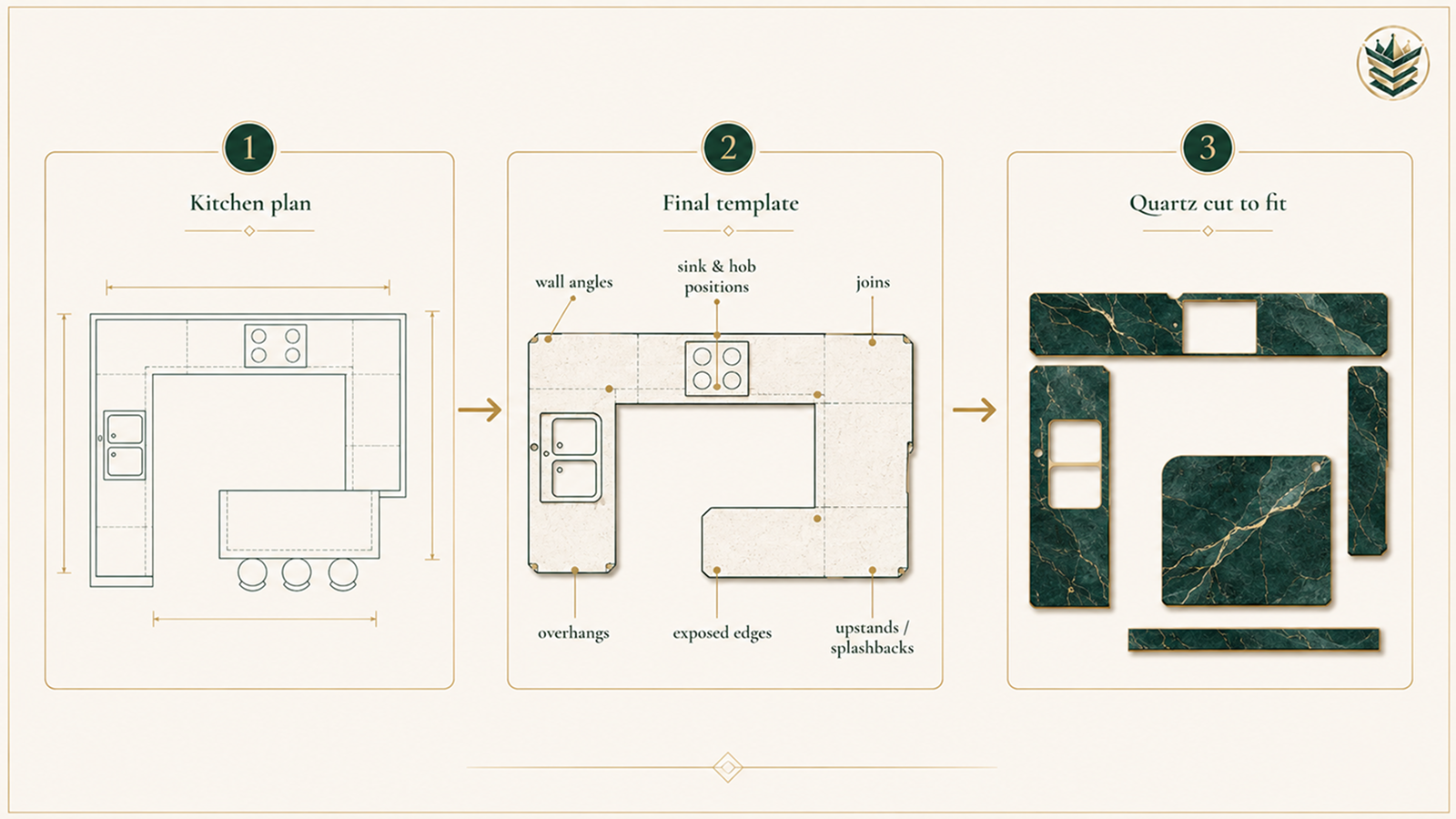
A quartz quote can start from a kitchen plan, but the slab should be cut from the finished room. That final site measurement is the template.
Templating usually happens after the base units are fitted and fixed in place. The supplier checks the real wall angles, cabinet positions, appliance spaces, overhangs and any exposed edges. This is also the point where small layout details become more serious, because they affect how the quartz is cut.
What can change after templating:
- The exact size of each quartz piece
- The position of sink, hob and tap cut-outs
- Where the joins will sit
- How much overhang is safe
- Which edges need polishing
- The final fit of upstands or splashbacks
Some quotes include templating from the start. Others treat it as a separate site visit. Before paying a deposit, ask if templating is included and which changes after the visit can affect the final price.
Do not rush this stage just to get the worktop fitted sooner. Once the quartz has been cut, a sink position that is slightly off or an overhang that feels too short is no longer a quick adjustment.
Site Conditions That Can Add to the Quote
Some hidden costs do not come from the quartz itself, but rather they come from the room the quartz is being fitted into, especially access, cabinet condition and any trades needed around the worktop.
Access to the Kitchen
Delivery is part of the fitting job, as well as the drop-off. Quartz is heavy, rigid and awkward to carry, so the route from the workshop to your kitchen can affect the quote.
A ground-floor kitchen with parking outside is a simpler job. A flat with stairs, a tight hallway, restricted parking or a long carry from the van can take more time and more people. Large islands can also change the fitting cost because one heavy piece is harder to move safely than two smaller runs.
Fitting should be checked in the quote as well. Some suppliers include it in the main price. Others separate the material, fabrication, delivery and installation, so the first number looks lower than the fitted job.
Send access photos if the route is awkward. A few quick pictures of the entrance, hallway, stairs and kitchen doorway can help the supplier price the job properly before fitting day.
Cabinet Levelling and Support Work
Quartz needs a steady base. If the cabinets are uneven, loose or not fully fixed, the fitter may not be able to install the worktop as quoted.
This is more common in older kitchens, partial renovations, or jobs where new quartz is being fitted onto existing units. A cabinet can look fine from the front, but sit slightly out of level across the run. Once a long, flat piece of stone goes on top, that small difference becomes harder to ignore.
Some of these fixes are small. Others may need a carpenter, kitchen fitter or builder before the quartz can go in. That cost may not sit inside the worktop quote, so it is worth checking early if your cabinets are ready for stone.
Plumbing and Electrical Changes
The worktop quote usually covers the quartz, not the trades around it. That can catch people out if the sink, tap, hob or sockets are changing position.
A new undermount sink may need plumbing adjusted after the quartz is fitted. A boiling-water tap, filter tap, or waste switch can add more parts under the sink. A pop-up socket or hob change may bring an electrician into the job as well.
These costs are not always handled by the worktop supplier. Some companies can coordinate them, but many will expect your plumber, electrician or kitchen fitter to disconnect everything before fitting day and reconnect it afterwards.
It’s best to deal with this before templating, as once the sink, hob and socket positions are confirmed, those decisions are built into the quartz.
Old Worktop Removal and Disposal
Replacing a worktop usually means doing something with the old one. Some suppliers include removal in the fitted price. Others will fit the new quartz but leave the old surface for you or your builder to deal with.
This can be a small cost if the old worktop is a laminate and easy to remove. It can be more involved if the old surface is stone, tiled, glued down heavily, or connected around sinks, taps and appliances.
Ask about removal before fitting day. You need to know if the quote includes taking the old worktop out, carrying it away, and disposing of it properly. If it only includes fitting the new quartz, you may need to arrange a builder, skip, council collection or waste carrier separately.
For UK disposal rules, GOV.UK has a useful page on disposing of household waste. It is worth checking if you plan to remove the old worktop yourself or use a private waste company.
Upstands, Splashbacks and Matching Pieces
Upstands, splashbacks and matching pieces can make two quartz worktop quotes look unfairly different. The quartz colour may be the same, but the amount of stone and fitting work may not be.
| Quote detail | Worktops only | Worktops with matching pieces |
| Main worktop runs | Included | Included |
| Quartz upstands | Not included | Included |
| Hob splashback | Not included | Included |
| Window sill or side panel | Not included | May be included |
| Extra cutting and polishing | Lower | Higher |
| Installation detail | Simpler | More involved |
| Final fitted quartz worktop price | Usually lower | Usually higher |
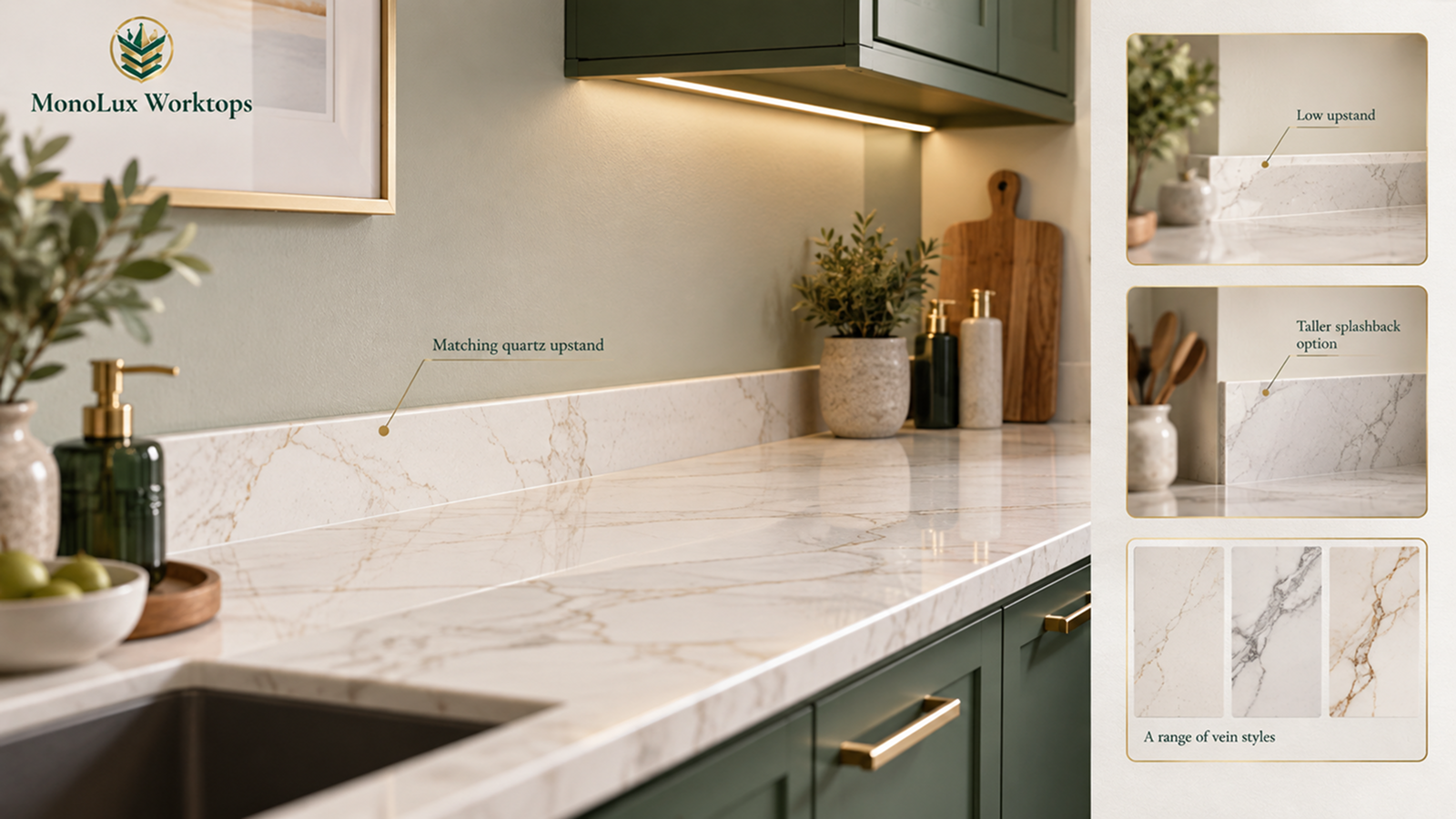
An upstand is the short quartz strip along the back of the worktop. A splashback is larger and usually sits behind the hob, sink or a wider wall section. Matching pieces can also include window sills, shelves, side panels or island cladding.
Before comparing quotes, check if both suppliers have priced the same extras. A worktop-only quote should be compared with another worktop-only quote. If one quote includes upstands, splashbacks and extra quartz details, those same items need to be added to the other quote before the total price means anything.
Joins, Extra Slab Use and Waste
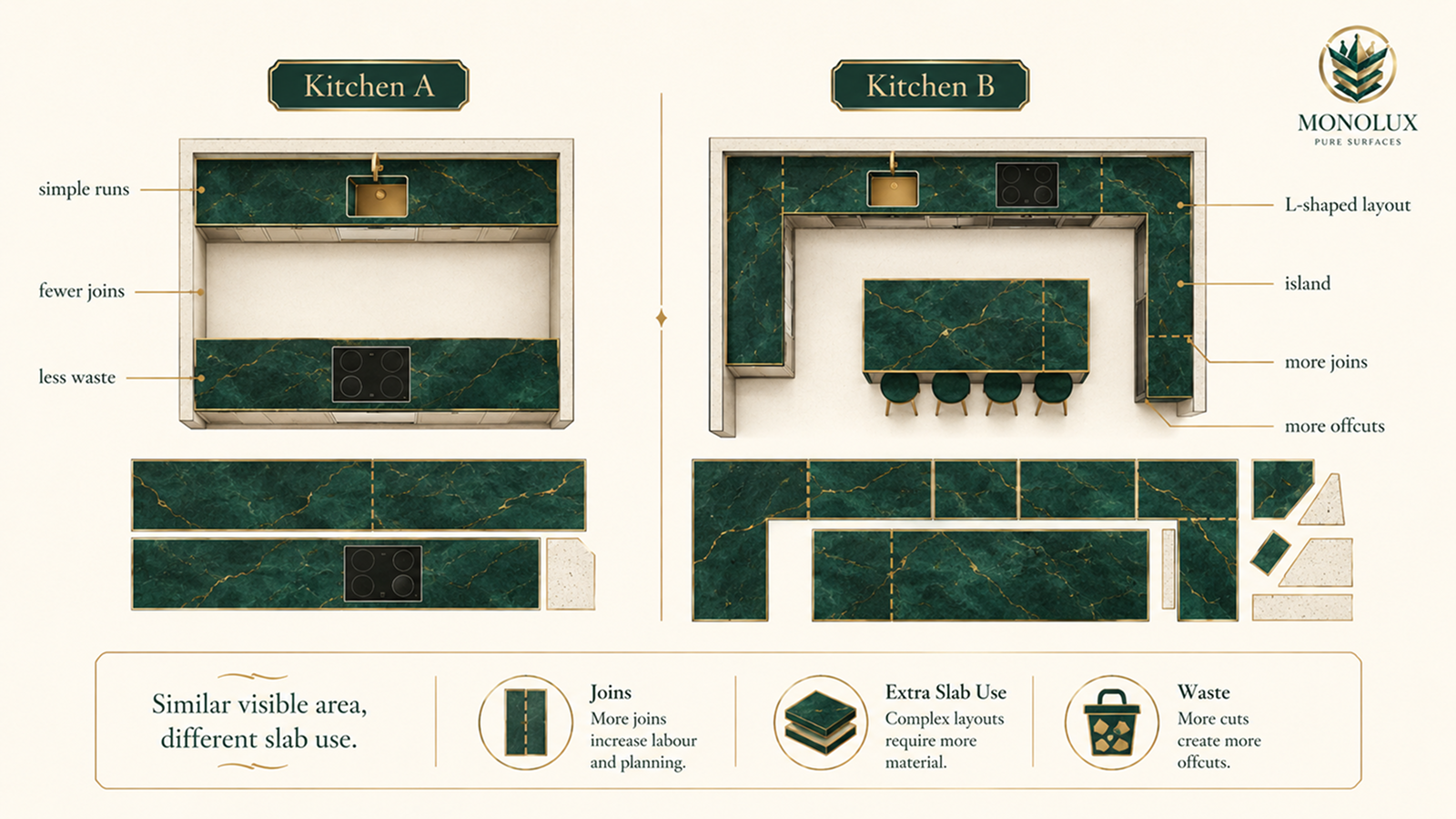
A quartz worktop quote depends on how the pieces are cut from the slab, not only on how much worktop you see once the kitchen is finished. Two layouts can have a similar visible surface area but need a different amount of quartz.
Example:
Kitchen A has two straight worktop runs, one sink cut-out and one hob cut-out. The pieces are simple to plan, the joins are limited, and the offcuts are easier to manage.
Kitchen B has an L-shaped corner, a wide island, a breakfast bar overhang and a bold marble-effect pattern. The supplier may need to plan the slab more carefully so the joins sit in sensible places and the veining does not look awkward.
This is where extra slab use can appear. A small return, corner notch, oversized island or waterfall end can leave offcuts that look useful but are too narrow, too short or facing the wrong way for the rest of the kitchen.
Joins also affect the quote. A cheaper layout may place joins where they are easiest to cut. A better-planned layout may need more workshop time, but it can make the finished quartz kitchen worktop look more balanced.
Premium Colours, Finishes and Brands
The quartz colour itself can change the quote before any fitting details are added. Some colours are easier to source and sit in a lower price range. Others cost more because of the pattern, finish, brand, slab availability or the level of detail in the design.
A simple way to think about it:
Lower price pressure: plain whites, simple greys, softer neutral colours and more widely available ranges.
Medium price pressure: marble-effect quartz, darker colours, sparkle finishes and designs with stronger movement.
Higher price pressure: premium Calacatta-style patterns, bold veining, unusual colours, specialist finishes or branded ranges with higher slab costs.
This does not mean the most expensive quartz is always the best choice for the kitchen. A simpler quartz can look better in some layouts, especially if the cabinets, flooring and lighting are already busy. On the other hand, a bold marble-effect quartz may be worth the higher price if the worktop is the main feature of the room.
How MonoLux Helps You Avoid Surprise Quartz Worktop Costs

Hidden costs are easier to avoid when the quote is based on the full job. At MonoLux Worktops, we review your kitchen layout, quartz choice and fitting details before your quote is confirmed, so the price can reflect the worktop you are actually planning.
With MonoLux, you can:
- Browse quartz worktops by colour, pattern and price, with options starting from £89/sqm
- Order free samples before choosing your final quartz colour
- Use the Online Quote Tool to send your kitchen details for a fitted quote
- Have the team review the layout, material choice, cut-outs, upstands, splashbacks and fitting details before confirmation
- Benefit from direct slab sourcing, which helps keep quartz prices competitive
- Get accurate fabrication through in-house CNC cutting
- Compare similar quartz colours if your first choice pushes the total above budget
- Take advantage of current offers or better slab use where possible
- Get a fast five-day installation after templating, where the project details allow it
- Work with a team with over 20 years of experience in quartz worktops
How we stopped the quote from creeping up for Oliver
When Oliver was planning his Basingstoke kitchen, he wanted a bright, premium-looking finish without paying more than he needed to for that effect. Instead of letting a higher-priced Calacatta-style option push the quote up, we helped him compare a better-value alternative: Mono Arctic Starburst.
Its crisp white surface and reflective flecks gave him the light, polished look he had in mind while working beautifully with his blue-grey shaker cabinets. You can read Oliver’s story and see the finished kitchen here.
Start by choosing the quartz colours you like, then send your kitchen details through the Online Worktop Quote Tool. Our team can review the full job and help you move from a basic material price to a clearer, fitted quartz worktop quote.
FAQs
- What are the most common hidden costs of quartz kitchen worktops?
The most common hidden costs are sink and hob cut-outs, tap holes, drainer grooves, edge profiles, upstands, splashbacks, templating, delivery, fitting, old worktop removal and changes needed around plumbing or electrics. A good quartz worktop quote should show which of these are included and which ones are priced separately. - Are sink and hob cut-outs included in a quartz worktop quote?
Sometimes they are included, but not always. Standard sink and hob cut-outs may be part of the fitted quote, while undermount sink polishing, extra tap holes, pop-up sockets or waste switch holes may be added separately. Always ask how many cut-outs are included before comparing one quote with another. - Do quartz worktops need templating before fitting?
Yes, templating is normally needed before the quartz is cut. It gives the supplier the final measurements after the cabinets are in place so the worktop can be made to fit the real kitchen rather than an early plan. Some quotes include templating, while others list it as a separate visit. - Is the price per metre the same as the fitted price?
No. A price per metre usually gives you a starting point for the worktop material or a standard run, but it may not include fabrication, delivery, templating, fitting or extras. The fitted quartz worktop price is the number that matters because it reflects the full job. - Can an L-shaped kitchen or island make quartz worktops more expensive?
Yes. An L-shaped kitchen, a wide island, a breakfast bar, a waterfall end or an awkward corner can change how the slab is cut. That can affect joints, waste, handling and the number of slabs needed. This is why two kitchens with similar surface areas can end up with different quartz worktop costs. - Are upstands, splashbacks and drainer grooves included as standard?
Not always. Upstands and splashbacks use extra quartz and need their own cutting and fitting. Drainer grooves also add workshop time because they are cut into the stone beside the sink. Ask for these items to be listed clearly so the quote is not confused with a worktop-only price. - Can I buy quartz worktop material only without fitting?
Some buyers ask for material-only prices, especially during DIY renovations, but quartz is heavy and needs specialist cutting, polishing and handling. If you compare a material-only quote with a fitted quote, the fitted quote will look higher because it includes more of the job. For a fair comparison, separate the material, fabrication, delivery and installation costs. - How can I keep quartz worktop costs within budget?
You can control the cost better if you make the quote specific from the start. Choose a realistic quartz colour, compare 20 mm and 30 mm options, avoid unnecessary extras, keep the layout simple where possible, and ask about similar lower-price stones. If your budget is around a fixed figure, tell the supplier early so they can guide you before the quote grows. - Do quartz worktops have long-term maintenance costs?
Quartz does not normally need sealing, which helps keep maintenance simple compared with some natural stones. You should still protect it from very hot pans and avoid cutting directly on the surface, because damage around edges, corners or heat marks can be expensive to repair. Day to day, mild soap and a soft cloth are usually enough. - Can quartz be cut or changed on-site after fitting?
It is better to avoid last-minute changes after templating because sink, hob and tap positions are built into the slab. Small site adjustments may be possible in some cases, but quartz cutting and drilling should be handled by professionals using proper dust-control methods. This is another reason to finalise appliances, sink choice and layout before fabrication starts.