
A kitchen worktop overlay covers a suitable existing surface while leaving the old top underneath. It may suit an unchanged layout with a sound base, but check the product, finished height and fitting requirements.
Quartz, granite and laminate overlays vary in construction. Knowing what is supplied helps you compare the fitted result with a full replacement.
Are Kitchen Worktop Overlays Worth Considering?
An overlay may suit a kitchen with a stable worktop and an unchanged layout, subject to the chosen supplier’s assessment.
- The existing top stays in place, so its condition and support must meet the overlay system’s requirements.
- Engineered quartz, granite-labelled composites, HPL sheets and decorative films have different specifications.
- Compare itemised fitted quotes. A thin covering does not automatically mean a lower total cost than replacement.
- Check added height, sink and hob arrangements, joints and warranty responsibility before choosing either route.
What Is a Kitchen Worktop Overlay?
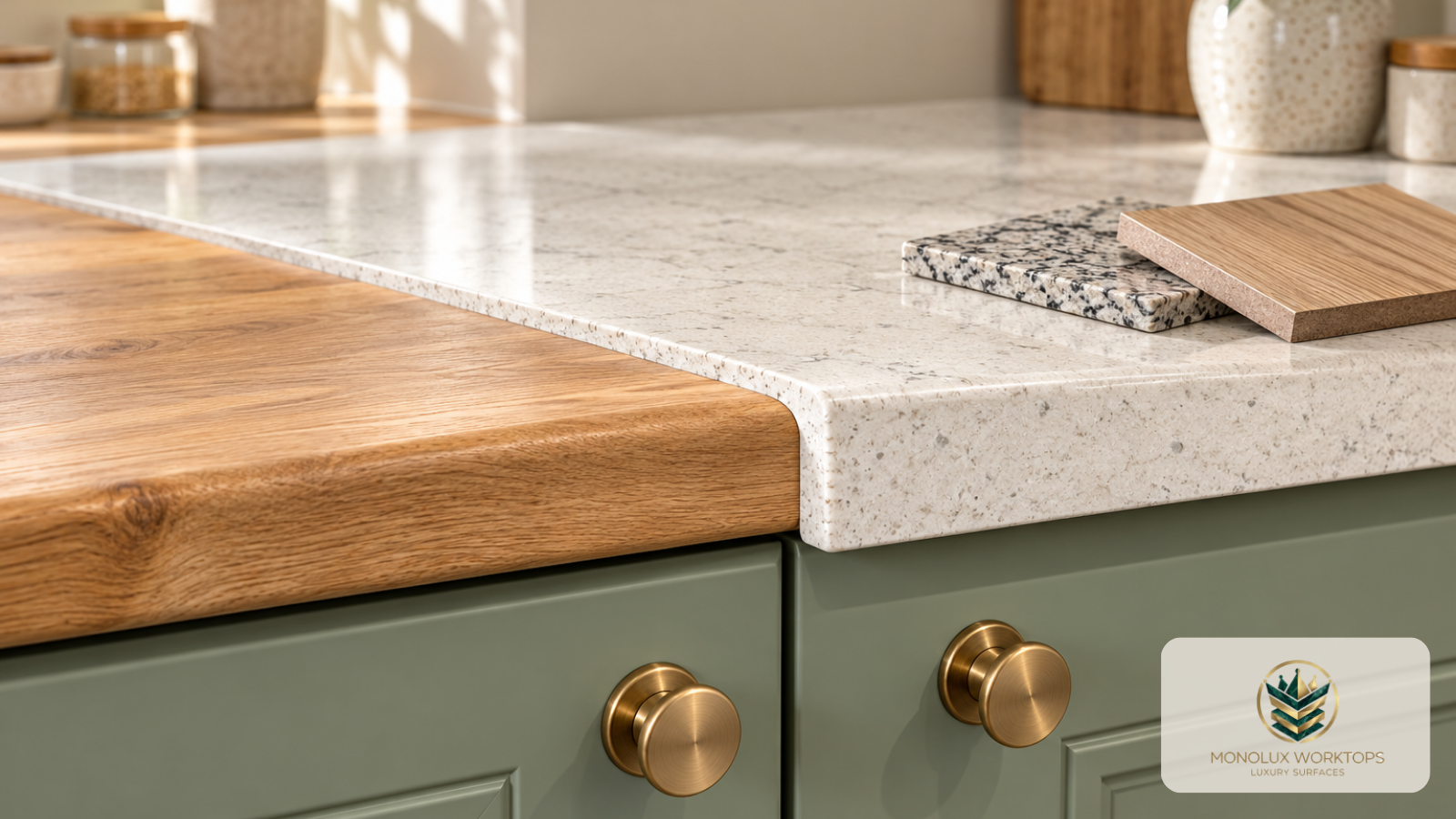
An overlay adds a new covering to the existing work surface. Depending on the system, it can also cover the front edge to conceal the old top. Openings for sinks, taps and hobs must be planned around both layers.
Full replacement removes the old worktop and fits a new top onto the kitchen units. An overlay retains the accepted base; a new finish cannot repair damage underneath. If the existing top is unsuitable for an overlay, explore our quartz kitchen countertops as a full-replacement option.
Quartz, Granite and Laminate Overlays: What Are You Buying?
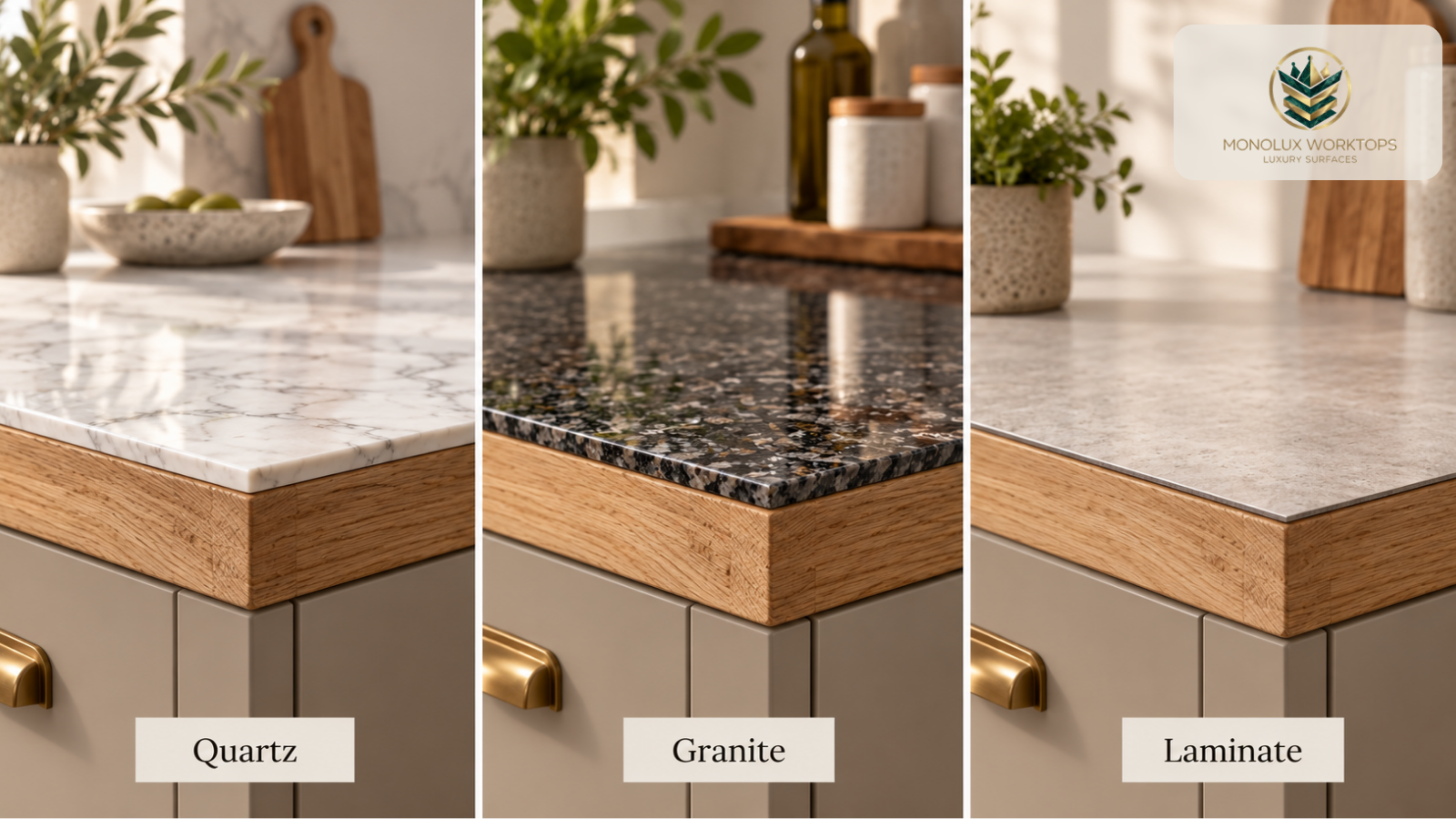
Ask for the named product and its specification before comparing material labels. Thickness, composition and fitting instructions vary between systems.
Quartz overlay worktops
Quartz overlay worktops may use thin engineered stone designed to sit over a suitable existing top. Ask for the named product, its composition and its approved substrates rather than relying on the word ‘quartz’ alone.
Products differ in thickness and edge construction. Confirm how much height the selected system adds and how the finished edge will conceal the existing worktop.
Follow the selected product’s care instructions. Use chopping boards and trivets rather than assuming a thin engineered surface can withstand knives or direct heat.
Granite overlay worktops
A granite overlay is not necessarily a thin slice of quarried stone. Some granite-labelled systems use engineered aggregates or composite material bonded to the retained worktop.
Ask for the selected product’s actual composition and care guidance. Do not assume a granite-labelled composite needs the same sealing routine as a natural granite slab.
A granite-effect pattern on laminate or film is another product again. The appearance alone tells you little about construction, sealing requirements or resistance to daily wear.
Laminate overlay worktops
Laminate overlay worktops need a closer look at what is supplied. High-pressure laminate (HPL) uses resin-impregnated papers pressed under heat and pressure. A separate sheet needs a compatible base and approved bonding method.
Self-adhesive decorative film is different. Check the manufacturer’s guidance on kitchen use, food contact and heat exposure. Standard d-c-fix films, for example, are not recommended for kitchen worktops because of food contact and heat near cooking appliances. Specialist films may have different specifications.
A complete replacement laminate board includes its own supporting core. Buying one does not establish that it can be fitted over your current top. Ask the supplier to identify the intended installation method before ordering.
How Much Do Kitchen Worktop Overlays Cost in the UK?
For UK budgeting, use these indicative supplied-and-fitted overlay prices per square metre:
- Laminate overlays: around £80–£180/m².
- Quartz overlays: around £350–£700/m².
- Granite-labelled composite overlays: roughly £450–£800+/m².
These are planning ranges, not fixed quotations. Granite-labelled systems vary widely in composition and specification, so compare the actual product and fitting scope.
Your kitchen’s size, layout, joints, sink and hob cut-outs, upstands, base repairs and reconnections affect the total. Small jobs may carry a minimum fitting charge. Check VAT and exclusions before comparing estimates.
For the alternative of removing the old surface and fitting full quartz worktops, our quartz worktop budget guide explains conventional replacement costs. Compare both routes using the same layout and inclusions before deciding which offers better value for your kitchen.
Can Your Existing Worktop Take an Overlay?
An installer needs to assess the complete worktop assembly. These four checks help you prepare for that visit.
- Check the base and support. Point out swelling around the sink, loose edging, movement, uneven areas and any history of leaks. The installer should assess the old top and cabinets, then explain any repairs needed before accepting the base.
- Check the finished height and edges. Ask where the new surface will meet window sills, taps, upstands and splashbacks. Confirm the finished front-edge depth too. The thickness you see from the front may differ from the layer added across the top.
- Confirm the sink, hob and connections. Explain any plans to move an opening or change a sink type. Retaining an appliance does not automatically mean leaving it connected throughout fitting. Removal, adaptation and reconnection need agreeing, alongside the appliance manufacturer’s installation requirements.
- Agree on the joints, water protection and warranty. Ask how openings and joins will be finished and who takes responsibility for the retained base. Material, seams and installation can have different covers, so a surface warranty alone may leave questions unanswered.
The supplier must still approve your kitchen for its chosen system.
Worktop Overlay or Full Replacement: Which Makes Sense?
Imagine a kitchen with firmly fixed worktops, no signs of water damage and a layout you want to keep. If the added height works around the window and appliances, an approved overlay system is worth pricing. You are keeping an accepted base and changing the surface above it.
Now consider a top that is swollen beside the sink, with a hob you want to move. Covering it leaves the installer with base repairs and altered openings to resolve. Full replacement deserves a quote at that point, and sound kitchen cabinets may still be retained.
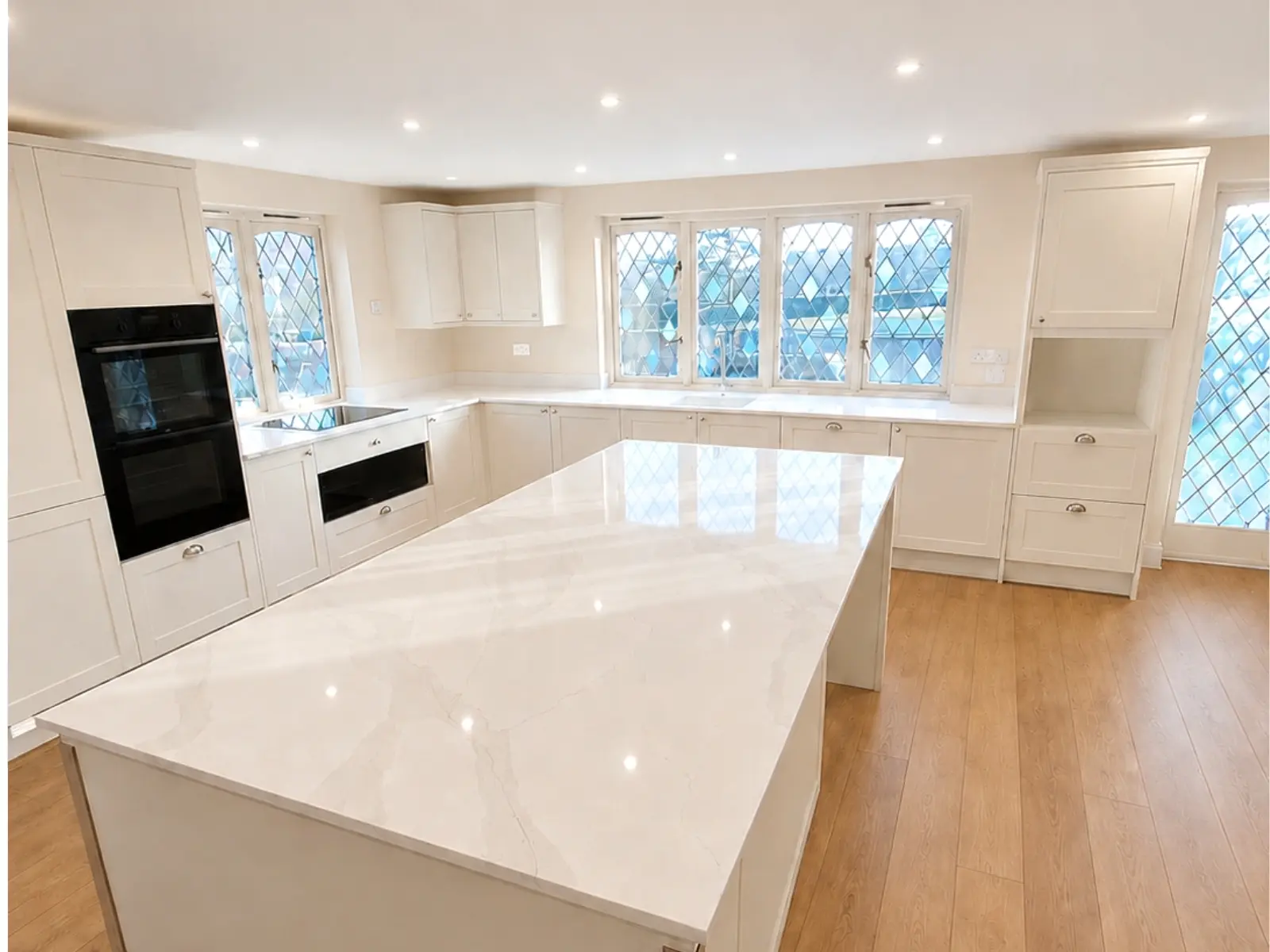
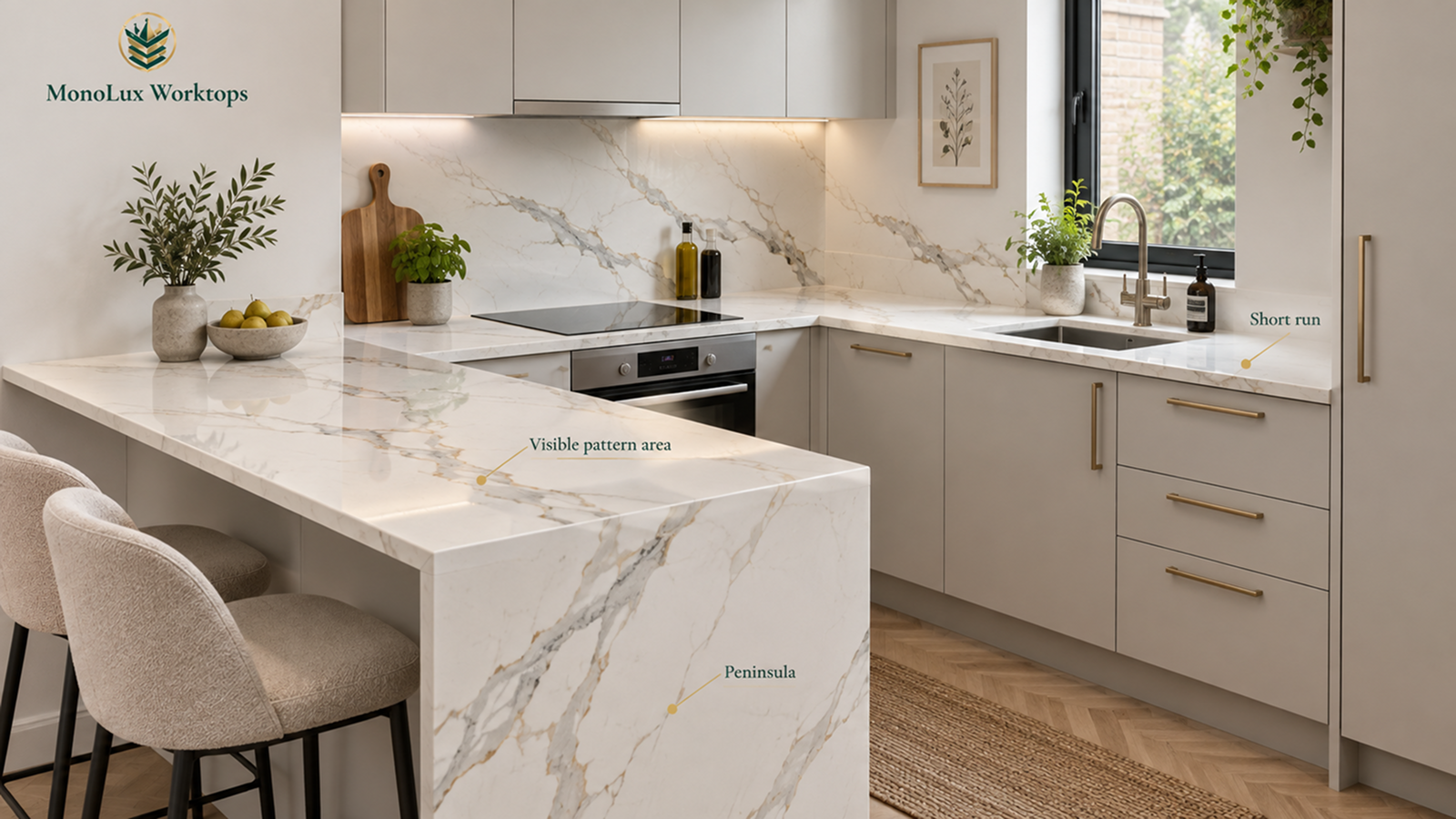
In Aoife Murphy’s Basingstoke kitchen renovation, we fitted 20mm Mono Calacatta Gold quartz across the L-shaped runs and central island, with matching upstands. The installation refreshed the existing kitchen without changing its structure. It was a conventional quartz installation, not an overlay.
What Should a Worktop Overlay Quote Include?
Ask these five questions before accepting an offer, and have the answers recorded in the quotation.
- Which product am I buying? Request the system name, composition, finish, surface thickness and finished edge detail.
- What preparation is included? Confirm the survey findings, base acceptance, repairs and treatment of any moisture problems.
- Who handles the fitting and connections? Identify responsibility for templating, cut-outs, edges, joins and sink, tap or hob removal and reconnection.
- What is included in the final total? Check upstands, splashbacks, delivery, access charges, disposal, making good and VAT, along with exclusions.
- What happens if something fails? Ask about the cover for the surface, the retained base, the seams and the workmanship, plus who assesses problems and carries out repairs.
Use that written scope when comparing offers. Two similar-looking surfaces can come with different amounts of preparation and fitting work.
Considering a Full Quartz Worktop Instead?
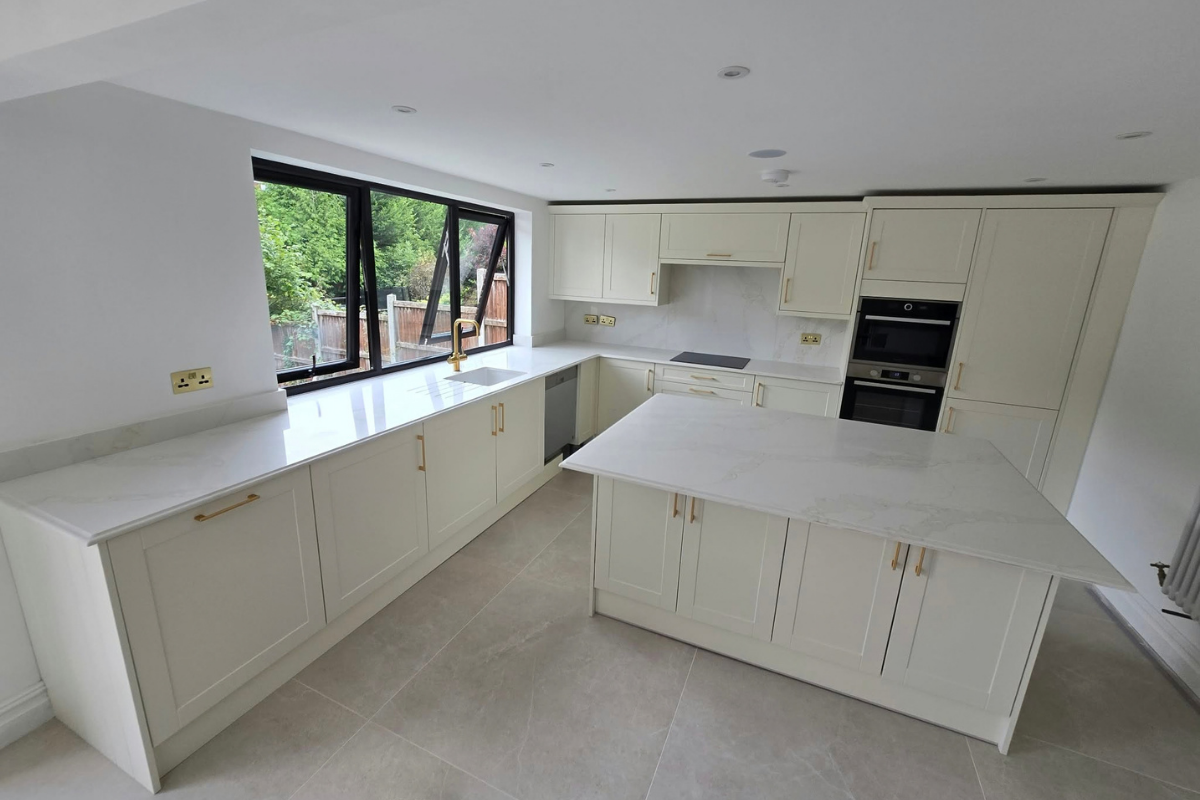
If you decide to remove the old top, MonoLux can help you plan a conventional quartz worktop replacement.
- Compare quartz colours and finishes for your kitchen.
- Ask about samples and full-slab viewing before choosing.
- Discuss measurements, sink and hob cut-outs, and edge details.
- Have your estimate reviewed by the MonoLux team.
- Arrange templating, in-house CNC fabrication and fitting.
Start with our quartz worktop price calculator for a replacement estimate based on your layout. This tool covers full quartz worktops; it does not price overlays.
FAQs
- Are worktop overlays cheaper than replacing worktops?
Not always. An overlay may avoid removing the existing surface, but preparation, fabrication, cut-outs and fitting still cost money. Compare like-for-like quotes for the same kitchen rather than assuming a thinner surface will be cheaper. - Can quartz overlays be fitted over laminate or wooden worktops?
Some engineered overlay systems may accept sound laminate or timber bases, but not every product supports them. Ask for written substrate approval and a survey of the existing top before proceeding. - How long does worktop overlay installation take?
There is no universal timeframe. Surveying, templating, fabrication, preparation and fitting may happen on separate days. Ask the supplier for the full schedule, including any period when your sink or hob cannot be used. - Can you fit a kitchen worktop overlay yourself?
Stone-based overlay systems generally involve professional templating, fabrication and fitting. Some sheets or films are sold for self-application, but approval for kitchen worktop use depends on the exact product. Check the manufacturer’s instructions before attempting DIY installation.