
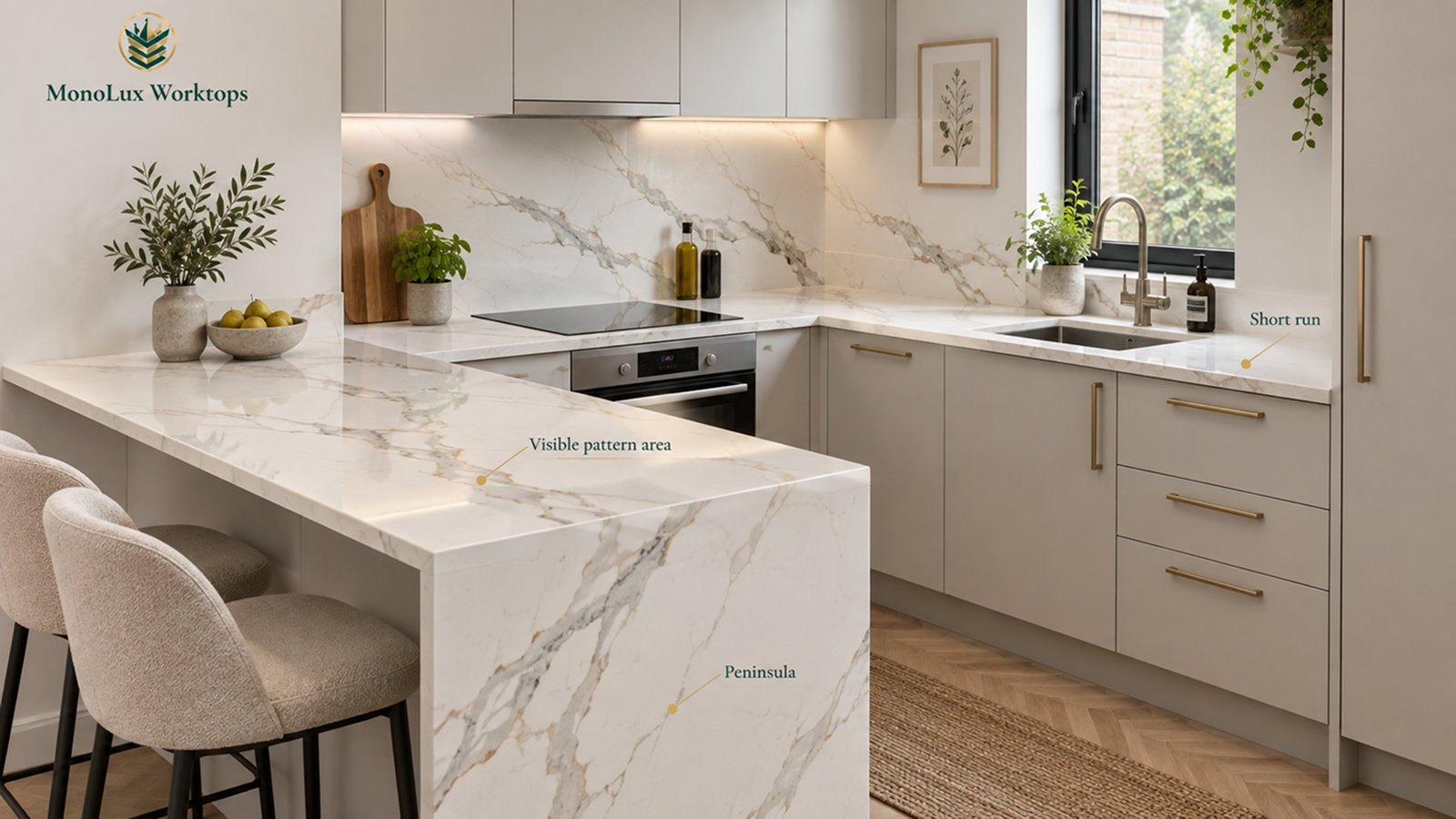
Bold Calacatta quartz can work in a smaller kitchen. Room size contributes to the result, though the amount of visible quartz, vein strength, and pattern placement usually shape the finished effect more directly. The same dramatic design may look controlled on two short worktop runs and much stronger when extended across a peninsula or splashback.
Two kitchens with similar floor areas can display very different amounts of quartz. One may have short worktops beneath a painted wall, while another carries its quartz worktops across several runs, a peninsula and a full-height splashback. The second layout places far more pattern within view.
Can Bold Calacatta Work in a Small Kitchen?
Yes, provided the pattern suits the surfaces on which it will appear. Use the finished worktop layout as your reference rather than judging the design from the kitchen footprint or colour name alone.
- Look at the total visible quartz area across worktops, peninsulas and vertical pieces.
- Compare vein scale, pattern density, contrast and the open background between motifs.
- Consider how corners, joins, sinks, and hobs will crop or interrupt the pattern.
- For large-scale veining, compare the sample with a full-slab image or a completed installation.
What Makes a Calacatta Pattern Look Bold?
Calacatta designs vary considerably, even when several products share a white or pale background. Four visual qualities help explain why one pattern appears quiet while another immediately becomes the room’s focal point.
Vein scale. A broad branch may occupy much of a short fabricated worktop, even when the complete slab contains generous pale areas. Broad veining can still work, although the position of each motif becomes more noticeable on a shorter run.
Pattern density. Some designs leave long stretches of open background between the veins. Others carry movement across most of the surface, giving the eye fewer quiet areas between one motif and the next.
Contrast. Faint warm-grey lines tend to recede against a pale background. Burgundy, brown or stronger grey movement attracts greater attention, even when the spacing between the veins is similar.
Surrounding visual weight. Detailed shaker doors, pronounced timber grain, dark cabinetry, patterned flooring and mixed metal finishes all add information around the worktop. A strong Calacatta pattern can still sit comfortably among these features, although keeping some surrounding finishes quieter can stop several strong elements from competing for attention. Our guide to cabinet colours for Calacatta quartz explores those combinations in greater detail.
How Much Calacatta Will Your Kitchen Show?
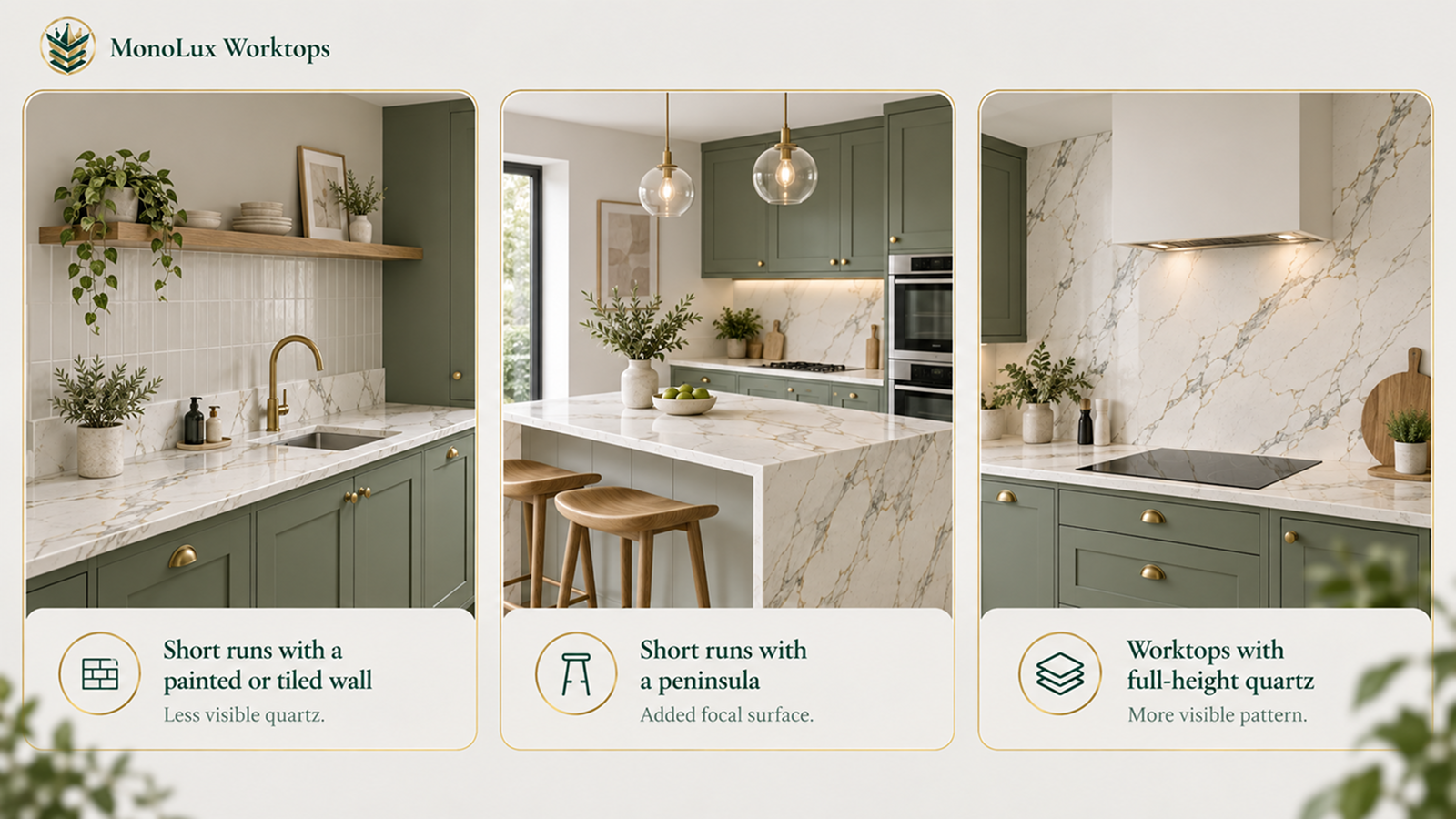
Floor area gives an incomplete picture because people see surfaces rather than a room’s footprint. Count every horizontal and vertical area on which the pattern will appear, then consider how those areas relate from the main viewing positions.
Short runs with a painted or tiled wall. A compact kitchen with two modest worktop runs may expose relatively little quartz. A stronger vein can act as a controlled focal point because the surrounding wall does not repeat the same movement.
Short runs with a peninsula. A peninsula adds another horizontal plane, often close to the centre of the room. It may display an uninterrupted section of quartz, so the pattern can become more prominent than it appears on narrow wall runs divided by appliances.
Worktops with full-height quartz. Continuing the same design behind a hob or sink increases the visible patterned area considerably. This may create a coherent connection between the horizontal and vertical surfaces, or it may introduce more movement than the room needs. The outcome depends on the design’s contrast, density and cropping.
Matching upstands and a windowsill add smaller areas of the same material. Each piece may be modest by itself, but together they change how frequently the pattern appears around the room.
How Fabrication Changes the Pattern You See
A slab image presents the design before it is divided into the pieces required for the kitchen. The completed worktop consists of cut sections of the slab, so its visual composition will differ from that of the uninterrupted slab.
Cropping. A large vein may remain almost complete on one section, continue only partly onto another, or fall outside the finished piece. On a short run, the retained part of one motif may become the strongest feature in the room.
Sink and hob cut-outs. These openings remove sections of quartz from the worktop. A cut-out may pass through a broad branch, divide it into separate visible fragments or remove part of it altogether.
Corners and joins. L-shaped and U-shaped kitchens divide the worktop into pieces that meet at a turn. Adjacent pieces may show different parts or orientations of the pattern, so uninterrupted movement should never be assumed from a full-slab image.
Pattern direction. Direction becomes easier to notice across a long run, peninsula, island or vertical splashback. One orientation may emphasise the length of a worktop, while another brings a broad motif into a more central position. The preferred arrangement depends on the pattern and the surfaces visible together.
How Pattern Strength Changes the Calacatta Choice
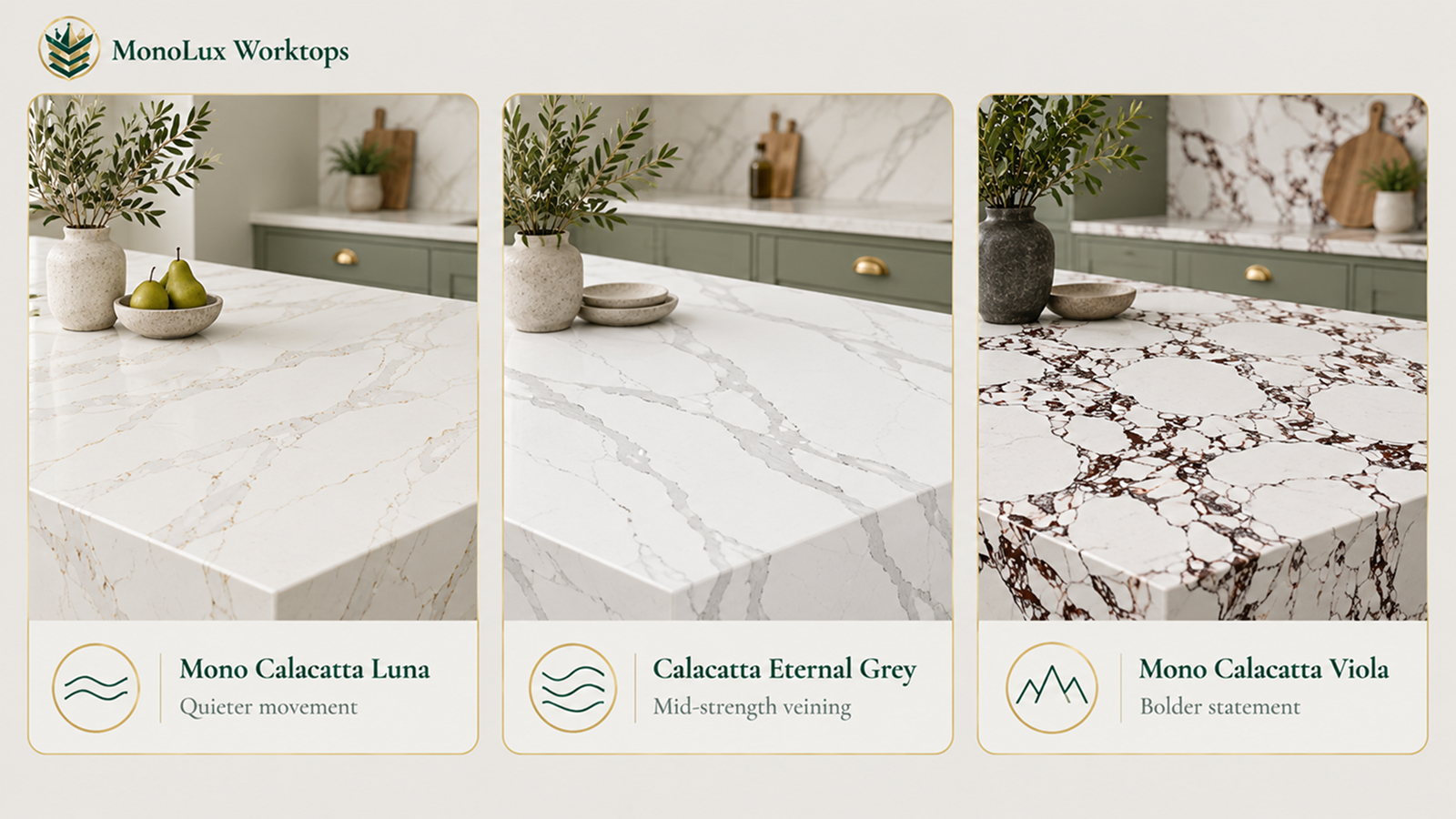
The three MonoLux designs below show how background space, contrast and density can vary across the Calacatta range.
| Design | Visible pattern character | What to consider in a smaller kitchen |
| Mono Calacatta Luna | Pale background with faint warm-grey and gold branching, low contrast and broad open areas | Its lower contrast and broad open areas give it a quieter visual presence |
| Calacatta Eternal Grey | White background with broad grey branches, finer dark lines and moderate contrast | Check how the larger branches will be cropped across short runs and cut-outs |
| Mono Calacatta Viola | Dense burgundy, brown and dark movement with less uninterrupted pale background | Several visible surfaces will produce a strong statement, so placement and surrounding finishes deserve closer attention |
These examples represent three different levels of visual activity rather than rules for particular room sizes. Our full Calacatta quartz range includes other combinations of vein scale, contrast and open background.
See the Pattern at Room Scale Before You Choose
A physical sample can reveal the base colour, undertone, surface appearance and local vein detail. It cannot show where a large motif will fall across a full run or how much pale background will remain after corners and cut-outs divide the slab. Our guide explains how to compare quartz worktop samples at home alongside the cabinets, flooring and lighting already planned for the room.
For larger patterns, view a full slab or a clear large-format image as well. Completed projects are also useful because they show how the quartz reads across real worktops, vertical pieces and interruptions.
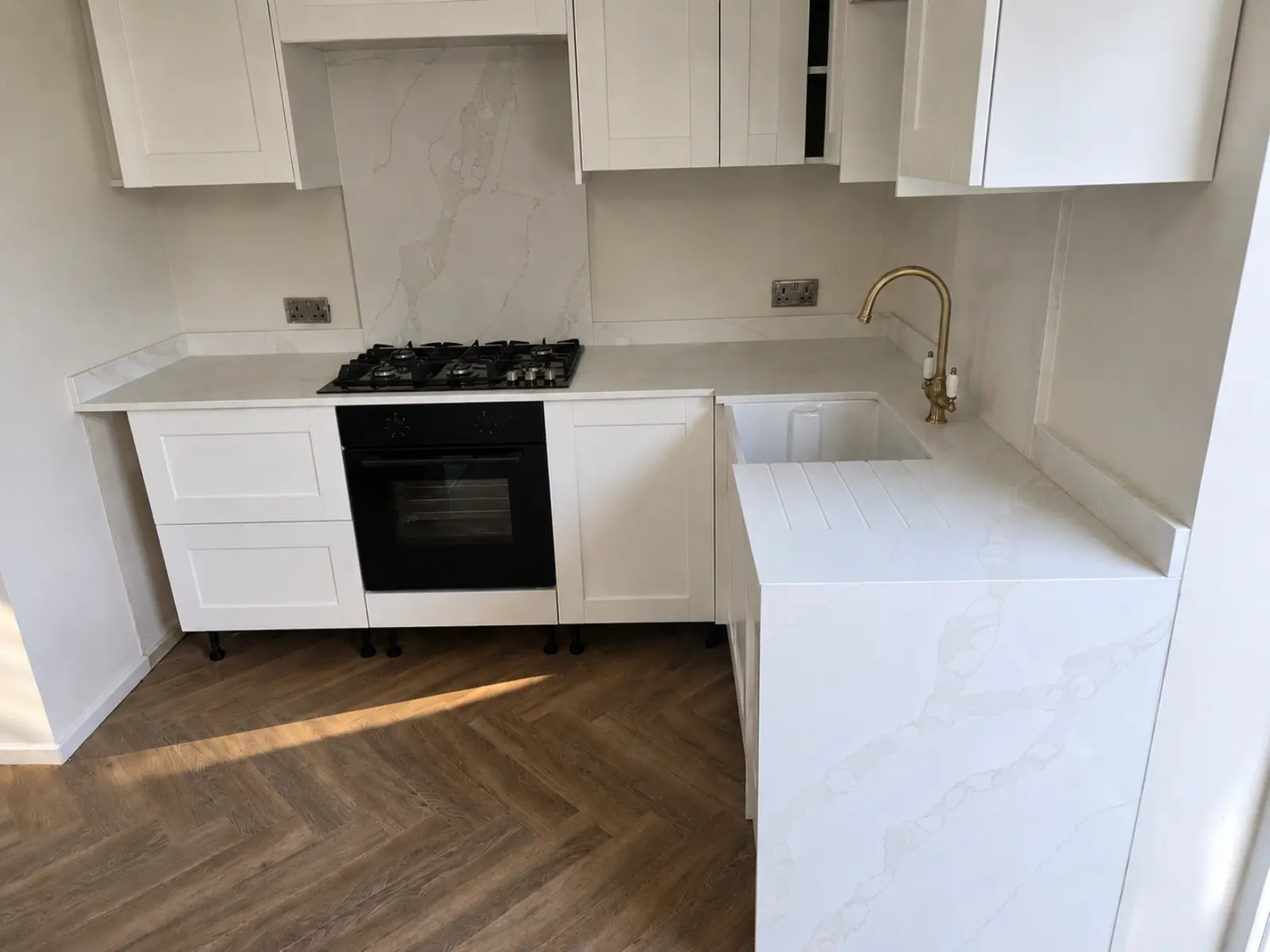
One example is Ashley’s compact L-shaped kitchen in Northampton. It uses Calacatta Luna with soft white shaker cabinets, warm flooring, matching upstands and a windowsill, with the quartz continuing behind the hob.
The room displays the pattern across horizontal and vertical surfaces, while Luna’s relatively low contrast leaves an open background between its veins. View the physical sample under the daylight and artificial lighting used in your kitchen, as changes in light can alter how strongly warm, grey or darker veins stand out from the background.
Compare Calacatta Quartz for Your Kitchen
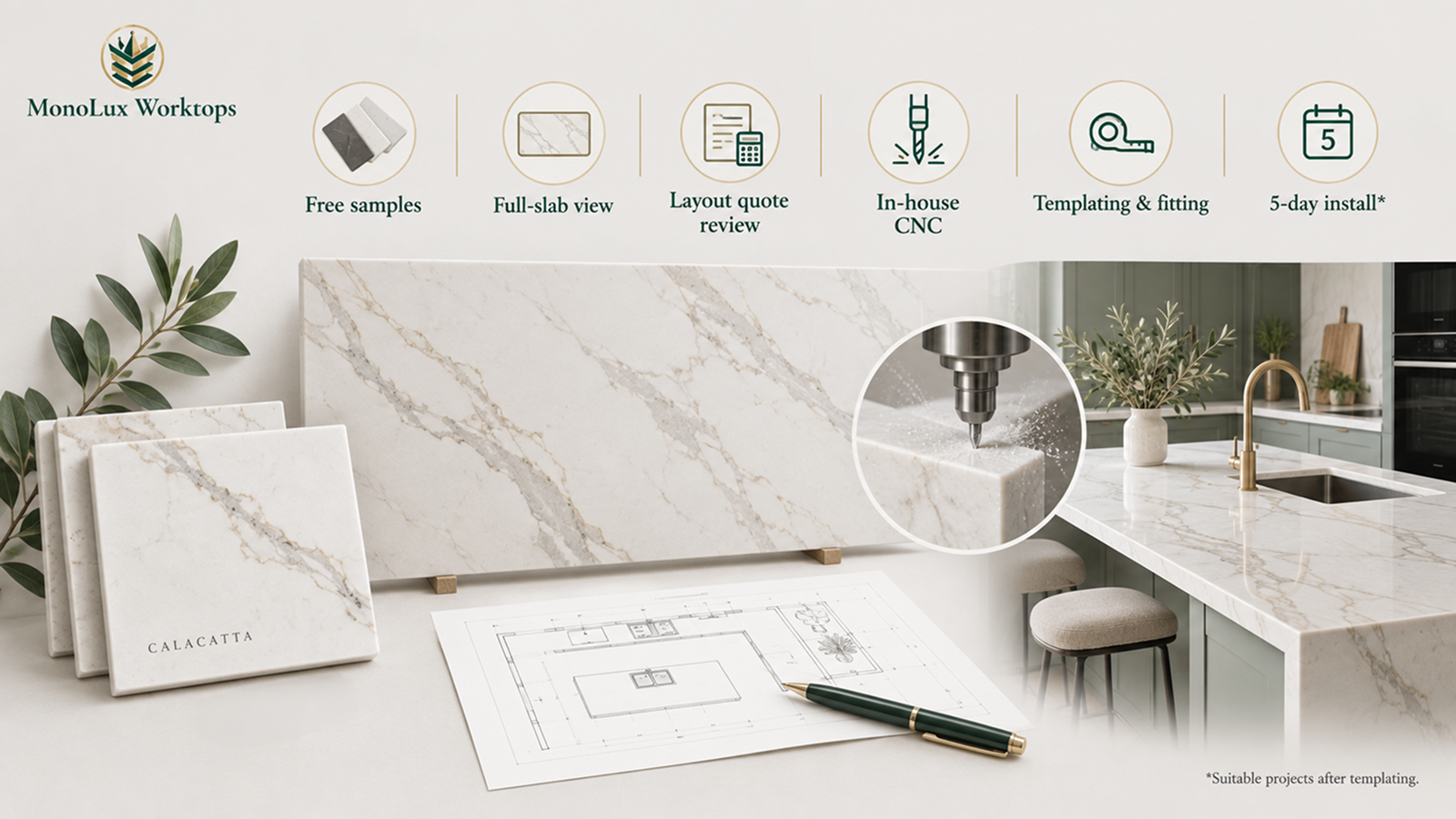
Once you have narrowed down the pattern, we can help you move from a small sample or slab view to the finished worktop. MonoLux supplies, templates, fabricates, and installs quartz worktops, using in-house CNC fabrication for cutting, polishing, edge profiling, and sink or hob cut-outs.
- Order free samples from eligible product pages to compare the colour and veining in your kitchen.
- Arrange a full-slab view when a larger Calacatta pattern needs to be judged beyond a small sample.
- Send us the actual layout so our under-2-hour estimate can account for worktop runs, cut-outs, joins, upstands and any vertical quartz pieces.
- For suitable projects, a five-day installation can be available after templating.
Once you have your measurements ready, enter them into our quartz worktop price calculator to start your fitted quote.
FAQs
- Can Bold Calacatta Quartz Work With Dark Cabinets in a Small Kitchen?
Yes. Dark cabinets already add visual weight, so pay attention to the flooring, splashback and other strong finishes around them. A dramatic Calacatta pattern can still work well when there are quieter areas elsewhere in the kitchen. - Should I Use Calacatta Quartz for Both the Worktop and Splashback in a Small Kitchen?
Using the same quartz vertically increases the amount of pattern visible in the room. A lower-contrast Calacatta can remain relatively restrained across both surfaces, while dense or strongly contrasting veining creates a much more prominent feature. - How Much Does Quartz Cost for a Small Kitchen?
There is no single small-kitchen price. Worktop length, the number of pieces, cut-outs, joins, upstands, and vertical quartz sections can all change the fitted quote. Use your actual kitchen layout when requesting an estimate.